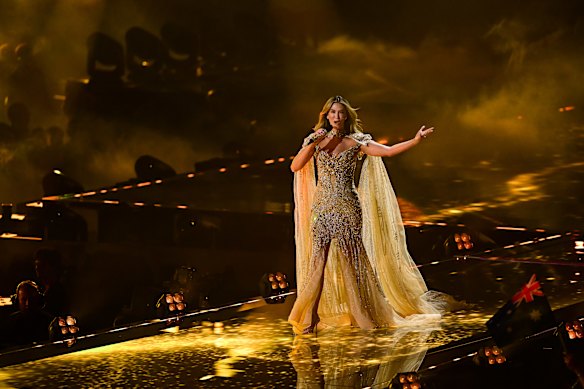

Could Delta Goodrem become Eurovision’s next golden child? She certainly looked the part on Friday, as she ascended into the air, glittering in a gold gown coated in thousands of Swarovski crystals.
The Australian singer-songwriter secured a spot in the European song contest’s final with her sun-soaked performance of Eclipse, a track she co-wrote with Jonas Myrin, Ferras Alqaisi and Michael Fatkin.
Not only is she in the final, but fans now believe she may actually be in with a chance to win. Following her standout performance at the second semi-final, online prediction polls lifted her from fifth place to second. Even famed UK television presenter Graham Norton admitted on Joel Creasey’s podcast last week that Australia could come out victorious.
That’s right, an Australian may win a European song contest – although despite the hype that would be an extraordinary turn of events, and she would have to beat the hot favourite Finland. While this alone would be impressive enough (albeit slightly baffling), it’s even more astounding given Australia’s questionable track record at the world’s oldest music competition.
Since entering the contest in 2015, we have failed to qualify three times: Montaigne in 2021, Electric Fields in 2024 and Go-Jo in 2025. At this time last year, it was safe to say Australia was a minor threat on the grand European stage.
However, Delta seems to have turned the tide. On Sunday, she will face fellow finalists from Bulgaria, Ukraine, Norway, Romania, Malta, Cyprus, Albania, Denmark and the Czech Republic. They will join the 10 successful countries from the first semi-final: Greece, Finland, Belgium, Sweden, Moldova, Israel, Serbia, Croatia, Lithuania and Poland, and will also come head-to-head with the so-called “Big Five”: France, Germany, Italy and the UK – and the host country, Austria, who automatically progresses to the final.
So, what are Goodrem’s chances? Well, according to Aussievision and Eurovisionworld, two major Eurovision outlets, Australia has made it to the “Top 5” in winner prediction lists, coming just below Finland and edging out heavy-hitters like Greece and Denmark.
Courtney Act, Australian drag queen and lead commentator for SBS’ Australian Eurovision coverage, has been closely watching Goodrem’s progress, telling fans on Friday that the singer’s performance contained all the necessary elements for victory: solid vocals, impressive production design and intoxicating energy.
“She’s so beautiful. Her voice is just so pure. The pitch is perfect, the song is wonderful, the production is brilliant, and it just builds and builds and builds,” Act said on their Instagram story.
Guy Sebastian, who represented Australia at Eurovision in 2015, also showed support for his fellow participant by sharing voting details on his Instagram story, and noting that Goodrem was “killing it”.
Goodrem even has support from Prime Minister Anthony Albanese, who on Friday told ABC Melbourne radio that he believed the homegrown singer deserved to take home the win. “She’s at the stage of her career [where] she doesn’t need to do this at all,” he said. “She’s doing this because she wanted to represent Australia … I hope that she cracks it – she deserves it.”
It’s not just Australian commentators backing Goodrem. Ryan Clark and Angela Scanlon, hosts of the BBC’s Eurovision coverage, said audiences were lapping up her performance. “In the rehearsal yesterday, there [was] definitely excitement about having somebody of that ilk on stage, and she didn’t hold back,” Scanlon said during a segment on This Morning Britain ahead of the semi-final. “There’s a little bit of danger involved in the staging, which I think people are going to love.”
Elsewhere, Mark Savage, the BBC’s music correspondent, also said Delta was one to watch ahead of the grand final.
“Her odds have been shortening all week – and her song, a classic ballad in the Celine Dion style, is guaranteed to appeal to both the public vote and the juries of professional songwriters, who each account for half of the score,” he said.
Meanwhile, popular Eurovision content creator and vocal coach Georgina Hall-Brown has added Goodrem to her list of potential Eurovision winners, praising the singer’s vocal strength and referring to her as a “queen”. Similarly, vocal coach Tim Welch, who has worked with artists like Lauryn Hill and Keshi, applauded Goodrem’s tonal quality and her voice’s ability to stand on its own.
Of course, Eurovision results are always relatively tricky to predict. Its voting system is prone to vote-harvesting campaigns, which can sometimes upend an already numerically fragile voting system. Goodrem is also performing in the first half of the final on Sunday, meaning she will likely have to work even harder to remain in the audience’s mind over the following hours of the finale.
And if history indicates anything, luck hasn’t always been on Australia’s side. While several previous Australian participants have cut through, none have officially won. Dami Im managed to win the professional jury vote with Sound of Silence in 2016. However, she was just edged out by Ukraine’s Jamala once the public televote was added, leaving her in second place.
Then, of course, there was Kate Miller-Heidke in 2019, who wowed crowds with Zero Gravity, which she somehow performed atop a five-metre tall flexible pole. This insanely courageous performance only secured her ninth place, however.
And though Sebastian was basically the whole reason Australia became a permanent fixture of Eurovision after 2015, he still only managed to come fifth with his soulful performance of Tonight Again.
What would a Goodrem win mean for Eurovision?
If Goodrem does win, where does this leave Eurovision? Would the contest take place Down Under next year after literal decades in Europe?
Put simply, no. According to special entry specifications agreed to when Australia joined the contest, if Goodrem won, the country would co-host with a European city next year, ensuring it remains true to its name: Eurovision.
Now, all eyes are on Goodrem to see if she can break this run of bad luck. As a seasoned professional singer, known globally for hits like Born to Try, she is uniquely placed to impress both the professional jury – which could favour her pitch-perfect vocals – and the public vote, which could be swayed by the spectacle of her gravity-defying performance. The only question is whether this will be enough to help her pip Finland’s Linda Lampenius and Pete Parkkonen for the win.
SBS will air the Eurovision grand final live at 5am AEST on Sunday. Semi-final 1 will be repeated at 7.30pm AEST tonight; semi-final 2 and the grand final will be repeated at 7.30pm AEST on Saturday and Sunday, respectively.
Find out the next TV, streaming series and movies to add to your must-sees. Get The Watchlist delivered every Thursday.
 Nell Geraets is a Culture reporter at The Age and The Sydney Morning Herald.Connect via X or email.
From our partners
Disclaimer : This story is auto aggregated by a computer programme and has not been created or edited by DOWNTHENEWS. Publisher: www.smh.com.au