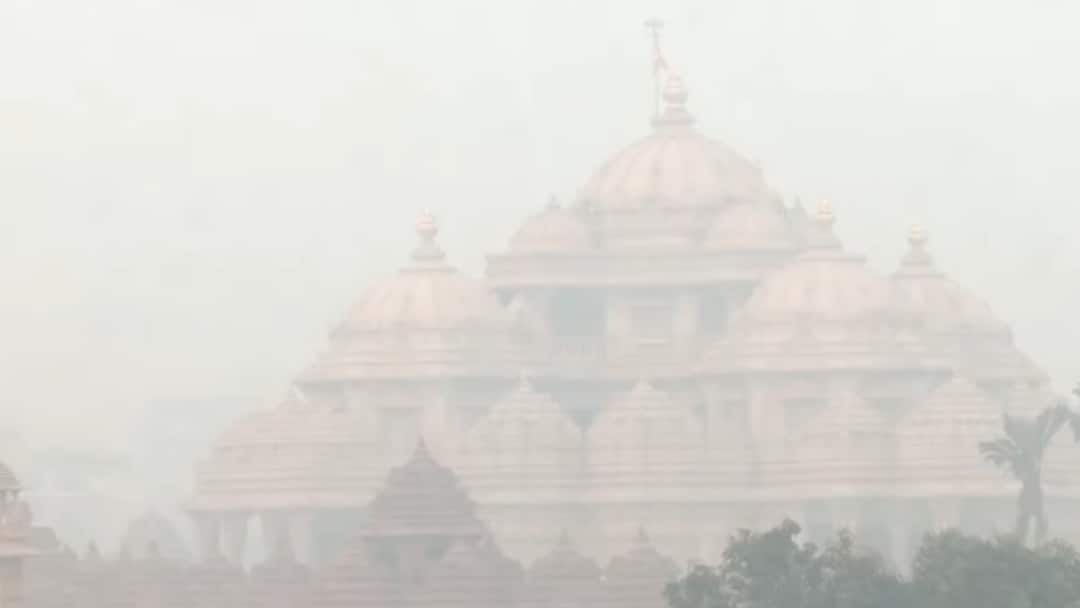
- Delhi’s air quality ‘severe’ for third consecutive day.
- GRAP Stage II implemented; pollution to remain ‘very poor’.
- Transport and farm fires are primary pollution contributors.
- Punjab recorded 98 farm fires, highest across six states.
Delhi’s air pollution worsened for the third consecutive day on Wednesday, with 20 monitoring stations recording ‘severe’ air quality and the city-wide AQI reaching 369. Several neighbourhoods reported readings above 400, with Jahangirpuri and Punjabi Bagh emerging as the worst-affected areas.
Jahangirpuri, Punjabi Bagh Record Highest AQI At 447
Jahangirpuri and Punjabi Bagh topped Delhi’s pollution chart with an Air Quality Index (AQI) of 447 each. Other areas also reported alarmingly high pollution levels, with IIT recording 438, Rohini 433, DTU 432, Vivek Vihar 428, Alipur 419, Narela 418 and Bawana 408. Mundka recorded an AQI of 436.
Of the capital’s 59 monitoring stations, 20 reported ‘severe’ air quality, while 33 recorded readings in the ‘very poor’ category. The remaining six stations fell under the ‘poor’ category. PM2.5 was identified as the primary pollutant.
#WATCH | Delhi: The Air Quality Index (AQI) in the area around Akshardham Temple is 305, categorised as ‘very poor,’ as per the CPCB (Central Pollution Control Board). (Visuals shot at 07:25 am) https://t.co/yydN7DSNBv
— ANI (@ANI) November 4, 2026
Pollution levels were also elevated across parts of the National Capital Region (NCR). Gurugram recorded an AQI of 321, followed by Noida at 305, Ghaziabad at 229 and Faridabad at 125.
GRAP Stage II Restrictions In Place As Pollution Persists
The deterioration follows Monday’s decision to implement Stage II of the Graded Response Action Plan (GRAP) in Delhi. The city’s 24-hour average AQI stood at 324 on November 2, marking its first entry into the ‘very poor’ category this season.
The Air Quality Early Warning System for Delhi has predicted that pollution levels could remain in the ‘very poor’ category until at least Friday, November 6.
Weather conditions are unlikely to provide immediate relief. Wednesday’s forecast indicated maximum temperatures of 27-29 degrees Celsius and minimum temperatures between 14 and 16 degrees Celsius. With no rainfall predicted, the sky was expected to remain mostly clear during the morning.
Transport And Farm Fires Account For Major Pollution Share
Transport emissions contributed the largest share of Delhi’s pollution at 15.8 per cent, according to the Decision Support System (DSS). Stubble burning was close behind, accounting for 15.3 per cent.
Residential emissions contributed 3.9 per cent, while industries in Delhi and surrounding areas accounted for 3 per cent. Construction activities contributed 2.2 per cent and waste burning 1.4 per cent. Energy production and road dust each accounted for 1.2 per cent, while other sources made up 1 per cent.
Punjab Reports 98 Farm Fires In A Single Day
Satellite data detected 219 farm fire incidents across six states on November 2. Punjab recorded the highest number at 98, followed by Rajasthan with 67 and Madhya Pradesh with 48. Uttar Pradesh reported four incidents and Haryana two. No incidents were detected in Delhi or Uttarakhand.
Data from the CREAMS Lab at ICAR-Indian Agricultural Research Institute, cited by PTI, showed that 3,535 farm fire incidents were recorded across the six states between September 15 and November 2.
Punjab accounted for 1,612 incidents, Rajasthan 738, Madhya Pradesh 614, Uttar Pradesh 349, Uttarakhand 176, Haryana 44 and Delhi two.
The stubble-burning season runs from September 15 to November 30. Delhi recorded its first farm fire incident this season on September 19, followed by another on October 24.
Disclaimer : This story is auto aggregated by a computer programme and has not been created or edited by DOWNTHENEWS. Publisher: abplive.com