
Progressives rallied round the controversial Graham Platner after his primary victory in Maine on Tuesday, while Donald Trump again exerted his grip on the Republican party, helping to defeat a politician who had pushed for the release of the Jeffrey Epstein files.
Primary elections were held in four states – Maine, Nevada, North Dakota and South Carolina – ahead of November’s midterms to decide control of both houses of Congress. The results offered mixed signals about the direction of the two major parties.
The marquee race was a Senate primary election in Maine, where Platner won 72% of the vote, defeating the state governor, Janet Mills, who had suspended her campaign but remained on the ballot, and third-placed David Costello, based on early results reported by Reuters.
The result sets up a bruising general election battle against the Republican incumbent, Susan Collins. Maine is among a handful of states where Democratic strategists believe a Republican-held seat is genuinely vulnerable.
Platner, 41, a Marine veteran and oyster farmer from the small coastal town of Sullivan, had in effect wrapped up the nomination weeks ago when Mills suspended her campaign after concluding there was little prospect of catching him.
But Platner was carrying substantial political baggage, including old incendiary Reddit posts, a tattoo resembling a Nazi symbol, sexually explicit messages sent to other women early in his marriage and accusations from a former girlfriend that he had been physically intimidating. Platner has apologised repeatedly for aspects of his past conduct and has linked some of his struggles to post-traumatic stress disorder and depression after combat deployments in Iraq and Afghanistan.
Addressing a crowd of cheering supporters at a YMCA gym in Blue Hill, Platner acknowledged the controversies directly, adopting a tone that was part confession, part political appeal. “If you believe, as I do, that we can change our politics and change our country, then you must also believe that people can change,” he told supporters.
“I’ve made mistakes in my life, mistakes that I regret, that I live with, that I continue to learn from. I’m still far from perfect, but every day I wake up and I try to be a little bit better and a little bit kinder than I was the day before.”
Supporters packed the hall long before Platner appeared. His mother, Leslie Harlow, took the stage before him, describing her son as someone who had spent his life helping others. “I am very, very proud of my son,” she told the crowd. Platner’s wife joined him after his speech in what appeared to be a carefully choreographed effort to project stability and unity.
During the height of the #MeToo movement, Democrats often portrayed themselves as champions of strict accountability for allegations of personal misconduct. But on Tuesday party leaders wasted little time rallying around their nominee. The Senate Democratic leader, Chuck Schumer, and Senator Kirsten Gillibrand, who chairs the Democratic Senatorial Campaign Committee, said in a statement that Collins “has never been more vulnerable” and “Maine voters will elect Graham Platner”.
The race against Collins is likely to be tight and could help decide control of the Senate. In his remarks, Platner, a progressive populist backed by Senator Bernie Sanders, set out a critique of Collins that is likely to feature heavily in the coming campaign. Mentioning her name prompted immediate boos from supporters.
“Susan Collins may have started her career decades ago in Washington with good intentions, but she has become just as spineless and corrupt as the establishment she now serves,” he said. “She got elected promising to protect Roe versus Wade, only to turn around and put a justice on the supreme court who overturned it. She lied to us.”
He accused the senator of enriching herself while ordinary Americans struggled and attacked her support for military interventions abroad. “Susan Collins has never met a war she didn’t like,” he said.
But Republicans are already sharpening their attacks. The Senate Leadership Fund, a powerful Republican organisation, labelled Platner a “dangerous deviant”. Conservative groups are expected to spend millions highlighting the allegations against him.
Beyond Maine, Tuesday’s elections offered fresh evidence of the issues shaping the wider political landscape.
South Carolina served up another test of Trump’s enduring influence over the Republican party. The president enjoyed a comfortable victory through his ally Lindsey Graham, who secured renomination to the Senate without being forced into a runoff.
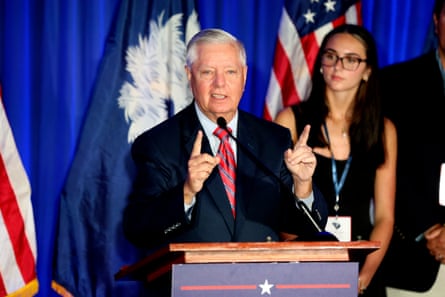
Graham, once one of Trump’s fiercest critics before becoming one of his closest allies, thanked the president during his victory speech and promised to continue supporting his agenda in Washington. “President Trump, I’m coming back to the Senate,” he declared.
On Truth Social, Trump toasted Graham’s “BIG WIN tonight” in a field “of very capable candidates”.
In the South Carolina primary for governor, congresswoman Nancy Mace became the latest casualty of Trump’s efforts to topple Republicans after she demanded the release of the government’s Epstein files. She responded on X: “As a survivor, I chose to stand on principle and stand against the Epstein cover-up. I chose to expose the names hidden in the sexual harassment slush fund. I chose to expose DEI judges. I chose to expose the abusers of children. And apparently, I chose wrong if the goal was winning an election.”
But Trump’s preferred candidate, Lieutenant Governor Pamela Evette, failed to secure an outright majority and must now face Alan Wilson, the state attorney general, in a runoff election later this month.
The longtime South Carolina congressman James Clyburn easily fended off a little-known primary challenger. Two Republicans are still competing for the chance to face Clyburn but he is expected to be the overwhelming favourite in the general election.
In Nevada, Democrats selected the state attorney general, Aaron Ford, as their nominee for governor, setting up what is expected to be one of the country’s most competitive statewide contests. Ford defeated the Washoe County commissioner, Alexis Hill, after largely ignoring his primary opponent and focusing instead on the Republican governor Joe Lombardo.
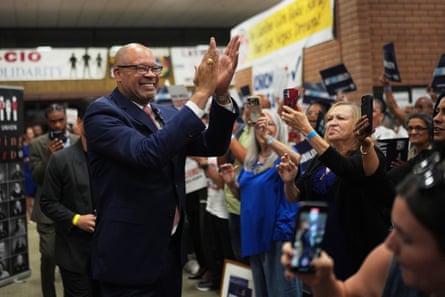
At his victory celebration, Ford painted a bleak picture of the state’s economic condition. “Nevadans are feeling more pain at the gas pump, at the grocery store, at the businesses that are closing in front of our eyes,” he said.
Ford repeatedly linked Lombardo to Trump and argued that both were responsible for rising economic anxiety. “This is all about strengthening the working class,” he said.
Lombardo remains one of the most vulnerable Republican governors seeking re-election. Democrats believe economic dissatisfaction could create an opening, although Republicans insist the governor’s record on jobs, public safety and education will prove decisive.
Nevada also produced one of the most important congressional contests of the cycle. Republicans nominated Marty O’Donnell, the composer best known for creating the soundtrack to the hugely successful Halo video game franchise, to challenge Democratic congresswoman Susie Lee in the state’s highly competitive 3rd congressional district.
O’Donnell’s win marked another victory for Trump, who has seen his endorsed candidates win primaries across the country.
Teresa Benitez-Thompson won the Democratic primary in Nevada’s 2nd district. Benitez-Thompson, a former assembly leader, faces an uphill battle. Republicans outnumber Democrats by 70,000 in the district that covers Reno and rural northern Nevada.
In Maine, the Republican primary for governor will be decided by ranked choice voting. No candidate won the majority of votes on Tuesday so the race will go to a ranked runoff.
Disclaimer : This story is auto aggregated by a computer programme and has not been created or edited by DOWNTHENEWS. Publisher: theguardian.com