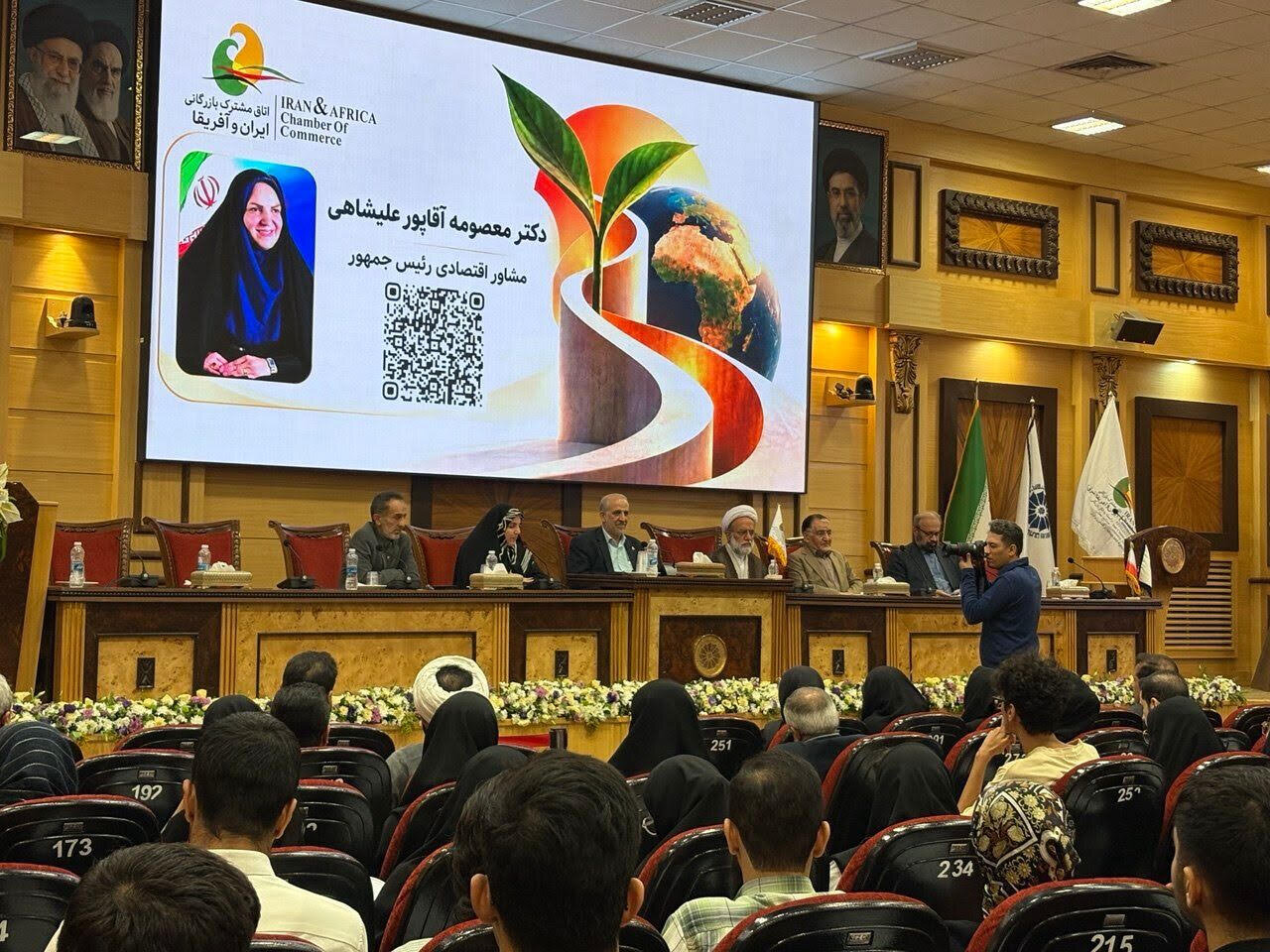
TEHRAN- The Advisor to the President for Economic Cooperation, referring to the importance of coordination among government institutions, the private sector, and academic centers, said: “Developing trade relations with Africa requires moving from preliminary and ceremonial talks toward results-oriented economic diplomacy.”
According to IRNA, Masoumeh Aghapour said on Wednesday at the second course of the Iran-Africa Chamber of Commerce, aimed at empowering the younger generation to enter international trade: “To achieve this goal, the government must facilitate the ground for the activity and presence of the private sector; universities and academic centers must provide the necessary knowledge and specialized support; and economic actors, relying on their understanding of the market and their capabilities, must take on the main responsibility for advancing trade projects.”
Aghapour added: “None of these sectors alone can actualize all existing capacities. Cooperation and division of responsibility among the government, universities, and the private sector will pave the way for the formation of an efficient system for developing foreign trade.”
The Advisor to the President for Economic Cooperation, emphasizing the necessity of changing Iran’s approach to developing trade relations with the African continent, said: “Success in African markets will not be achieved by increasing the number of trips and signing memoranda of understanding; rather, we must seek the implementation of real projects, the formation of capable companies, the conclusion of operational contracts, and the training of a new generation of international trade actors.”
He added: “Africa is not merely a market for supplying Iranian goods; it is a strategic horizon for the future of Iran’s economy and an important platform for the effective presence of the new generation in the field of international trade.”
Aghapour, referring to the government’s special attention to the capacities of the younger generation, said: “Belief in the capabilities of young people and their role-playing in the country’s economic transformations is one of the important issues on the path of Iran’s economy transitioning from traditional structures toward a modern economy and broader international interactions.”
He said: “The younger generation, especially young people familiar with modern technologies and global economic developments, can play a role in designing new paths for foreign trade, identifying international opportunities, creating innovative businesses, and developing Iran’s economic relations with other countries.”
The Advisor to the President for Economic Cooperation, referring to the demographic, economic, and trade capacities of the African continent, stated: “Africa, with its young population, broad production and consumption capacities, and developing markets, is one of the important areas for expanding Iran’s economic cooperation. Therefore, the view toward this continent must change from a short-term approach limited to case-by-case interactions to a long-term and targeted strategy.”
He stated: “To effectively exploit these capacities, economic actors’ view of Africa must be based on precise market knowledge, assessment of opportunities, and the design of executive plans. Therefore, success in international markets becomes meaningful when initial contacts lead to sustainable economic cooperation, joint projects, export development, and the creation of added value for the country’s economy.”
Aghapour, referring to the complexities of economic activity in foreign markets, said: “Successful presence in African markets requires precise knowledge of the economic conditions, regulations, and trade mechanisms of destination countries. Before entering any market, economic actors must professionally examine potential risks, the supply chain, laws and regulations, the banking and foreign exchange system, and the methods of conducting trade transactions.”
The Advisor to the President for Economic Cooperation added: “Iranian exporters must carefully study the destination market before offering their products, and by understanding distribution methods, retail shelves, household preferences, and consumer expectations, they must design and offer products suited to market needs.”
Aghapour considered the establishment of a specialized department for trade with Africa and the training of specialized personnel to be among the important steps toward developing economic cooperation with this continent, and stated: “One of the country’s fundamental needs is cultivating human resources familiar with the characteristics of African markets and equipped with specialized knowledge of international trade.”
He added: “Specialized training must be linked with operational experience so that young people can, in addition to becoming familiar with the theoretical foundations of trade, gain experience in real processes of negotiation, marketing, identifying business partners, and implementing contracts.”
The Advisor to the President for Economic Cooperation said: “Developing cooperation with this continent should not be limited to exporting traditional goods; rather, the ground must also be provided for the presence of Iranian technology companies, knowledge-based firms, and providers of specialized services. Therefore, identifying the real needs of destination countries and matching the capabilities of Iranian companies with these needs must be at the center of trade planning.”
EF/MA
Disclaimer : This story is auto aggregated by a computer programme and has not been created or edited by DOWNTHENEWS. Publisher: tehrantimes.com