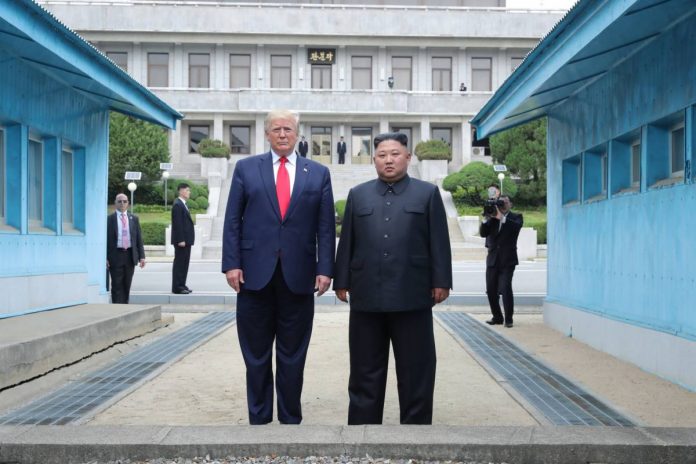
As talk of a possible Trump-Kim summit grows in 2026, shifts in North Korea’s domestic political events suggest Kim Jong Un is quietly preparing to meet Donald Trump. The U.S. president told reporters on Oct. 12 that he “may” meet Kim during an Asia trip next month. That trip includes the Asia-Pacific Economic Cooperation summit in Shenzhen, China.
Pyongyang’s public messaging toward Washington remains somewhat heavy-handed for now. At home, however, the regime appears to be carefully adjusting Kim’s political conduct with a summit in mind. Several notable developments over the past two months support that reading of events in Pyongyang.
The Ninth Party Congress in February hailed Kim as the “greatest leader” of North Korea. It also formalized the Workers’ Party of Korea as, in name and in fact, “Kim Jong Un’s party.” In March, the Supreme People’s Assembly, North Korea’s rubber-stamp parliament, approved a revised constitution. The new text strengthened his status and powers so thoroughly that it could fairly be called “Kim Jong Un’s constitution.”
His ideology and leadership now sit at the center of the party’s monolithic ideological and leadership system. In effect, what amounts to “Kim Jong Un-ism” has firmly taken hold across the country. The regime has built an absolute power structure in which no one can question Kim’s plans or decisions.
That power even allowed Kim to write the “hostile two-state theory” into the constitution, despite its clash with his predecessors’ legacy. The doctrine, which Kim declared in December 2023, treats North and South Korea as two hostile states rather than one divided nation. Pyongyang is now reorganizing its entire political system around Kim’s ideology and leadership.
This trend shows up not only in propaganda but also in classrooms across North Korea. Teaching about Kim’s greatness has now become the top priority in schools nationwide. The National Conference of Teachers held on Sept. 2 made that priority unmistakably clear to educators. Pyongyang then convened a training session for party propaganda officials on Sept. 18. The session ordered officials to wage an even stronger ideological offensive on behalf of Kim’s thought and leadership.
On the surface, the regime still holds up “Kimilsungism-Kimjongilism,” the founding ideology named for Kim’s grandfather and father. In practice, Kim’s own ideology and leadership now serve as the yardstick for every political judgment. The names of Kim Il Sung and Kim Jong Il carry less weight in the party rules and constitution than before. North Korea, in other words, now effectively belongs to Kim Jong Un alone.
Having monopolized power, Kim has effectively become the embodiment of the state itself. The “flag-raising ceremony and central oath-taking gathering” offered a vivid symbol of this shift. The event was first held on Sept. 9, 2025, the anniversary of the regime’s founding.

At that ceremony, the national flag served as a political emblem of Kim as much as of the state. The oath went beyond a simple pledge to the country and read like a vow of total obedience to Kim. The flag thus became a symbol fused with Kim’s personal authority as well as with the nation.
The ceremony later stirred controversy in South Korea when some religious groups there called for flying the North Korean flag. Displaying the North Korean flag in South Korea is generally restricted under the National Security Act.
This year’s ceremony, however, followed a noticeably different pattern from the one set in 2025. With Kim’s power arguably at its peak in 2026, I expected an even stronger display of loyalty this time. The Sept. 9 event this year, however, proved me wrong on that point.
Compared with last year, the emphasis on personal loyalty to Kim weakened considerably at the ceremony. The oath leaned heavily toward patriotism for the state rather than devotion to the leader. It looked as if organizers had deliberately kept Kim himself out of the spotlight. Kim also skipped the other related state events held around the anniversary. The commemorative performance stressed patriotic feeling for the country rather than praise for him personally.
A similar pattern emerged on Oct. 10 at events marking the 81st anniversary of the party’s founding. Kim appeared at the celebrations but gave no speech and took little part in other events. That stands in sharp contrast to his conduct at a university event just 10 days earlier. On Sept. 30, Kim attended the anniversary of Kim Il Sung University’s founding and spoke in person. He also stayed to watch the commemorative performance that followed the ceremony. Kim Il Sung University, located in Pyongyang, is North Korea’s most prestigious institution of higher learning.
Coverage by Korean Central Television, the country’s main state broadcaster, is especially telling. The channel aired a relatively short 16-minute edit of the Oct. 10 celebratory performance the next day. Its cameras never once showed Kim at any point during the program. That choice is unusual given North Korea’s established practice in covering major political events. State media has long worked to maximize Kim’s authority and greatness in every broadcast. This time, it chose not to put him front and center at all. This string of changes may reflect deliberate political staging rather than mere coincidence.
Skipping an anti-American centennial ahead of a Trump-Kim summit
These moves likely reflect Kim’s own intentions, and their timing deserves close attention. They emerged after Trump publicly expressed interest in meeting the North Korean leader. As he prepares for a possible summit, Kim may want to show that North Korea is more than a one-man dictatorship. The strategy could aim to soften his image as a dictator abroad. It could also signal that the country’s political system does not revolve around him alone.
Another case supporting this view is the centennial of the Down-with-Imperialism Union, marked around Oct. 17. Pyongyang claims a teenage Kim Il Sung founded the group in Manchuria on Oct. 17, 1926. The regime treats it as the root of the Workers’ Party of Korea, though outside historians consider the official account embellished.
To mark the 100th anniversary of the union, known in state media as “T.D.,” Pyongyang staged a string of political events. It held a central research and discussion forum on the union’s legacy on Oct. 13. The Rodong Sinmun, the party’s official newspaper, ran a commentary on Oct. 14 and an editorial on Oct. 17.
Commemorations then followed one after another throughout the rest of the week. On Oct. 15, labor organizations held presentations on the leaders’ writings, and young students competed in an oratory contest. A central report meeting and a combined performance by young students followed on Oct. 16.
On the anniversary itself, participants toured the Korean Revolution Museum in central Pyongyang. They also laid flowers at the Taesongsan Revolutionary Martyrs’ Cemetery and joined political and cultural events across the country.
North Korea celebrated the centennial as a nationwide political event, yet Kim attended none of the gatherings. On the anniversary, the Rodong Sinmun reported only that he had sent educational equipment to Kim Chaek University of Technology. Even as large commemorations unfolded day after day, Kim stayed out of public view. His absence left the impression that he had deliberately kept his distance from the celebrations.

What, then, explains Kim’s absence from such a major anniversary for the ruling party? The centennial events repeatedly stressed two core messages to North Koreans across the country. One was loyalty to Kim, framed through the unbroken succession of North Korea’s supreme leaders. The other was anti-imperialist independence, which organizers set as the first mission of the Workers’ Party of Korea.
When the union formed in 1926, its anti-imperialist struggle targeted Japanese colonial rule over Korea. For decades since, however, the main target of that struggle has been the United States. This year’s commemorations made their anti-American character plain to anyone watching.
For a leader preparing for a summit with Trump, these slogans would have posed a considerable burden. Personally attending mass rallies that chant anti-American slogans would have been a politically awkward choice. That is especially true with a meeting with the U.S. president possibly on the table.
Kim had already kept a low profile at earlier state events this fall. He may have wanted to avoid appearing at an anniversary built around anti-imperialist struggle. In the end, he skipped every one of the centennial events.
His absence alone cannot prove that Kim intends to reopen U.S.-North Korea diplomacy. Taken together, though, several trends reveal a clear political pattern in Kim’s recent behavior. These include his reduced visibility at major events, the relative restraint in his personality cult and his absence from strongly anti-American events. These signs suggest Kim keeps a hard line in public while building a domestic climate suited to a Trump-Kim summit.
For these reasons, I believe Kim privately and genuinely wants to meet Trump.
The views expressed in this column are the author’s own and do not necessarily reflect those of Daily NK.
Disclaimer : This story is auto aggregated by a computer programme and has not been created or edited by DOWNTHENEWS. Publisher: dailynk.com