Picture stepping out of a Delhi Metro station at 9.30 pm. The last bus has gone, the lane home is poorly lit, and every waiting auto has a man at the wheel. You weigh the distance, the dark and the driver before deciding how to get back.
That is the gap Delhi’s new pink autos are meant to help close. According to news reports, the Cabinet cleared the DURGA scheme on 23 September 2026, and applications opened on 12 October. Of 1,300 electric autos in phase one, 1,170 are for women and 130 for transgender persons, who will own and drive them.
Women applicants must be Delhi residents aged 20 to 40; a lottery decides allotments where applicants outnumber a district’s quota. Buyers can claim a ₹50,000 incentive under the Delhi EV Policy 2026; the government hasn’t said what each will pay.
Here are six pink schemes, and what the evidence says.
1. Delhi’s free bus travel for women
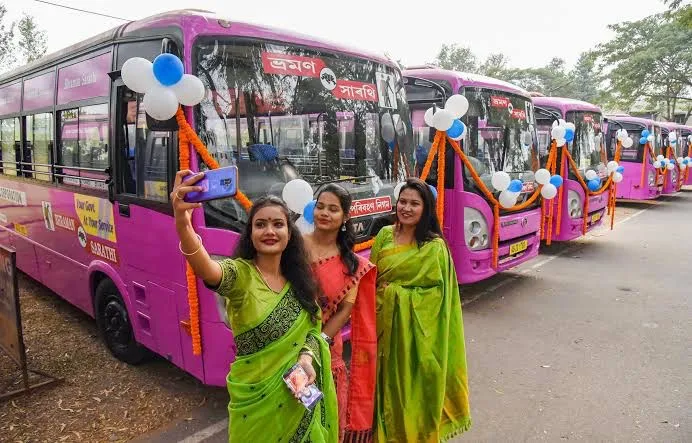
Delhi has offered women free bus rides since October 2019. A WRI India working paper found women’s share of daily bus riders rose from 33% in 2019-20 to 42% in 2022-23, though hostile crew, overcrowding and unreliable service blunt the gains.
The Pink Saheli smart card became mandatory for free travel on 18 September 2026, per Vikaspedia.
2. Free buses in Tamil Nadu and Karnataka
In three Tamil Nadu districts studied by the State Planning Commission, women saved an average of ₹888 a month under Vidiyal Payanam, The Hindu reports.
Karnataka’s Shakti shows the other side. Women’s rides rose from 183.07 crore in 2023-24 to 275.71 crore in 2025-26, but ETV Bharat reports ₹5,172 crore in reimbursements is pending, and the transport corporations posted their first loss in 2025-26.
3. Pink autos and e-rickshaws
In Mumbai and Thane, a 5% reservation of rickshaw permits made 465 licences available, and the first 19 trained women began driving in April 2017, The Better India reports.
Getting vehicles to women has been the hard part. Maharashtra set a 2024 target of 10,000 pink e-rickshaws. Minister Aditi Tatkare said 9,440 applications arrived and 130 women received vehicles; Hindustan Times reports bank loans and driving licences were obstacles for a vehicle costing about ₹4 lakh. Delhi’s 2022 attempt reserved 1,406 electric auto permits for women and drew 743 applicants in its first round, NDTV notes.
4. Ghaziabad’s pink booths
Staffed by women police, these booths also handle family quarrels. The Times of India reports 4,038 complaints of disputes between couples from September 2023 to April 2024, with a police official saying 3,981 were solved there, and a 16% fall in crimes against women in seven months.
/filters:format(webp)/english-betterindia/media/media_files/2026/10/15/3-2026-10-15-14-03-47.webp)
Both figures come from the police, with no independent evaluation. The Wire found a booth in Greater Noida empty at about 5.30 pm on 1 September 2026.
5. Kerala’s Pink Protection
Kerala Police launched it in July 2021 with 10 cars, 40 two-wheelers and 20 bicycles, NDTV reports. We found no published outcomes.
The nearest evidence is a J-PAL trial of Hyderabad’s SHE Teams, which are not a pink scheme: street harassment overall did not change, but severe incidents fell 27% where uniformed officers patrolled.
6. Pink polling booths
The Election Commission said in April 2024 that over 5,000 polling stations would be run entirely by women. Delhi had 70 among 13,641 for the 2024 Lok Sabha polls, The Hindu reports. We found counts, but no study of the effect on turnout.
So, do pink initiatives work?
At that Metro station, the colour of the auto matters less than three questions: is one waiting, can the woman driving it afford to own it, and does the ride home feel safer?
/filters:format(webp)/english-betterindia/media/media_files/2026/10/15/pink-polling-station-2026-10-15-14-04-49.jpg)
Where a scheme removes a cost, like a bus fare, women’s travel measurably changes. Where the promise is safety, outcomes are largely unmeasured or come from the police themselves.
Maharashtra and Delhi have shown a reserved permit is not a vehicle on the road. What will decide DURGA:
-
Access: whether applicants can get through the loan and licence process.
-
Transparency: whether the government publishes who applied and who received vehicles.
-
Evidence: whether its planned two-phase study records safety, not only income.
The Transport Department has asked DMRC and NCRTC for parking and charging space at Metro stations, which fits the scheme’s aim of a safer late-evening journey home.
Sources:
-
‘Fare-free Bus Travel Scheme for Women: Lessons from Delhi’: by Harshita Jamba, Aravinda Devaraj and Chaitanya Kanuri for WRI India, Published on 17 March 2025 (revised 5 December 2025)
-
‘Sexual Harassment in Public Spaces and Police Patrols: Experimental Evidence from Urban India’: by Sofia Amaral, Girija Borker, Nathan Fiala, Anjani Kumar, Nishith Prakash and Maria Micaela Sviatschi for the National Bureau of Economic Research (NBER Working Paper 31734), Published on September 2023
-
‘Delhi govt to distribute 1300 e-autos to women and transgenders under DURGA scheme’: by PTI for ThePrint, Published on 11 October 2026
-
‘Free bus travel for women in Tamil Nadu helps them save money and travel safe’: by ETB Sivapriyan for Deccan Herald, Published on 26 November 2022
Disclaimer : This story is auto aggregated by a computer programme and has not been created or edited by DOWNTHENEWS. Publisher: thebetterindia.com