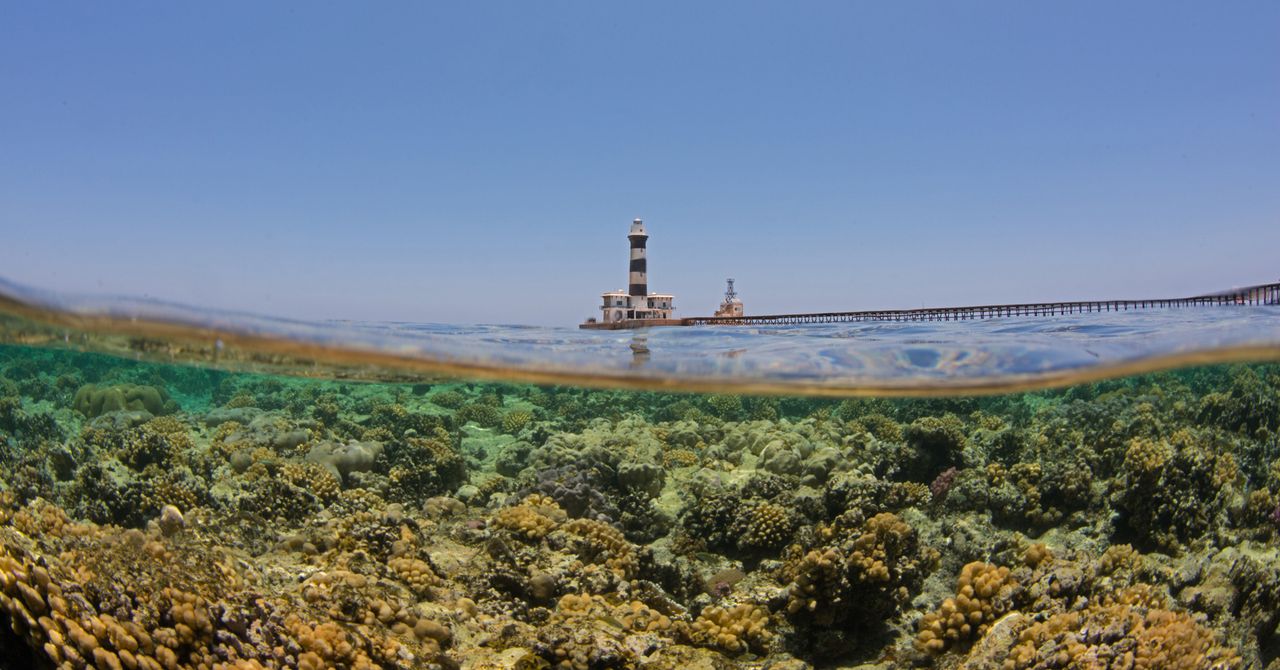
As coral reefs have undergone massive bleaching events across the globe, the corals of Egypt’s Red Sea have offered some hope. They’ve been unusually resilient to rising water temperatures, and if the oceans continue getting hotter, some scientists even predict that Egypt’s northern reefs could become the world’s last-remaining corals.
That’s what Mahmoud Hanafy, a professor of marine biology at Suez Canal University and consultant for the Hurghada Environmental Protection and Conservation Association (HEPCA), has previously predicted. But in the summers of 2023 and 2024, heat waves strained Red Sea coral ecosystems. A HEPCA survey led by Hanafy found bleaching throughout the Red Sea corals in 2024. In the northern areas, less than a tenth of coral colonies surveyed were affected, but further south, bleaching took out half the corals.
Scientists are racing to piece together what these events mean for reefs long described as “super coral” for their unparalleled hardiness. But now the question is not just how much heat they can withstand, but what has protected them until recently—and whether that protection will hold.
In overly warm waters, the algae nestled amongst the corals’ polyps begin to produce toxic substances. As a defense mechanism, the corals eject the algae. This is what is referred to as coral bleaching, and because these microscopic organisms are corals’ primary food source, bleaching events leave corals to starve.
That’s among other negative impacts hot seas may be having on corals, which is an issue not just for the corals, but all the other life among the reefs. According to the United Nations Environment Program, reefs cover less than 1 percent of the seafloor yet support at least 25 percent of marine species—some that are only just now being discovered.
For many years, northern Red Sea reefs remained quite stable as temperatures rose, while other coral ecosystems suffered bleaching. Eslam Osman, a marine ecologist at King Abdullah University of Science and Technology (KAUST), points to the Egyptian corals’ evolutionary history as a likely explanation for their heat tolerance.
Corals are believed to have spread into the Red Sea through the Bab al-Mandab Straight, which lies at the southern point of the sea between modern-day Djibouti and Yemen. Crossing through these especially warm waters acted as a natural filter, Osman posits. Heat-tolerant species and genotypes survived, and their offspring spread northwards into cooler waters.
However, resilience varies across the region, which is part of why Hanafy is unconvinced that evolutionary history is the primary explanation for the resilience of Egypt’s reefs. He places greater emphasis on water circulation.
The northern Red Sea experiences changes in current direction. This can create vertical mixing, which brings cooler water from far below toward the surface, he explains. These conditions could be buffering the corals against the heat even when the surrounding air temperatures remain high.
The distinction matters. The survival of these reefs may not have much to do with the biology of the corals or their symbiotic algae, and this might explain why the Red Sea corals began bleaching in 2024.
The sea remained unusually calm for about a month and a half during the 2024 heat wave, weakening the circulation he believes normally helps protect the reefs. HEPCA’s report identifies weak water circulation as a contributing factor in the bleaching. Exceptionally low tides in July 2024 may also have intensified stress on shallow coral communities.
Osman accepts that calm seas could have made bleaching more severe but says the circulation explanation needs further research. “I’m not denying the possibility of that,” he says. “But what I’m saying is, the temperature was the main issue.”
The two explanations are not necessarily mutually exclusive. But understanding their relative importance could help scientists assess how vulnerable these reefs are to future heat waves.
There are signs of recovery. HEPCA’s preliminary estimates a year after the bleaching event put recovery rates at 75 to 88 percent, depending on species and location. That is a far stronger rebound than seen elsewhere across the globe, where many reefs are only beginning to recover—if they show any progress at all.
Work to protect the Red Sea reefs ahead of the next heat wave is also under way, with the Egyptian government designating new protected areas as well as partnering with the United Nations Development Program and the Global Fund for Coral Reefs on conservation and sustainable management.
Osman sees such initiatives as a positive step but stresses that conservation requires sustained support. “We definitely need more stable financial resources, because conservation is not a single-year act.”
For Hanafy, the future of Egypt’s reefs also depends on whether climate change alters the circulation that has perhaps been keeping the corals alive.
Whatever explains their unusual resilience, local conservation cannot halt ocean warming. “Therefore, the key is to reduce carbon dioxide and greenhouse gases. Any other solution will just buy time,” Hanafy adds.
This story originally appeared in WIRED Middle East.
Disclaimer : This story is auto aggregated by a computer programme and has not been created or edited by DOWNTHENEWS. Publisher: wired.com