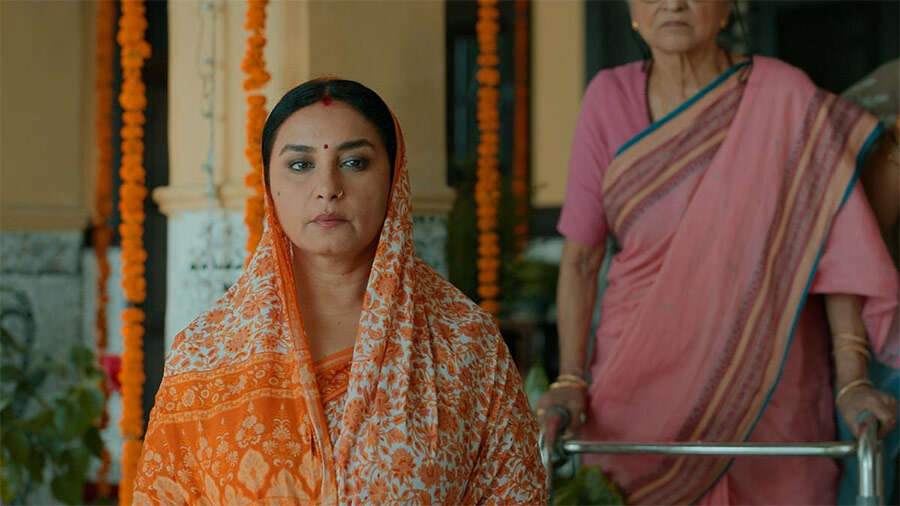
2026 has indeed been a euphoric year for her. With Chiraiya, Last Man in Tower, Gajab Raat releasing back to back, Dutta is no longer the strong and small supporting presence who elevates someone else’s story. She is the one carrying it.
In a candid conversation with Filmfare, she talks about her multiple collaborations with Manoj Bajpayee over the years, the lessons she carries from Yash Chopra, Shah Rukh Khan and Shyam Benegal, the sting of being labelled “consistently good,” and more.
I was spellbound when I heard the script of Chiraiya. I was shaken by the subject and took my time to absorb it. It was something that no one thought would be this crazy or have such an impact. I did it because I wanted to belong to something like this. Everything in that show, from the action to the dance and the emotional arc are things that I have always loved doing.
You have spoken about having immense faith in Neeraj Pandey’s craft. How was it working with him on Gajab Raat? What are a few things that make you believe in his vision so much?
Special 26 was the first film I did with him. Ever since then, he’s always asking me, “Are these dates available?” And I have a big grin because I know there’s something kickass coming. I love being his audience, so I never ask him what I’m doing because all the layers unfold while I’m shooting. I absolutely loved the way he placed me in the film. The walk, I think, very strangely got picked up. Everyone has a huge smile on their face when they talk about it.
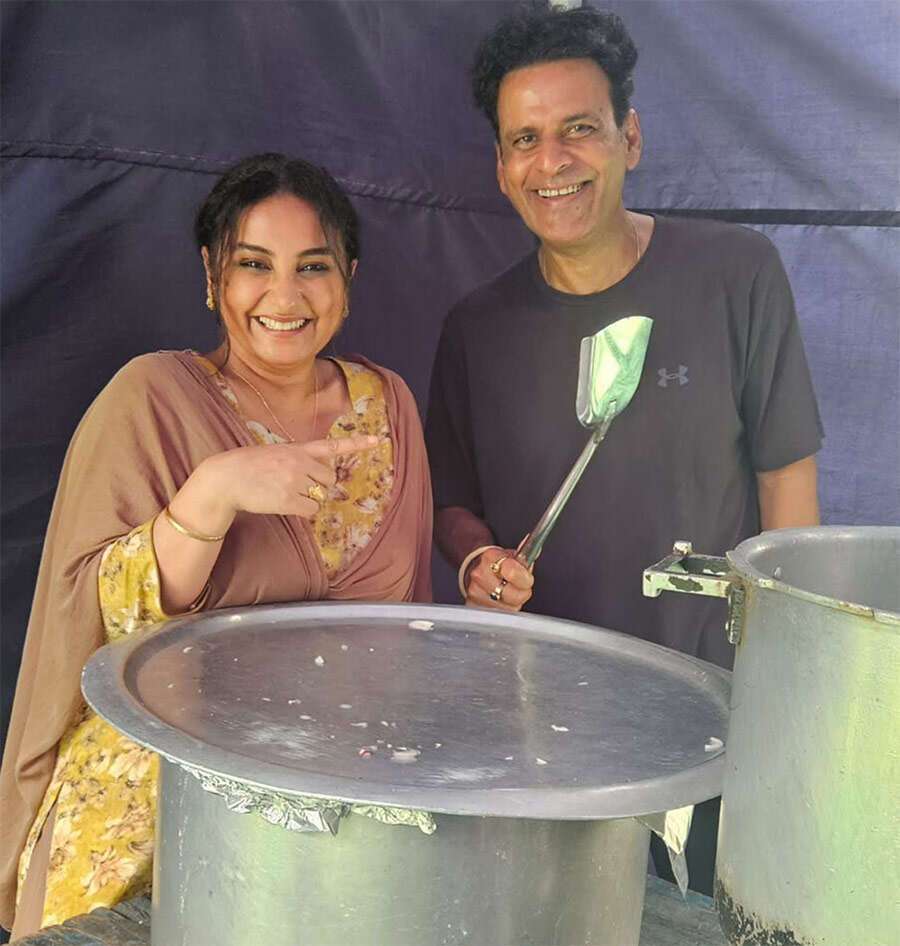
With Manoj, the face-off was delightful in Gajab Raat. Last Man In Tower is also one of my very favourites because the role is layered, vulnerable and brutal. I think we made up for all the movies we did together but didn’t have scenes in. This year, I mostly shot with Manoj. It’s been a hat-trick because after this, we’re doing Gandhi together. He is somebody who is so effortlessly easy. There’s a simplicity about him that is absolutely endearing. He nurtures you as an actor. He lets you do what you have to do, and he does his own thing. Together, I think we improvise beautiful things. I’m now having withdrawal symptoms. I’m going to another project and Manoj isn’t there (laughs). I’ve probably gotten into the habit of having him around.
Is there a particular behind-the-scenes memory that has stayed with you?
In Last Man, I remember we were shooting on the third floor, which had no lift. So, we would walk up and down. One day, he said, “I’m going to cook for everyone.” There was this little kitchen area where the unit was set up. He would go down, start cooking and come up again, three floors up. Then he would do an intense scene with me, go down again, start cooking and come back up. His passion for acting is well known, but his passion for cooking is something else. And the love with which he fed people was amazing to see. Also, there were lots of jokes on the sets. We’d talk about everything but work, and then get into a serious scene. That’s where friendship comes in. That’s where camaraderie comes in, and that’s what trickles into the scenes as well.
You have been part of the industry for over three decades and have portrayed a wide range of characters. Looking back, was there a particular project that changed the course of your career?
There have been many, actually. There was Veer-Zaara (2004), then Bhaag Milkha Bhaag (2013) and Badlapur (2015). But I think the show that changed it all for me was definitely Chiraiya (2026). Every actor needs that one thing that belongs to them. Then everyone starts considering you bankable, both professionally and commercially. That bankability is something I started feeling with Chiraiya. The commercial aspect got attached to me. So many brands came my way, and I got to see the other side of it.
The National Award was definitely a feather in my cap. People started investing in me more, with greater trust and faith. Earlier, it used to be, “She’s a sweet face, how can we give her negative roles?” Then, after the National Award, they were like, “No, no, she can do it.”
Definitely. When I was doing Delhi-6. I was very inhibited as an actor, and I remember we were supposed to do a scene in which I had to completely lambast another co-actor. I couldn’t get myself to say what I was expected to say because I was very shy.
I remember thinking the look is right, the Haryanvi is right, but there’s something missing. That’s when Rakeysh Omprakash Mehra told me, “All you have to do is let Divya sit out and let the lady, the character that you play, take over.” And I realised that was the biggest stumbling block in my own scene because Divya would come up with a rationale and say, “How will it be if you do this?” But when I became Jalebi, I thought and walked like Jalebi, Divya was nowhere. I would just open my top buttons and say, “Okay, this is her.” I would ask all my co-stars to tell me more expletives. I was suddenly bindass. I have to thank Rakeysh Mehra for the advice he gave me.
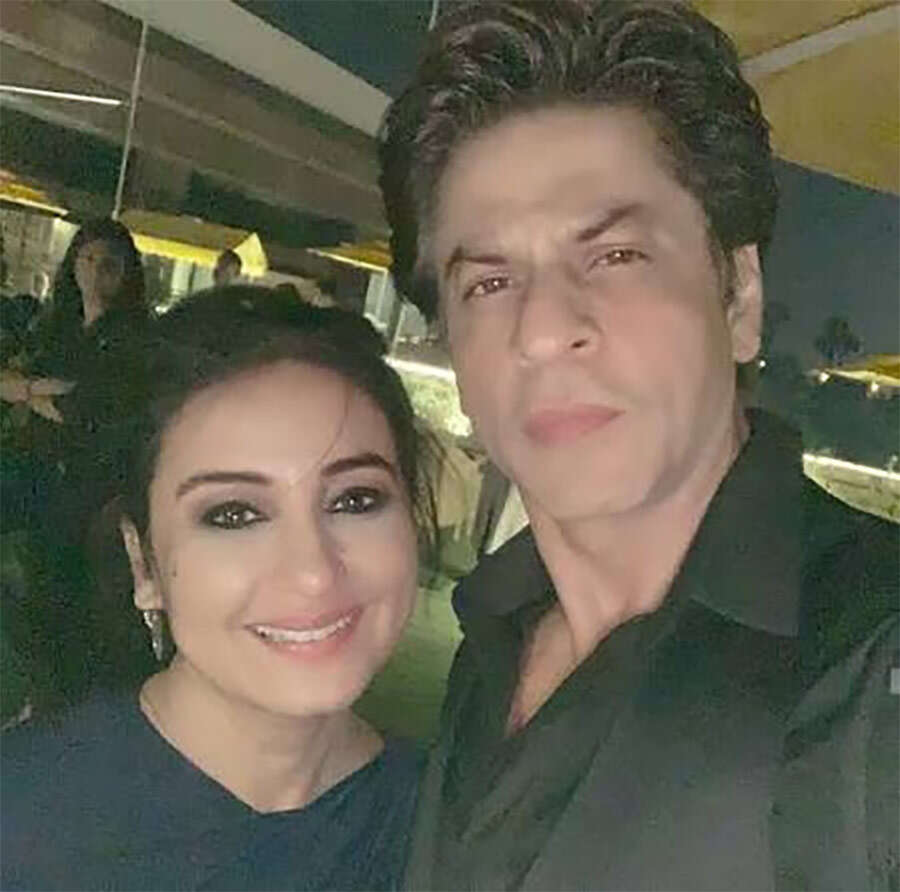
And then, of course, there was Shah Rukh. When we were doing Veer-Zaara, I didn’t know my camera angles correctly. He would just tell me, “There’s a camera there, you are doing good. But where are you looking?” I was so in awe that I would keep looking at him. He would say, “Not me, darling, the camera is there.” He would help me with little things. I was like a newcomer, and he would engage me with whatever he was doing. He would show me his scenes and take my feedback. The kind of confidence I got from being on that set is unmatched.
Shyam Benegal also gave me the confidence to choreograph my own dance for the first time I ever worked with him. I was 17. So, these two or three people have been really important to me.
Veer-Zaara is approaching its 22nd anniversary. What is your most vivid memory of working with Yash Chopra, and what was it like being on his sets for the first time?
I had dreamt of being directed by Yash Chopra. Then, to be on his set, I had to pinch myself 50 times and ask, “Am I on his set?” It’s still a dream. I remember one day on the set I was supposed to give a huge monologue, and I didn’t know the concept of sync sound. They said, “You have to speak it correctly because it won’t be dubbed.” That made me more nervous. I said, “I cannot mess it up because this is a dream.” I did it in one go. Everyone clapped, and that hug I got from Yash uncle, I will never forget. This is what dreams are made of.
You are an actor as well as a writer. How do these two creative pursuits complement each other?
I think these are two professions that allow you to express yourself: one in your own words and the other in somebody else’s words. But the execution is your performance. Recently, when I was doing a film for which the dialogues were written in English and then translated into Hindi. I asked, “May I just do the translation myself?” And they said yes. I feel that when I did it, all the emotional quotients came in. You also have a little insight into whether or not something is appealing as a reader or as an audience member when you do a scene. I have a share in the roles I portray and the arcs they have.
Every actor goes through phases of appreciation and criticism. When a film doesn’t perform as expected or your work isn’t recognised in the way you hoped, how do you deal with it?
There was a time when I was considered consistently good. When you are consistently good, your work is not really celebrated because you are good. Gradually, you take that as a challenge. You want to outdo that and surprise everyone again, more than anyone else, yourself. More than criticism, my situation used to be different. People used to be like, “We don’t need to praise her, she is good.” It used to pinch me that if I’m good, tell me that I’m good. We, as actors, are like children. We do need that validation. I think within the industry, you have to keep proving yourself.
If you had to describe your journey in cinema through a few lines of verse, what would they be?
I had written something:
Is chakachaundh bhari duniya mein, saaf sa aaina dhoondhti hoon,
Jismein jo jaisa hai, waisa hi dikhe.
Also Read: Last Man in Tower Starring Manoj Bajpayee, Divya Dutta and Boman Irani Set for OTT Premiere
Disclaimer : This story is auto aggregated by a computer programme and has not been created or edited by DOWNTHENEWS. Publisher: filmfare.com