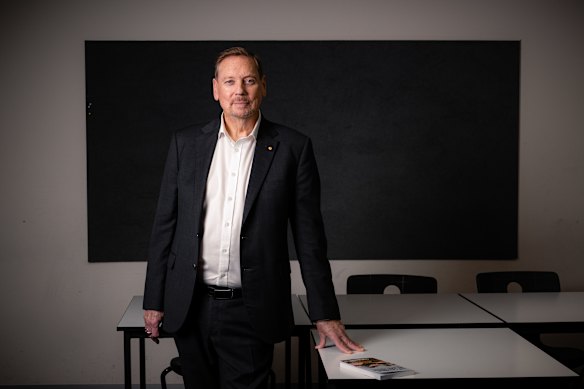

The grading system used in Australian schools is leaving hundreds of thousands of children so far behind their classmates each year that they never catch up, according to a leading international education expert.
The As Bs and Cs traditionally used to grade children’s work should be swept away and replaced with measurements that show what they have really learned since starting school, says Geoff Masters, a member of the International Baccalaureate (IB) board of governors.
Masters will appear at next month’s The Age Schools Summit in Melbourne, calling for revolutionary changes to schooling practices that have been standard for generations.
This year’s summit, on June 10 at Crown Conference Centre, will once again bring together the state’s leading educators, policymakers, and thought leaders to tackle the most pressing challenges and opportunities in Victoria’s education landscape.
Keynote speakers this year include state Education Minister Ben Carroll, opposition education spokesman Brad Rowswell and Department of Education Deputy Secretary David Howes.
A leading parents’ group, asked about Masters’ ideas, said on Wednesday that innovation in the classroom was always welcome, but not at the expense of clear reporting benchmarks that families could understand.
Masters argues in his new book, The Children We Leave Behind, that a system that looked more like a long-range road map, tracking a child’s progress through their entire schooling journey, would serve kids better.
“The problem with traditional letter grades is that they only indicate how well students have performed on the material they’ve just been taught,” Masters told this masthead.
“They don’t give a good indication of where individual children actually are in their learning or how far behind some students have fallen.
“Some students’ [abilities] may be two or three grade levels below or two or three levels above the year level that they’re in, but [grades] are not good at providing that kind of information, and they’re also not good at helping students and parents see the progress that children make over time.”
Masters argues that children would be better served by measuring the level of attainment in a subject, much like piano students are graded, assessed from the beginning of their schooling.
He says it makes no sense to move students on to the next level of learning – regardless of whether they have mastered the previous one – simply because they are a year older.
Grouping kids together according to their ages is good for socialisation, Masters argues, but from an educational perspective, it is time to be more flexible.
“Currently there’s teacher teaching year 7 mathematics, and another teacher teaching year 8 mathematics,” he says.
“You might say, let’s have those two teachers work together to address the needs of all students across that two-year span, or a three-year span, so you might do 7, 8 and 9, for example.”
Parents Victoria chief executive Gail McHardy said that assessment and reporting systems could be improved, but any changes to school structures should involve parents.
“There’s always room to improve assessment and reporting, but any new approach has to maintain clarity and confidence for parents,” McHardy said.
“There will always be tensions on the practical reality of ‘how’ when trying to meet the expectations of governments, academics, educators and parents. ”
“A grade is really a snapshot at a point in time. What parents also look at is whether their child is genuinely progressing and ready for the next stage of learning.”
Non-profit research centre The Centre for Educational Reform, where Masters is a research director, has ordered 400 copies of Masters’ publication and will distribute them to public secondary school principals around the country.
The institute’s chief executive, David Loader, said the mail-out was a contribution to the debate about the nation’s approach to schooling.
“It’s a fantastic book that’s going to change the way we think about schools,” Loader said.
“Geoff’s analysed schools and says the mechanics of schooling is wrong, and he’s identified a number of issues,” he said. “What he ended up with is a very penetrating analysis of what’s happening in schools.”
Loader shares Masters’ conviction that the current measurement practices are locking struggling children into a pattern of being left behind that becomes increasingly harder to escape.
“If you failed in grade 3 or 4, you’re going to be failing at grade 5, 6, 10, 11, 12,” the veteran educator said.
“You’re not going to catch up, and the notion that this is fair is ridiculous.
“The assessments are based on government getting access to data, then saying we are better than Sweden, or better than New South Wales, which is ridiculous.
“No, we ought to be about guaranteeing no student is left behind.”
Our Breaking News Alert will notify you of significant breaking news when it happens. Get it here.
From our partners
Disclaimer : This story is auto aggregated by a computer programme and has not been created or edited by DOWNTHENEWS. Publisher: www.smh.com.au