
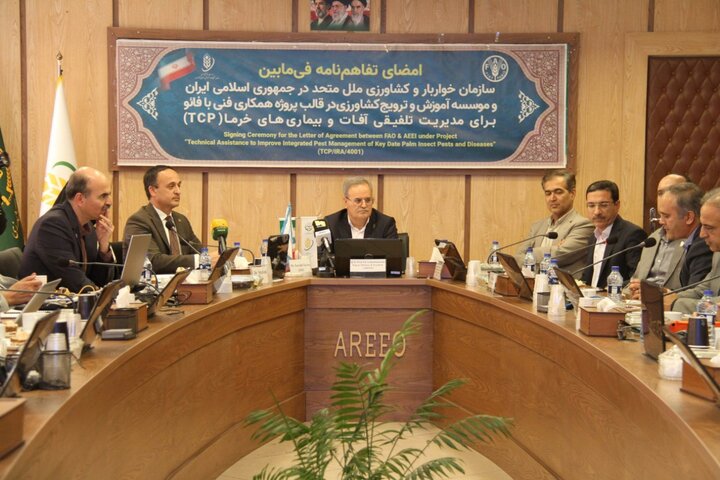
TEHRAN – The Food and Agriculture Organization of the United Nations (FAO) is strengthening national and provincial capacities to prevent, detect and manage key pests and diseases affecting date palm production in the Islamic Republic of Iran, supporting healthier orchards, reduced production losses and more sustainable livelihoods for date-producing communities.
This support will be advanced through a newly signed Letter of Agreement between FAO and the Agricultural Education and Extension Institute (AEEI) under FAO’s project “Technical Assistance to Improve Integrated Pest Management of Key Date Palm Insect Pests and Diseases”. The agreement was signed on October 5 in Tehran and will enable a multi-provincial capacity-development programme targeting approximately 1,720 farmers, agricultural extension officers and technical staff across nine provinces.
The ceremony was attended by Mr Golmohammadi, Deputy Minister of Agriculture.
“Strengthening the capacity of farmers and agricultural extension services is essential to ensuring that pest and disease management measures are effective, timely and sustainable,” said FAO Representative in the Islamic Republic of Iran, Farrukh Toirov. “Through this cooperation, FAO is supporting the application of science-based and environmentally responsible approaches that can help protect date palm production, reduce losses and strengthen the livelihoods that depend on this important sector.”
The Islamic Republic of Iran is one of the world’s leading date-producing countries, producing approximately 1.3 million tonnes of dates annually. Date palms are cultivated across around 260,000 hectares, with an estimated 40 million trees nationwide. Date production provides an important source of income and employment for farming families and rural communities, particularly in southern and central provinces, while also supporting a wider value chain encompassing harvesting, processing, packaging, transportation, trade and export.
The health and productivity of date palm orchards are therefore closely linked to the resilience of rural livelihoods and the competitiveness of the date sector. Pest and disease outbreaks can reduce yields and fruit quality, increase production costs and contribute to economic losses for farmers and other actors across the value chain.
“Through this initiative, FAO is supporting efforts to improve the management of major threats to date palm production, including the Red Palm Weevil, date palm borers, Dubas bug and important date palm diseases and disorders. The project focuses on strengthening surveillance, monitoring and early detection, while promoting effective, innovative and environmentally responsible Integrated Pest Management and Integrated Disease Management approaches,” Mr Toirov stated.
The newly signed Letter of Agreement will translate these objectives into practical capacity development in the field. Under the agreement, training activities will be carried out in Sistan and Baluchestan, Kerman, Hormozgan, Fars, Bushehr, Khuzestan, Yazd, South Khorasan and Isfahan provinces.
The programme will strengthen participants’ knowledge and practical skills in identifying pests and diseases, conducting surveillance and monitoring, recognizing threats at an early stage and applying appropriate integrated management measures. For farmers, improved knowledge of early signs of pest and disease incidence can support timely action and help prevent damage from becoming more severe. For extension officers and technical staff, strengthened capacities can support more effective field-level advice, monitoring and response.
By bringing technical knowledge and practical training closer to farmers and field-level agricultural professionals, the programme aims to support the wider application of integrated pest and disease management practices across major date-producing areas.
“The cooperation is expected to contribute to healthier date palm orchards, reduced production and economic losses, stronger farmer livelihoods and improved quality and competitiveness of Iranian dates in domestic and international markets.
Through the Letter of Agreement, FAO and its national partners are investing in the capacities, knowledge and institutions needed to support a more resilient and sustainable date palm sector in the Islamic Republic of Iran,” Mr Toirov concluded.
Disclaimer : This story is auto aggregated by a computer programme and has not been created or edited by DOWNTHENEWS. Publisher: tehrantimes.com




