
A woman’s murder allegedly committed by a U.S. Marine in Okinawa has triggered public outrage, prompted Japan’s premier to slam a “heinous crime” and rekindled controversy over the heavy military presence on the southern island.
Here are five things to know about the latest case and Okinawa’s thorny relations with the U.S. military bases.
What happened?
Okinawa prefectural police said they arrested Lance Cpl. Devin Jacob Ballard, 20, who is stationed at Futenma Air Station, on suspicion of strangling Anna Yagi, 39, at a hotel in the island’s capital city of Naha early Saturday and stealing her wallet and backpack. He has denied the allegations, according to Japanese media.
Security camera footage showed a man entering the hotel with the woman and later leaving alone.
Ballard was arrested when a patrolling officer saw him walking later Saturday in an entertainment district in Okinawa City, about 15 miles northeast of Naha. His shaved head and the tattoos on his arms matched those of the man in security footage, Kyodo News agency reported.
Why are so many bases concentrated in Okinawa?
Okinawa was under U.S. occupation from World War II until 1972. Today Okinawa hosts 70% of America’s military facilities and most of the 50,000 U.S. troops based in Japan today, despite comprising just 0.6% of Japan’s landmass.
In the wake of World War II, Japan regained its sovereignty under the San Francisco Peace Treaty of 1952, but Okinawa remained under American control, making it a hub of U.S. military build-up.
The 1972 return of Okinawa’s sovereignty to Japan did little to diminish the number of US bases on the island, leading to the disproportionate burden it is saddled with today.
Why is it so controversial?
There has been anger over increasing crime linked to the U.S. military on the island. The number of U.S. military-related criminal cases rose to 101 last year from about 40 in 2020, according to prefectural police.
The heavy U.S. presence has led to a host of issues, from helicopter crashes and noise pollution to crimes involving servicemen, including the 1995 gang-rape of a local 12-year-old schoolgirl.
That rape by three U.S. soldiers in Okinawa fueled widespread calls for a rethink of a 1960 pact that outlined the legal status of Japan-based U.S. military personnel.
The latest incident has sparked widespread anger.
“I’m outraged and flabbergasted to hear that a suspect came to the (entertainment area) after committing a murder,” Kenji Higa, who lives in Okinawa City, told the Okinawa Times.
Kotaro Ueda / Kyodo News via AP 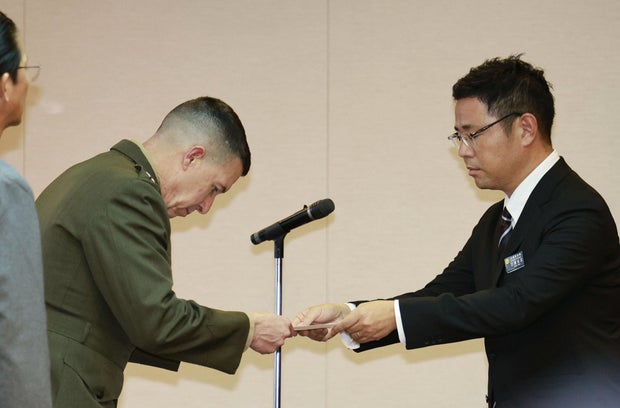
People in Okinawa have long opposed the heavy U.S. military presence on the island, but some have come to see its strategic value due to what is widely viewed as a growing threat from China.
Some also argue the military bases create jobs and help boost Okinawa’s local economy, accounting for around 5% of the region’s annual income.
How does jurisdiction work?
The 1960 Japan Status of Forces Agreement is often accused of rendering U.S. military bases virtually extraterritorial and immune to Japan’s domestic laws.
Japanese authorities are, for example, hard-pressed to conduct an on-site probe into alleged environmental pollution inside the bases and regulate low-altitude flights of their aircraft.
Among the most contentious is Japan’s lack of primary jurisdiction over crimes committed by US military personnel while on duty.
Even if crimes are committed while off-duty, as long as the individual responsible remains on base, their custody won’t be handed over to Japan until they are indicted, according to the Japan Federation of Bar Associations.
In this case, Kyodo reported that a police officer questioned and detained the suspect as he walked alone on a street in Naha’s entertainment district late Saturday.
Japanese prosecutors started examining the suspect’s case on Monday to determine whether to press formal charges in coming weeks.
If convicted, he could face life in prison or the death penalty.
How sensitive is the issue for Japan?
Despite the controversy, Japan — which has a pacifist constitution — relies on U.S. military might as a deterrent against any potential attack, stressing the importance of American soldiers being trained and on standby 24/7.
But Japan’s safety is not necessarily America’s only concern.
Experts say Washington essentially sees Okinawa as its strategic foothold to deploy militarily in the region and beyond, and the island is seen by both countries as important for monitoring China, the Taiwan Strait and the Korean peninsula.
In the past, American troops were mobilized from Okinawa to participate in conflicts such as the 1990 Gulf War and the 2003 Iraq War.
Disclaimer : This story is auto aggregated by a computer programme and has not been created or edited by DOWNTHENEWS. Publisher: cbsnews.com