Mark Truby has three Gen Z sons, and he has watched them size up their futures with one eye on artificial intelligence.
“They get a little bit paranoid that AI might replace the job they might go to school for,” said Truby, Ford Motor Company’s chief communications officer, describing his three Gen Z sons, aged 19 to 24. Calling himself a child of the ’80s, Truby cited the classic ads “your brain on drugs,” “Smokey the Bear” and “got milk” as campaigns he grew up on, and explained to Fortune that Ford wants the Ad Council to do for the trades what it did for forest fires.
Truby’s sons are entering a job market where the entry-level rung looks shakier. The New York Fed put unemployment among recent college graduates at 5.7% in June, against 4.1% for all workers. Stanford economists reported in August that employment among workers ages 22 to 25 in highly AI-exposed occupations is about 19% below where it would be had it kept pace with less-exposed jobs, up from 15% a year earlier. They found the adjustment comes mainly through reduced hiring of young workers rather than layoffs.
Whether AI is the cause is contested. The Stanford authors say their findings are descriptive patterns, not causal estimates, and the gaps shrink when education is accounted for. Harvard economist David Deming is a major voice pointing to remote work, and Apollo’s Torsten Slok notes that the graduate unemployment gap began widening about six months before ChatGPT’s release. A Ramp and Revelio Labs study found entry-level headcount at heavy AI spenders grew 12% over two years. Meanwhile, what Ford CEO Jim Farley calls the “essential economy,” the mechanics, electricians, plumbers, technicians, welders and other workers who keep the physical world running — is facing a shortage that Ford argues could become more acute in the age of AI.
At Ford Pro Accelerate in Detroit on Wednesday, comedian and Ford spokesperson Nate Bargatze offered a joke about his own lack of a degree. “It wasn’t for me,” he said of college. “Those SATs and all that, that stressed me out.” Jillian Marquez, Senior Fabricator at Roush Automotive, spoke onstage with Bargatze. She said college wasn’t for her, either — she left college after a little under two months. Not only young women can go into the trades, but “even younger men and skinny men,” she said. “You can still do it. What I want to say is it’s really all about your mindset.”
At the first Ford Pro Accelerate event last October, Farley plaintively recalled a conversation with his own son, who said at the dinner table, “I don’t know why I need to go to college,” after working as a mechanic during the summer and loving it. Another Farley initiative, the Alliance for America’s Skilled Trades, formed in partnership with BlackRock, Google and Carhartt, estimated in a report earlier today that employers will need to fill about 1.7 million skilled-trades openings each year through 2035.
Addressing the crowd at Michigan Central at this year’s Pro Accelerate, Farley argued that the country is now “paying that price” for telling young people for decades that college was the only path to the American dream. He argued that college “is not the only path to a great life in America” or to starting a business, “especially in the age of AI.
For this year’s Pro Accelerate, Ford is upping the ante, partnering with the Ad Council, Home Depot, Dycom and The Wallace Foundation on truly grappling with the state of the skilled-trades crisis. “One of the first calls we made was to the Ad Council,” Truby said, noting that Farley believed in “the ability to really change minds and open up new ways for people to evaluate things.” Onstage at Pro Accelerate, Farley repeated Truby’s call for a “Smokey Bear” moment for young people in the trades.
The effort started with customers, Truby said, a byproduct of Ford’s major business selling commercial trucks and vans, and supporting blue-collar entrepreneurs through its Pro business. “We were hearing about the skilled trades gap more and more,” he said, relaying anecdotes about how dealerships “can’t hire enough mechanics, even though the wages are good.” The bigger obstacle is the script that families hand their kids. “We’ve got a generation basically telling most kids that the pathway to the American dream is a four-year college, that’s the safe way.” But it’s not the only way, he added.
Michelle Hillman, the Ad Council’s chief campaign and program officer, said the campaign will eventually run across channels in donated media time and space, and right now it’s in a fact-finding mission. She hailed Ford for aligning itself with several companies already tackling America’s skilled-trades shortage. The effort “isn’t supposed to replace what they’re doing; this is supposed to be additive.”
“Our ability to grow the economy depends on having the skilled workforce to build and sustain it,” Dycom President and CEO Dan Peyovich said in a statement to Fortune. “That starts with helping people understand what careers in the trades look like today and what they offer: a path to rewarding work, real opportunity and a sustainable long-term career.”
Saying that the Wallace Foundation’s mission is to help all communities build a more vibrant and just future by fostering advances in the arts, education, and youth development, President Jean Desravines said that future is not possible without young people having well-paying jobs and viable careers that lead to stability. The foundation hopes this campaign “will unlock the American Dream for so many of our young people who have felt that it was somehow out of their reach,” he said.
The effort began with customers, Truby said. Ford sells commercial trucks and vans, and “we were hearing about the skilled trades gap more and more.” He said, “We’ve got a generation basically telling most kids that the pathway to the American dream is a four-year college; that’s the safe way.” Ford has described the Ad Council-led program as a national social-impact effort.
The gap in the data
Ford and the Ad Council Research Institute ran 51 qualitative interviews in April and surveyed 5,712 people in June and July: 3,009 high school students, 2,501 parents and 202 school counselors. To Truby’s point, college was the most familiar path (56%) and the one families most expected (42%), while only 9% of teens were actively considering the trades.
Plenty of families are open to the idea, but far fewer act on it. About 38% of students and 48% of parents consider the trades, while only 11% of students and 12% of parents plan to pursue them. Home Depot chief marketing officer Molly Battin called that gap “such a telling stat.”
“There’s a stigma,” Battin said, arguing that the trades should be seen as “another very viable path.” About 61% of teens acknowledge stereotypes about trades workers, per the research, while only 33% of students said they’d feel respected in a trades career, versus 50% for health care and 46% for technology.
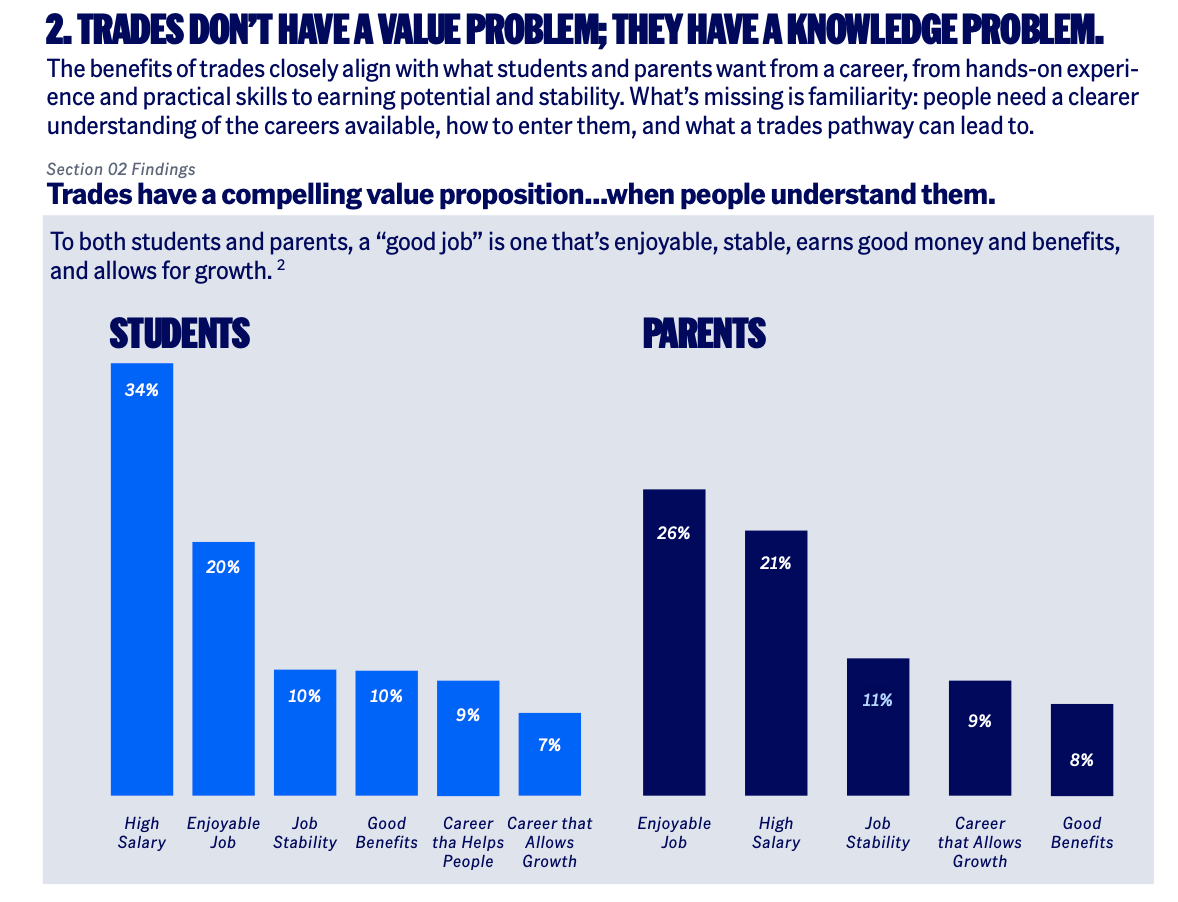
“Trades don’t have a value problem,” the report says. “They have a knowledge problem.” About 59% of students and 61% of parents say trade school options aren’t explained well at a young age. Only 54% of counselors recommend trades, versus 88% who recommend universities.
Parents are the biggest influence on teens, cited by 76%. Girls are even further from the trades. Boys are twice as likely to plan on one, 14% to 7%.
The campaign will lead with outcomes, Hillman said. Students and parents want “financial security, personal fulfillment, earning potential and stability,” she said, and the trades are “well-poised” to offer them. Those were the survey’s top motivators, at 59%, 44%, 42% and 39%.
The entrepreneurship pitch
Home Depot has been at this for quite a while and has welcomed Ford as a partner. Battin noted that the company launched Path to Pro in 2019 with $50 million and, just last week, added $13 million for Skills Explorer, a program for ages 11 to 17 run with the Boys & Girls Clubs and Scouting America.
Entrepreneurship is part of the pitch. Truby said his sons play hockey and the other “hockey families” usually started in “something that could be considered a skilled trade, and they built it into an entrepreneurial business.” This observation lands weeks after “The Everywhere Millionaire,” a thought-provoking popular economics book that found roughly 3 million owners of closely held businesses, similar to the hockey families Truby mentioned, hold about 13 times the wealth of the Forbes 400. Most started their own companies. Many of these were auto dealers, and many are undoubtedly Ford Pro members.
Battin agreed that companies should celebrate the stories of tradespeople, “how they’ve gone on to build these incredible businesses and the success that they’ve had.” They should be showcased in a different light, she argued, because while people may not think about it “what they’ve been able to build is really tremendous.”
Truby’s advice to his sons is to look at work differently. “If you like working with your hands, if you like that feeling when you create something… really open your eyes to it,” he said.
For this story, Fortune journalists used generative AI as a research tool. An editor verified the accuracy of the information before publishing.
Disclaimer : This story is auto aggregated by a computer programme and has not been created or edited by DOWNTHENEWS. Publisher: fortune.com