
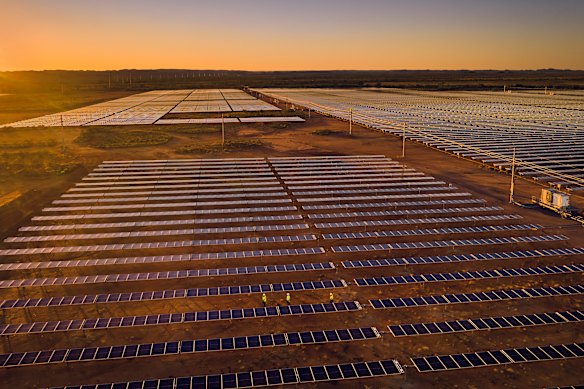

Mining giant Fortescue, which is rapidly switching its vast Pilbara iron ore operations to run on electricity, is pushing for reform of the country’s diesel tax credits which it says are an unnecessary “handout” to the mining industry worth billions of dollars.
Fortescue, founded by billionaire Andrew Forrest, said it will target the diesel tax credits in a national television and radio campaign that highlights the “imbalance at the heart of the current policy, contrasting the cost-of-living pressures faced by everyday Australians with the billions of dollars in tax credits flowing to the mining industry.”
Australia’s largest miners get the lion’s share of an estimated $11 billion returned to businesses each year under the Fuel Tax Credit Act 2006, which effectively subsidises the use of diesel, with much of the fuel imported.
The US-Israel war on Iran and the blockade of oil tanker traffic in the Strait of Hormuz has caused an escalating global fuel shock which sent unleaded petrol and diesel pump prices soaring in Australia. High fuel prices, unleaded is above $2 a litre and diesel more than $3, are causing distress for households and businesses already struggling with other cost pressures and rising interest rates.
The Albanese government’s temporary halving of the fuel excise will provide some relief to motorists, but the measure ends on 30 June. Treasurer Jim Chalmers is considering other cost of living measures to ease the oil shock’s hit on consumers in the upcoming federal budget.
The Westpac-Melbourne Institute’s consumer sentiment index fell 12.5 per cent in April, its biggest monthly fall since the pandemic and fears of job losses are mounting, reaching their highest level in a decade excluding the pandemic.
Fortescue, itself one of the largest recipients of the diesel tax credits, is calling for a $50 million annual cap per company, saying the reform is both fair and economically responsible. A cap would save the federal budget an estimated $2.46 billion annually – with savings expected to grow significantly over time, it says.
The miner claimed $308 million in tax credits in financial year 2025 on 600 million litres of diesel.
Fortescue chief executive Dino Otranto said the scale and unfairness of the diesel tax handout was not properly understood. “This diesel tax handout is meant to support essential industries, not deliver outsized benefits to the biggest players,” he said.
“At a time when families are cutting back and small businesses are doing it tough, it is reasonable to ask whether this is the best use of taxpayer money. Clearly, it is not.”
Fortescue’s position is unlikely to be popular with rival miners.
The Institute for Energy Economics and Financial Analysis estimates mining accounts for 35 per cent of Australia’s annual diesel fuel use of about 10 billion litres, and the government provides about $4.5 billion a year to keep it operating. Rio Tinto uses about 1.6 billion litres of diesel a year, two-thirds of which powers its Pilbara vast iron ore business.
The Institute said that, unlike on-road heavy vehicles where rebates are tied to vehicle emission standards, mining’s fuel tax credits are uncapped and growing.
Earlier this month, Fortescue said it was accelerating building a green energy grid powered by solar and wind in the Pilbara over the next 18 months with the aim of eliminating fossil fuels from its operation by 2030. The company expects to generate 2 gigawatts of power, enough to runs its operation, backed up by 4-5 gigawatt hours of battery storage.
It expects to save $US100 million ($140 million) in fuel costs by next year, it said.
The Business Briefing newsletter delivers major stories, exclusive coverage and expert opinion. Sign up to get it every weekday morning.
 Simon Johanson is a business journalist at The Age and The Sydney Morning Herald.Connect via X or email.
From our partners
Disclaimer : This story is auto aggregated by a computer programme and has not been created or edited by DOWNTHENEWS. Publisher: www.smh.com.au


