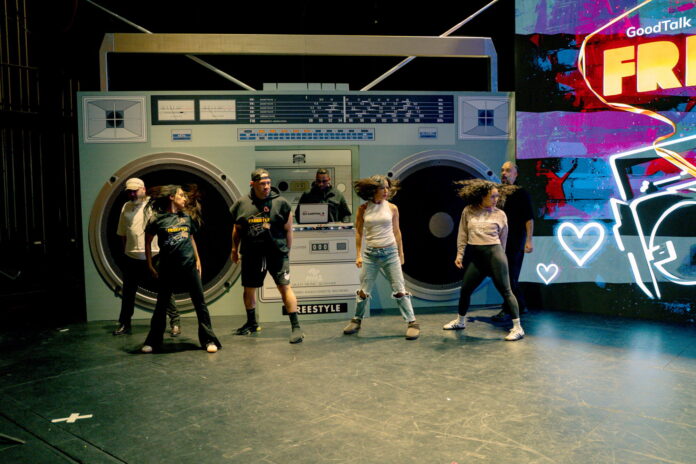
Starring Justina Machado and featuring singer Judy Torres, the 1980s-inspired musical “Freestyle: A Love Story” will make its Los Angeles debut on Nov. 6 at the Wilshire Ebell Theatre.
Bronx-born musician and producer Judy Torres remembers the first time she heard Nayobe’s 1985 song “Please Don’t Go”: the upbeat dance track with an infectious bass line and love-struck lyrics that pleaded with a lover to stay close.
“ I was floored at how beautiful of a vocalist she was,” said Torres of the Afro-Cuban artist, who hailed from Brooklyn but found a musical home in the genre known as freestyle. Though sometimes dubbed as “Latin freestyle” or “Latin hip-hop,” thanks to the many Latino vocalists who came to shape its sound, some fanatics trace the origins of the electro-funk genre to “Let the Music Play,” the 1983 smash hit by D.C. singer Shannon.
As Torres puts it, this distinctly 1980s sound — crafted with synthetic instrumentation and syncopated percussions sourced from Roland TR-808 drum machines, as popularized by Afrika Bambaataa’s 1982 single “Planet Rock” — didn’t have a label then. “It was just music,” she says.
But by 1993, as prominent radio stations transitioned from dance-pop to hip-hop and R&B, the freestyle movement fizzled out.
“Like a record scratch, there were no shows,” added Torres.
The genre’s vibrant, knotty history of set the scene for the musical-dance production of “Freestyle: A Love Story,” of which Torres is a co-producer. Created and directed by George Valencia — alongside his wife, “Scrubs” actor Judy Reyes as executive producer, plus “Ugly Betty” actor Ana Ortiz as co-producer — “Freestyle: A Love Story” will make its Los Angeles debut on Nov. 6 at the Wilshire Ebell Theatre.
The musical tells the fictional story of two middle-aged Caribbean Latinos, who reunite during a nostalgic night at a Freestyle Extravaganza at New York’s Radio City Music Hall. As 808 kicks echo through the atmosphere, the pair is transported back to 1987: the night they fell in love at a bass-thumping freestyle show.
Proceeds from the night will benefit the Sound of GOL Foundation, an organization founded by George Valencia and Judy Reyes that supports Latina soccer players.
(From George Valencia)
“The idea of telling a love story and having that love story run parallel with the actual musical movement of freestyle, which lasted nine years, is basically the whole framework of the play,” said Valencia to De Los.
Proceeds from the night will benefit the Sound of GOL Foundation: an organization founded by Valencia and Reyes, which supports Latina soccer players.
“Right now, in a time that is looking very dark for Latinos in the United States, I want people to take away that our history has proven time and time again that no matter what they do to us, they can’t take away our revolutionary joy,” added Valencia, making mention of the Trump administration’s mass immigration sweeps.
The production will star “One Day at a Time” actors Justina Machado and James Martinez as the former lovers — as well as Torres and K7, a.k.a. Louis Sharpe, frontman of the Latin freestyle group TKA, who will further bring the artists’ perspectives into the narrative.
“It’s the music that was a part of our everyday life,” Machado told De Los. “Wherever there was a huge Latino population, I think it was kind of a rite of passage.”
Machado was particularly obsessed with Lisa Velez, the lead vocalist of Lisa Lisa & Cult Jam, who took freestyle to new heights. The group’s breakout 1985 single “I Wonder if I Take You Home” echoed in the dance clubs before crossing over into mainstream radio and landing the No. 34 spot on the Billboard Hot 100.
Their flamboyant track “Head to Toe,” hit No. 1 on the Billboard Hot 100 in 1987, making it the first time a Latina vocalist (as part of a group) topped the chart.

“When I was on ‘One Day at a Time,’ they knew I loved Lisa Lisa so much they hired her to perform at the wrap party for Season 1,” recalled Machado. “I have a video from 10 years ago, where I am just freaking out — ‘Is that Lisa Lisa?’ I swear I saw nobody else. It was just me and Lisa Lisa … She was my hero.”
Torres said she lost her mind when someone told her Lisa Lisa was Puerto Rican, just like herself. She recalled thinking: “If she can do it, maybe I can do it,”
By 1996, Torres would release her first single, “No Reason to Cry,” a punchy, melodramatic dance track ghostly vocals that reassure someone of her love.
That song reached No. 30 on the Billboard Hot Dance chart the following year. The track was the lead single from her 1989 debut album, “Love Story,” an electrifying project that sonically transports listeners into dramatic telenovela scenarios.

“Freestyle was the original Latin explosion, because it was created in New York, by the people of New York,” said Torres. “It was street kids, Hispanic kids. All of a sudden, the fans were realizing, ‘Wait a minute — this music represents us, the artists look like us.’ It took off so quickly that many of us were signed by major record labels. We were performing all over the country. We had several shows a weekend.”
Still, prominent Latino artists with Spanish surnames, including Torres, were often told they had to change their last name in order to appeal to pop radio stations. She included these experiences into monologues during “Freestyle: A Love Story.”

“Freestyle music was never given flowers,” said Judy Torres.
(From George Valencia)
The artist known as Soavé, who sang the hypnotic 1989 hit “Crying Over You,” revealed to music magazine Wax Poetics in 2010 that his birth name, which is Jeffrey Martinez, “wouldn’t have sold a record.”
Meanwhile, Puerto Rican singer George Lamond, whose 1990 single “Bad of the Heart” peaked at No. 25 on the Billboard Hot 100, professed that he dropped his surname, Garcia, at the behest of his label, Colombia Records. In an interview with Youtuber Honey German, the artist said the label argued that he needed to be more marketable to audiences — but in reality, they didn’t know how to market an artist who was neither Black nor white.
“Now, did I get airplay on the pop stations? No. Is it because I decided to keep [the name] Torres? I’ll never know that,” said Torres. “In a way, we opened the doors [for future Latin stars], because now it’s common for us to hear the last names. Jennifer Lopez, Selena Gomez, Christina Aguilera.”
Torres acknowledged that “freestyle music was never given [its] flowers.” But with “Freestyle: A Love Story,” fans and artists alike can take “a trip back into time” and revel in its glory for an evening.
“I can’t change it,” said Torres of freestyle’s eventual sunset. “So I have to choose how I’m gonna move forward.”
More to Read
Disclaimer : This story is auto aggregated by a computer programme and has not been created or edited by DOWNTHENEWS. Publisher: latimes.com