
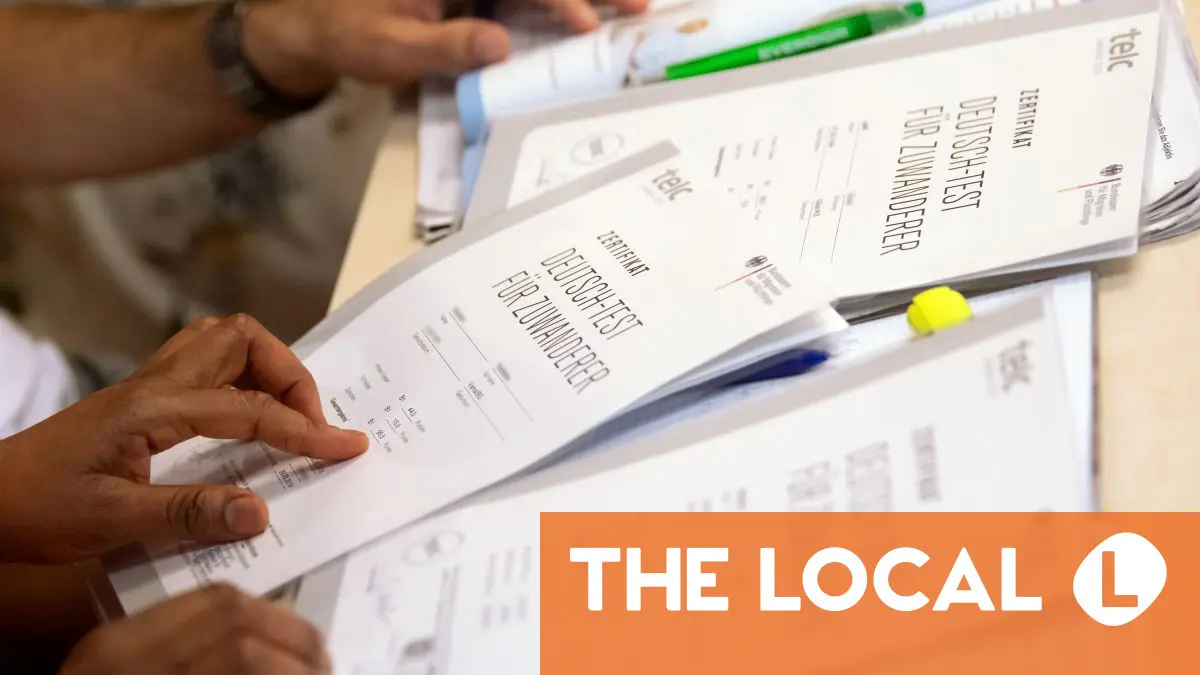
Foreign residents taking integration courses in Germany could soon face stricter rules when taking the main state-backed language exam.
For many newcomers to Germany, passing an integration course can be an important step towards long-term residence and, later on, citizenship.
Now Interior Minister Alexander Dobrindt wants to change the rules for the language exam at the end of that course, arguing that some participants have been exploiting a loophole in the current system.
According to a draft regulation first reported by Bild and later confirmed by a spokesperson for the Interior Ministry, new rules are due to take effect on November 1st.
The change concerns the German Test for Immigrants (Deutsch-Test für Zuwanderer, DTZ), which is the language examination taken at the end of Germany’s integration course.
At present, test-takers can achieve an overall result of B1 or A2 if they reach the required level in the speaking section and in at least one of the two written components: either listening and reading, or writing.
READ ALSO: LISTED – The best free websites and apps for German language learners
The Interior Ministry now wants to tighten those rules. Under the planned change, an exam would no longer be considered passed if one section is missed, even if strong results elsewhere would have previously been enough to secure an overall pass.
The ministry says the measure is intended to improve the security of the test and prevent abuse.
What is the DTZ and who takes it?
The German Test for Immigrants (DTZ) is one of the country’s most important language exams for newcomers and forms part of the final assessment for people who attend Germany’s state-funded integration courses.
The exam tests listening, reading, writing and speaking skills through everyday scenarios that immigrants are likely to encounter in Germany. Last year, 318,550 people took the test, according to figures cited by the Interior Ministry.
Of those candidates, 175,193 (55 percent) achieved the target B1 level, while 102,663 (32.2 percent) reached A2 level and 40,694 (12.8 percent) fell below A2.
READ ALSO: ‘Make effort early’ – Foreigners share how much German you need to live in Germany
Passing the DTZ at B1 level, together with the “Life in Germany” test, allows participants to receive an Integration Course Certificate. It can also be used to meet language and integration requirements linked to some residence procedures, including settlement permits.
The DTZ is primarily taken by participants in Germany’s integration courses, whereas people applying for residence permits or citizenship can meet language requirements through other recognised qualifications, depending on their individual circumstances.
How are people said to be cheating?
The Interior Ministry claims that some participants have obtained test questions and answers for the listening and reading section online before sitting the exam.
According to the draft regulation cited by Bild, some candidates allegedly achieved strong marks in the multiple-choice listening and reading tasks using memorised answers while leaving the writing section completely blank.
READ ALSO: ‘It’s too easy’ – The verdict on how Germany’s citizenship test should be changed
Because the current scoring system allows candidates to reach the required overall level through strong performance in other parts of the test, they could still pass if they also met the required standard in the speaking section.
The planned rule change is intended to prevent candidates from compensating for a missing or weak writing performance with higher marks elsewhere.
How much evidence has been provided?
The Interior Ministry has said there has been an “increasing number” of cheating attempts and cited concerns about test materials being shared online.
However, according to Welt, a ministry spokesperson was unable to say how many cases had been detected. No figures or published evidence have so far been provided to show how widespread cheating is on the DTZ cheating.
The announcement comes amid a broader push by Dobrindt to tighten parts of Germany’s integration and migration system.
Since taking office, the conservative CSU politician has sought to restrict access to integration courses for some groups of immigrants and also reduce funding for the programme.
Critics, including education providers and some coalition politicians, argue that integration courses remain one of Germany’s most effective tools for helping newcomers learn German and find work.
But cheating on language and citizenship tests is not unheard of in Germany. Earlier this year, police in Nuremberg announced an investigation into an alleged network that used stand-ins with forged identity documents to take language and naturalisation exams on behalf of immigrants.
Authorities described that operation as large-scale, but said it involved less than 100 cases.
That investigation concerned proxy test-taking rather than the specific DTZ loophole cited by the Interior Ministry in its latest proposal.
READ ALSO: ‘Short-sighted’ – Cutting access to integration courses in Germany doesn’t make sense
Disclaimer : This story is auto aggregated by a computer programme and has not been created or edited by DOWNTHENEWS. Publisher: thelocal.de




