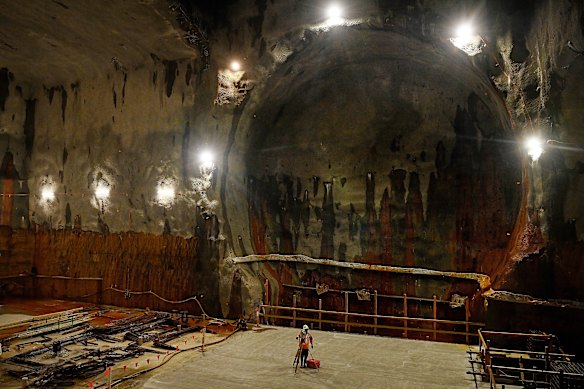

Up to 50 metres beneath Sydney’s lower north shore, two giant caverns have been carved out for what will be the climax in construction of the city’s third harbour motorway crossing.
Early next year, the first of two boring machines, each weighing 4400 tonnes, will break through into one of the caverns, completing one of the last sections of twin tunnels for the $7.4 billion project. The second machine will repeat the spectacular finish months later.
Yet the engineers and legion of workers toiling away deep underground on the Western Harbour Tunnel project are careful not to get ahead of themselves.
Despite reaching the halfway mark of its 1.5-kilometre journey from large caverns beneath Birchgrove, the boring machine named Patyegarang will begin the riskiest part of its trip later this month. That will involve scrapping through a 200-metre section of clay, silt and sand under the harbour.
“This is where the real engineering starts. It’s been a real challenge for us to be able to understand the ground conditions. We have brought experts from around the world,” Transport for NSW project director Simon Cooper said.
“This is engineering through softer ground that, 10 years ago, people thought might not be feasible. I’ll breathe a sigh of relief once we get to the other side.”
Ahead of the riskiest part, Patyegarang has had a “big pit stop” deep beneath the harbour, which has involved changing about 100 cutter discs – or “teeth” – mounted on its front. The second boring machine – called Barangaroo – is due to pass through the so-called paleo channel by March.
“We’re working 24/7 to make sure the machine keeps moving [through the paleo channel]. That is the key thing,” Cooper said.
Once they reach the finish line next year, the cutter heads mounted on the front of the two boring machines will be removed and buried to the side of each cavern, while the rest will be pulled apart and trucked out for reuse on other projects.
Each up to 23 metres high, 35 metres wide and 34 metres long, the so-called receival chambers are an engineering feat in their own right.
It took about six months to excavate them, waterproof their ceilings and inject the ground with grout to limit water from entering. Temporary gantry cranes will later be erected to lift out large pieces of the 137-metre-long boring machines.
Construction of the caverns has avoided having to dig deep shafts from the surface, and disrupting Waverton residents.
Cooper said it was uncommon for cutter heads from boring machines to be buried after tunnelling, although it was done for construction of the Channel Tunnel linking France to the UK.
“The challenge with this project is doing very large logistics in tiny confined spaces,” he said.
“It’s like a game of chess. You have to match your steps properly. Otherwise you’ll end up boxing yourself in or doing stuff which is not ideal.”
Once complete, the three-lane tunnels will link the Warringah Freeway on the north shore to the WestConnex toll road at Rozelle, in the south.
NSW Roads Minister Jenny Aitchison said it was difficult to comprehend the scale of what crews were building beneath Sydney. “Every metre of tunnelling brings us closer to giving motorists another way to cross the harbour, taking pressure off existing routes and building a more connected, resilient Sydney,” she said.
The width of each of the tunnels under the harbour is almost 16 metres, compared with the seven-metre-wide tunnels dug for Sydney’s metro rail lines. That makes each tunnel for the motorway large enough to fit three metro rail tunnels.
The entire 6.5-kilometre motorway is due to open for traffic in late 2028, easing congestion on a key part of Sydney’s road network as an alternative to the Harbour Bridge and Harbour Tunnel.
Start the day with a summary of the day’s most important and interesting stories, analysis and insights. Sign up for our Morning Edition newsletter.
 Matt O’Sullivan is transport and infrastructure editor at The Sydney Morning Herald.Connect via X or email.
From our partners
Disclaimer : This story is auto aggregated by a computer programme and has not been created or edited by DOWNTHENEWS. Publisher: www.smh.com.au