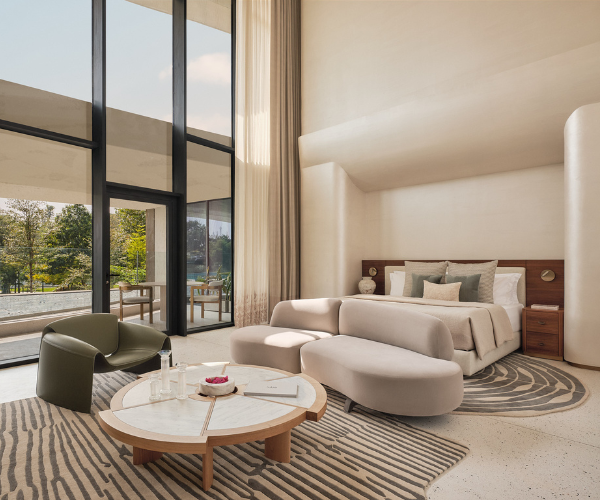
Somewhere in the hills of northern Kerala, India, across 30 acres of medicinal gardens and rewilded forest, stands a place that resists every category you might try to place it in. Called Tulåh Clinical Wellness, it’s a rather singular sort of sanctuary, where genome testing precedes visitors’ arrivals, where the air itself is medicine (cooled through water circulating Tulåhhe building’s walls rather than through conventional air conditioning, where the ventilation systems are individual to each room), and where a 99-year-old Ayurvedic physician’s counsel carries the same authority as a JCI-accredited specialist’s. It is the kind of place the wellness world has been searching for: genuinely luxurious, deeply rooted in science, both modern and traditional. To truly receive what Tulåh offers, guests have to show up willing—willing to slow down, to be disciplined, and to let the place work on them.
The story of how it came to exist is a deeply personal one. Faizal Kottikollon, the founder and chairman of KEF Holdings, has built businesses spanning steel, prefabrication, and digital-first advanced hospitals. However, Tulåh was born from something far closer to home—a health scare in 2022, when his left hand went numb and an MRI in Singapore revealed cervical myelopathy, a degeneration of the nerves in his neck. His own doctors at Meitra Hospital in Calicut, India, the hospital he founded, gave him the same advice that surgery was the only way forward. Instead, he found his way to Kottakkal Ayurveda Hospital and consulted with its 99-year-old physician, Mr. P.K. Warrier, who told him the nerves could be regenerated in 21 days. “Then I didn’t have an option,” Kottikollon recalls. “I said, what’s wrong with trying? Because everything needs to go through an experience.” He completed the program and returned to Singapore for a second MRI, and when the results came back, the nerves had regenerated, and within six months, his condition had resolved entirely.
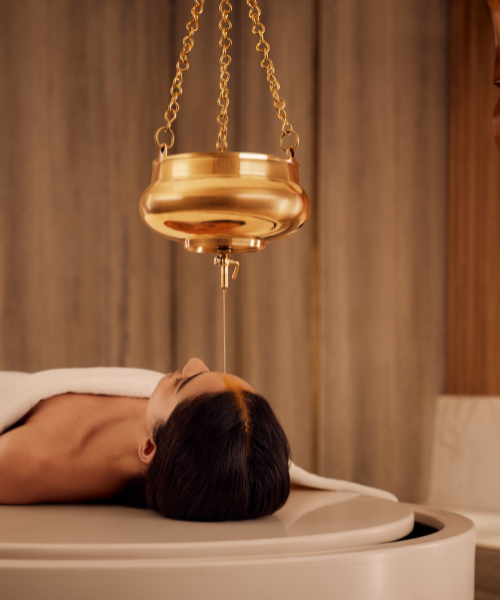
Energized by what he had witnessed, Kottikollon brought together practitioners from functional medicine, modern medicine, Ayurveda, and yoga, running trials across 100 patients at Meitra Hospital, studying lifestyle diseases including diabetes, cholesterol, and blood pressure. The results were significant enough to publish, and that data gave him the conviction that there was a new way of thinking about healthcare altogether, one that would eventually become tulåh.
The project started at $40 million and has since grown into an investment of over $100 million, the expansion driven entirely by discovery. Sound healing opened up as a discipline, and Tulåh now houses the world’s largest sound healing dome, the Sonorium, designed for nervous system regulation. Clinical yoga emerged as its own modality, drawing from Iyengar traditions and woven through with rehabilitation science in a way that addresses musculoskeletal healing far beyond what a conventional yoga class might offer. “We started expanding our horizon,” he says. “We did not stop at Ayurveda. We said, Why don’t we look at all the ancient modalities and look at the human being as a whole?”
That idea, the human being as a whole, sits at the very center of what Tulåh is responding to. Kottikollon’s critique of conventional medicine is a structural one, rooted in the observation that modern healthcare reduces people to their organs, with physicians spending no more than ten minutes with a patient. In ten minutes, as he asks pointedly, what can you truly understand? His research found that between 60 and 70 per cent of people arriving with health issues were suffering, at their root, from chronic stress. And so Tulåh was designed around that reality, from the Vedanta classes held twice daily, pre-religious and philosophical, rooted in the question of how to live more meaningfully, to the rituals that begin at sunrise, when guests are guided outdoors to receive the morning light; Tulåh is committed to well-being across the spectrum.
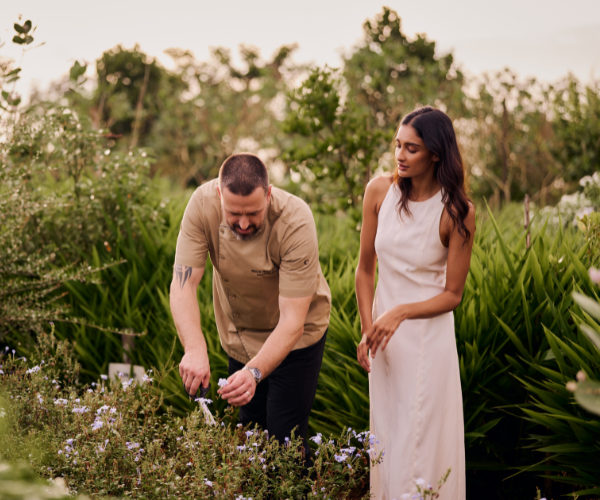
The choice of Kerala was equally deliberate. The region’s Western Ghats have preserved Ayurvedic practice in an almost unbroken lineage, and the 742 medicinal herbs catalogued in the 17th-century Hortus Malabaricus, documented by the Dutch governor when they were based in Cochin and now held in the Amsterdam Museum, represent the oldest official pharmacopoeia in the world. “The practices passed on through generations still exist there,” Kottikollon explains. And where other well – ness destinations dress Ayurveda in luxury packag – ing, tulåh grounds it in evidence, with every guest undergoing blood marker analysis, genome testing
and microbiome assessment before setting foot in the sanctuary. Those same tests are repeated on departure, the gap between the two sets of results being the clearest measure of what a guest’s protocols have actually done. The one thing Kottikollon hopes guests carry home with them is deceptively simple. “Be disciplined and follow the routine,” he says, his own morning beginning at 5am, within what Vedic philosophy calls Brahma Muhurtam, the hours between 4am and 6am when the intellect is said to be at its clearest, going outside, receiving the early light, and practicing breathwork. “The moment a person is happy internally, they always want to give happiness to others.”
This giving philosophy runs through everything Kottikollon has built, something he traces to what Sanskrit describes as “vasanas,” the character one is born with, and it shapes the way he thinks about wealth too, as custodianship rather than possession. “The day you are born, the breath is given freely, and nature is given freely, but we feel that we own it. The moment ownership comes in, our ego goes higher,” he explains. Through the Faizal and Shabana Foundation, his philanthropy has touched over two million lives and transformed nearly 1,000 government schools, and Tulåh feels like the fullest expression yet of that same instinct.
“The world is suffering. The world is in pain,” shares the founder. “Tulåh is a project where you bring in thought leaders and inspire them.” At its heart, it is a place built from one moment of personal crisis and the decision to follow an inner voice, one that led to a new way of thinking about wellness, one that Kottikollon now wants to share with the world.
– For more on luxury lifestyle, news, fashion and beauty, follow Emirates Woman on Facebook and Instagram
Images: Supplied & Feature Image: Supplied
Disclaimer : This story is auto aggregated by a computer programme and has not been created or edited by DOWNTHENEWS. Publisher: emirateswoman.com