
Healthcare workers are demanding answers after NSW’s patient safety agency banned hospitals from using eco-friendly medical supplies in favour of single-use products that end up in landfill and cost taxpayers millions of dollars each year.
Clinicians have accused the NSW Clinical Excellence Commission (CEC) of siding with a multibillion-dollar manufacturer of disposable medical devices that would lose money if the sustainable products were widely adopted.
The stoush revolves around remanufactured materials, which are formerly single-use items that are reprocessed into new products approved by the Therapeutic Goods Administration (TGA) and used daily in every other state and territory. These materials include patient transfer mattresses, compression sleeves, tourniquets and blood pressure cuffs.
The CEC, in a letter to the TGA, said the commission was concerned about infection control, traceability issues, a risk of expansion into more critical care items, and the potential for the materials to mislead doctors and patients.
But a NSW Health employee who has researched the issue extensively said the CEC’s position is not backed by research.
“Their concerns are not evidence-based, they’re not valid, and we can answer all those concerns with evidence we have specifically gone and sourced ourselves,” said the employee, Charlie*, who spoke on the condition of anonymity for fear of repercussions.
The chief executive of the only locally based third-party remanufacturing company, Medsalv, said they had spent two years asking the CEC for further clarification on the ban, but the commission had been reluctant to engage.
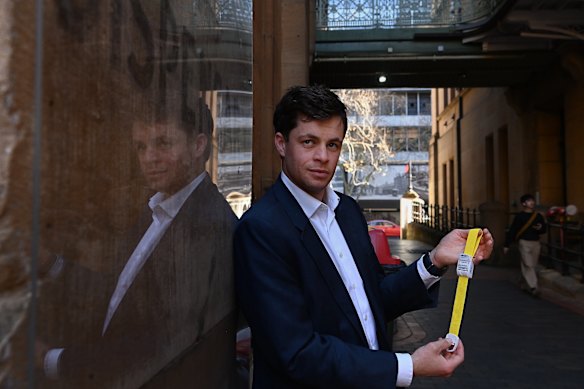
“I’ve engaged with them a number of times,” Medsalv chief executive Oliver Hunt said. “[I’ve tried to] explain how the regulations relate to medical devices and remanufactured devices specifically.
“The CEC is a patient safety organisation, its determination of functions is very clear. It hasn’t identified a patient safety issue here, so the question is, what is it doing here?”
Medsalv supplies more than 170 hospitals across Australia and New Zealand and has partnerships in every Australian state and territory except NSW.
Hunt said that Cardinal Health – one of the largest suppliers of medical devices in Australia, which booked a $US2.6 billion profit last year – had a pattern of intervening in Medsalv’s commercial relationships with hospitals across Australia.
The Herald has seen correspondence in which Cardinal Health representatives have lobbied in NSW hospitals to block Medsalv from collecting discarded medical products. This includes alleging that Medsalv was sending materials it had collected for remanufacturing straight to landfill, which Medsalv denies.
Cardinal Health has announced plans for its own remanufacturing facility.
In the letter to the TGA, the CEC advocated a regulatory distinction between remanufacturing by a third party (such as Medsalv) and by the original manufacturer (such as Cardinal Health), citing concerns about intellectual property rights.
“Remanufacturers do not hold the IP or technical specifications,” the letter said, contributing to the CEC’s “significant concern” about third-party remanufacturing.
The letter said that third-party remanufacturers may have “inadequate decontamination procedures”.
The CEC did not respond to questions about how intellectual property concerns were within its scope as a patient safety agency, or about its relationship with Cardinal Health.
“It asserts that third-party remanufacturing is somehow inferior,” Hunt said. “I think that it’s concerning to have a public official providing correspondence to a federal regulator without any evidence to support that position.”
The CEC has also raised concerns that remanufactured products could be repackaged and sold as new items, with no disclosure to patients or treating health workers.
“That is categorically untrue,” Charlie said. “All the devices are barcoded, so they’re trackable through the system: Where they go to, how many times they’ve been through.
“Original devices don’t have any such system, so it’s arguable that the remanufactured devices are actually safer, and easier to track.”
In a statement, a CEC spokesperson said it was awaiting updated guidance from the TGA, which was expected by the end of the year.
“Patient safety systems are working at their best when they identify and mitigate risks before patient harm occurs,” the spokesperson said.
A TGA spokesperson said that all manufacturers – remanufactured or otherwise – must hold evidence demonstrating compliance with regulatory requirements.
“Remanufactured medical devices supplied in Australia must meet the same requirements for safety, quality and performance as other medical devices,” the spokesperson said in a statement.
Charlie has spent two years advocating for remanufacturing in collaboration with colleagues.
When they explain the stoush to outsiders: “People go, ‘Is it really that high risk? Are you trying to put implantable devices from the bin into a newborn baby?’ [and] We go, ‘No – it’s a tourniquet’.”
Remanufactured medical devices are commonplace in Britain, the US and Europe, but are relatively new to the Australian market.
“In the US, it’s a multibillion-dollar industry,” said Forbes McGain, the University of Melbourne’s associate dean for healthcare sustainability and a physician who uses remanufactured devices in his practice.
“Reprocessing has been shown to be safe over many years in the US, under the watch of the FDA, [which] approved it long ago.”
Hunt said that his company cleans and tests all devices in its Geelong facility – they check if they’re inflating or stretching, if their clips work – before repackaging them and selling them back to hospitals.
He said that single-use devices are often labelled as such for commercial rather than safety reasons.
“Big [healthcare] companies tend to want to make things in a low-wage economy somewhere … ship it along a long supply chain, chuck it into a high-wage economy, and sell it for as much money as they can, and they really don’t mind what happens after.”
It costs the NSW government at least $16 million a year to dispose of the estimated 52,400 tonnes of waste that hospitals generate, according to 2021 research by not-for-profit body Circular Australia. This is equivalent to the weight of the Sydney Harbour Bridge.
“About 8 per cent of all waste in NSW is generated from the healthcare sector,” said Dr Anthony Hull, an anaesthetist and the NSW committee co-chair of Doctors for the Environment Australia.
“That’s a very, very large amount of waste, and a lot of it relates to single patient use items and [their] packaging.”
NSW Greens health spokesperson Dr Amanda Cohn said remanufacturing should be a “no-brainer” for NSW Health.
“It’s not just the right thing to do for the environment by reducing waste to landfill, it’s cost savings that can be reinvested in over-stretched public healthcare,” she said.
NSW Health Minister Ryan Park said he understood that the CEC was working closely with the TGA on the matter to ensure that patients were not put at risk.
Long term, both Hull and McGain want reusable products used in healthcare instead of remanufactured materials that are eventually thrown away – Medsalv’s devices can be remanufactured only up to 14 times.
NSW Health, in a statement, said it supported initiatives that reduced waste and environmental impact while maintaining safe, high-quality care.
“We will continue to monitor and work closely with the TGA and other jurisdictions to ensure any future decisions about remanufactured single-use medical devices are guided by patient safety, quality of care, and infection prevention controls.”
From our partners
Disclaimer : This story is auto aggregated by a computer programme and has not been created or edited by DOWNTHENEWS. Publisher: www.smh.com.au