
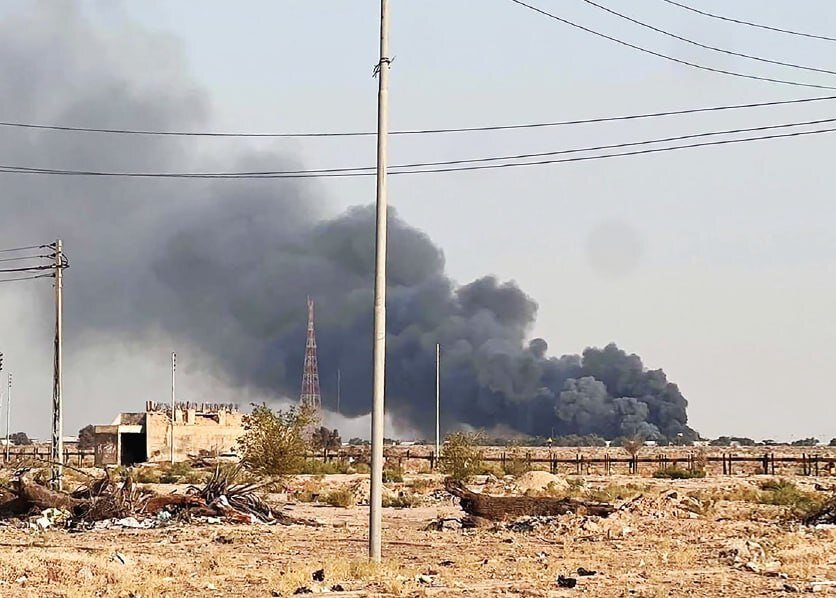
TEHRAN – The continuous military strikes executed by the United States against Iran in blatant violation of the recent interim agreement mark yet another severe miscalculation in Washington’s historically hostile approach toward the Islamic Republic.
The US military’s Central Command (CENTCOM) announced that it had targeted approximately 140 sites in Sunday’s waves of strikes, hitting several southern coastal installations, missile and drone launch positions, ammunition depots, and critical communications infrastructure. Loud explosions echoed across the strategic southern port cities of Bandar Abbas, Sirik, Chabahar, Bandar-e Deyr, Jask, and Asaluyeh. Local media confirmed that an Iranian navy officer was martyred during the early morning aggression. While CENTCOM claimed the strikes were launched in response to an Iranian operation against a commercial vessel in the Strait of Hormuz, the reality on the ground reflects a desperate superpower unable to enforce its dictates.
In a swift and crushing retaliation, the Iranian Armed Forces launched precise counter-strikes targeting US military installations spread across Jordan, Kuwait, Bahrain, Qatar, and Oman, while simultaneously declaring the strategic Strait of Hormuz closed until further notice. Fars News Agency reported on Sunday evening that Iran also launched three ballistic missiles toward the Al Mina area in Kuwait, targeting the launch site of US ATACMS missiles. According to the reports, three US soldiers were killed in the strike.
The Iranian authority controlling the Strait of Hormuz in the Persian Gulf said on Sunday the waterway is closed to all transit following recent “illegal movements” by US military forces in the region.
In a brief announcement on its X account, the Persian Gulf Strait Authority (PGSA) said passage through the Strait of Hormuz is currently unavailable.
In a statement released early Sunday, the Public Relations Office of the Islamic Revolution Guards Corps (IRGC) declared that the United States had sought to “once again test what has already been tested.” The IRGC noted that Washington attempted to impose its will on the Omani government and deliberately provoked regional tensions through the illegal movement of several warships south of the Strait of Hormuz. According to the IRGC, its Aerospace Force successfully struck key American military infrastructure at Jordan’s Prince Hassan Air Base during the opening phase of the retaliatory operation. In a subsequent statement, the IRGC confirmed that a second offending foreign vessel violating maritime regulations in the Strait of Hormuz was struck and brought to a definitive halt, warning: “The American-Zionist enemy should know that the continuation of its aggression will bring even more crushing responses.”
Concurrently, the Iranian Army’s Public Relations Office announced it had deployed waves of self-destructive drones against US military assets in Kuwait and Bahrain in response to aggression in southern Iran. The Army detailed that its precision drones successfully targeted a Patriot air defense system, a primary ammunition depot, and a tactical radar site operated by the US military in Kuwait. A second wave hit a critical US military communications hub and radar installation in Bahrain. The Army explicitly warned that full responsibility for the consequences of these hostilities and the resulting insecurity in the region rests squarely with the “American-Zionist enemy,” emphasizing that any repeat of these missteps would be met with far more severe responses.
These fresh US attacks stand in clear violation of the 14-point memorandum of understanding (MoU) signed between Tehran and Washington on June 17, which explicitly called for a permanent end to hostilities on all fronts and committed both sides to final agreement negotiations within 60 days. Under Article 5 of that very agreement, the US had officially accepted Iranian management of the Strait of Hormuz in collaboration with regional neighbors. Merchant vessels can only transit the strategic waterway through direct coordination with Iran—a reality established since the US and Israel launched their broader war of aggression on February 28.
That war, which was briefly paused by a Pakistani-mediated ceasefire on April 8, saw the US-Israeli axis martyr thousands of Iranian citizens, the vast majority of whom were civilians, alongside the initial martyrdom of the Leader of the Islamic Revolution, Ayatollah Seyyed Ali Khamenei, and senior military commanders. In response to that initial aggression, Iran executed 100 waves of drone and missile strikes that dealt severe blows to US military infrastructure. The subsequent enforcement of Iran’s sovereignty over the Strait of Hormuz triggered soaring global fuel prices and inflation, driving Donald Trump’s domestic popularity to near-record lows and forcing him to accept the April 8 truce. Trump’s recent claims that the ceasefire outlined in the June MoU is “over”—while simultaneously trying to keep the door open for talks—only highlight the erratic nature of his administration’s foreign policy.
While the original US-Israeli war goals were aimed at decimating Iran’s military might and forcibly altering the country’s leadership, senior global officials, alongside admissions in US and Israeli media, have widely described Iran as the definitive strategic winner of the conflict. Washington completely failed to forcibly reopen the waterway during 39 days of active warfare, and it failed to dictate terms at the negotiating table. The latest round of strikes indicates that the US is repeating its historical miscalculations, vainly attempting to dominate the strategic strait through raw force.
As Mohsen Rezaee, an adviser to Iran’s Leader, observed, the Strait of Hormuz remains “one of the vital components of the country’s deterrence and plays a decisive role in ensuring security and national interests.” Rezaee firmly added, “Hormuz acts as a strategic deterrent, and Iran will protect the country’s interests and security by relying on its defense capabilities and national strength.”
The volatile escalation of threats and unilateral actions by Trump represents a transparent attempt to mask a profound strategic crisis, offering bombastic rhetoric to divert global attention from Washington’s tangible failures on both the battlefield and the diplomatic stage.
By authorizing fresh strikes and declaring the ceasefire void, the US president is actively trying to gloss over the reality that his administration has been decisively defeated in its military objectives. The failure of the US military to force open the Strait of Hormuz during the height of the conflict, coupled with the immediate and devastating precision of the IRGC and Iranian Army counter-strikes against American regional bases, has completely shattered the myth of Western conventional supremacy. Trump’s reliance on theatrical bellicosity underscores a desperate effort to control the domestic political narrative as the economic fallout of the war—manifested in rampant domestic inflation and soaring energy costs—erodes his political survival at home.
Diplomatically, the immediate US violation of the June 17 memorandum of understanding exposes the structural bankruptcy of Washington’s statecraft. Rather than operating from a position of strength, Trump’s sudden pivot back to force reveals a total inability to secure concessions through legitimate diplomacy, rendering US signatures meaningless in the eyes of the international community. Tehran’s disciplined enforcement of exact reciprocity has effectively trapped Western planners in an asymmetric dilemma where every act of aggression is met with immediate, cost-inflicting countermeasures against American infrastructure. Trump has failed to realize that empty threats and localized airstrikes can neither erase the strategic victory achieved by Iran nor alter the permanently shifted balance of power in West Asia, where the limits of US-Zionist military coercion have been fundamentally exposed.
Disclaimer : This story is auto aggregated by a computer programme and has not been created or edited by DOWNTHENEWS. Publisher: tehrantimes.com





