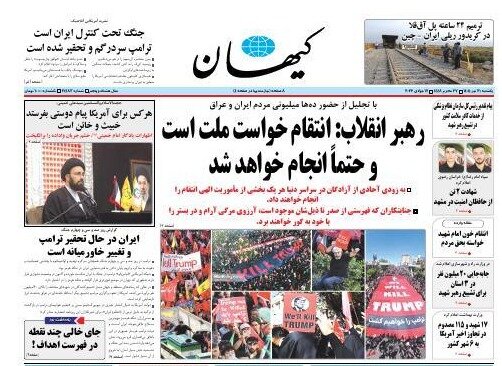
Kayhan dedicated an article to the recent US attacks on Iran’s infrastructure. It wrote that the terrorist US military has continued its aggressive strikes on Iran, targeting not only coastal infrastructure along the Persian Gulf, the Sea of Oman, and southern islands, but also two corridor points in Iran’s northeast.
Iran must not tolerate continued attacks on its infrastructure and should impose painful consequences on the enemy. Striking essential US and allied infrastructure is the only effective deterrent against further attacks. While targeting US bases in Bahrain and Kuwait is described as positive, Kayhan insists it is not sufficient on its own. These seemingly civilian infrastructures have long supported US and Israeli operations since the 12‑day war. The piece concludes that although the US, Israel, and Europe have a regional plan, Iran’s deterrent and punitive actions—such as the 40‑day war—will defeat it.
Iran: A special message to the United States
The Iran newspaper interviewed Sabah Zangeneh, former Iranian ambassador and OIC representative, about the large Iraqi turnout at the funeral of Iran’s Leader. One of the key messages of this event was directed at the United States. The ceremony demonstrated that Ayatollah Khamenei’s social, cultural, and political standing in the region is far greater than some US political circles assume. The main message is the emphasis on the unifying capacity of nations and the importance of mutual respect among states. If some governments have misjudged Iran’s position and the role of its leaders, Zangeneh says this is an opportunity to revise their views and move toward mutual understanding. Regional stability will only emerge when dialogue, cooperation, and respect replace confrontation, pressure, and destabilizing actions.
Etemad: Redefining the regional balance of power
Political analyst Gholamreza Karimi spoke with Etemad about the nature of the latest US attacks on southern Iran. He argues these strikes cannot be seen merely as an immediate reaction to recent incidents. Instead, he calls them “a turning point in a long-term strategic competition.” The core issue is not a few tankers but control over the world’s most important energy chokepoint—the Strait of Hormuz—and the rules governing the Persian Gulf. From Washington’s perspective, Iran’s insistence on maximum control over the Strait after the recent understanding created conditions for a new round of attacks, leading to a broad military response across five Iranian provinces. Karimi describes this as a “strategic warning” meant to raise the cost of any unilateral Iranian action. Tehran and Washington are both trying to redefine the regional power equation, and the current confrontation is part of a prolonged struggle over Iran’s place in the Persian Gulf security order.
Arman-e-Emrooz: Entering an era of developmental deterrence through smart governance
Ehsan Chitsaz, deputy for ICT development policy at the Ministry of Communications, explained the concept of “developmental deterrence” in an interview with Arman-e-Emrooz. He argues that Iran must move beyond defensive deterrence and enter a new phase: deterrence through development. This means the enemy must understand that Iran is resilient not only against military attack but also against sanctions, technological warfare, financial pressure, cognitive warfare, supply‑chain disruption, and data isolation. Iran has reached a level of missile, drone, cyber, intelligence, and human‑capital capability that dramatically increases the cost of aggression. But deterrence is not produced by missiles alone—it is the product of universities, laboratories, knowledge‑based companies, industry, engineers, scientists, and human capital. The mission now is to turn security into an investment and technology into public welfare. Investment in science and technology must become the top national priority, and AI should be deployed across health, energy, agriculture, education, industry, and governance.
Sazandegi: The fragility of the understanding
Sazandegi, in an article examining why the recent understanding between Iran and the United States is fragile, writes that the Tehran–Washington arrangement is less a stable mechanism for peace and more a tool for crisis management. In the United States, the rapid shifts in Donald Trump’s positions, along with the influence of domestic political competition, congressional pressure, and electoral considerations, have made Washington’s behavior difficult to predict. On the other side, Iran faces its own challenges: redefining its command structure and responding to internal pressures to retaliate against foreign attacks — factors that can shape strategic decision‑making. Beyond these internal dynamics, external actors will also play a decisive role. The degree of coordination between Israel and the United States, the stance of China and Russia regarding the continuation of the understanding, and the economic consequences of the crisis — especially for global energy markets and the security of the Strait of Hormuz — will all influence the future of the agreement. The article concludes that as the economic costs of tension rise, regional and global powers will have stronger incentives to maintain diplomatic channels.
Disclaimer : This story is auto aggregated by a computer programme and has not been created or edited by DOWNTHENEWS. Publisher: tehrantimes.com