

Like all very clever ideas, the origin story of Steven Moffat’s new play, The Unfriend, is almost absurdly simple. It started on a holiday cruise. You know the type: a picture postcard journey, drifting through islands, sunsets and dinner buffets. Everyone is there to socialise, but do you really take a cruise to make friends?
On just such a cruise, a couple – friends of Moffat and his wife, producer Sue Vertue – encountered a “charismatic and charming American lady, who seemed to be friends with everyone on board,” Moffat says. “They reluctantly exchanged email addresses, as we Brits always do, and she [subsequently] invited herself to stay.”
At the very last minute, the couple Googled her unusual name and discovered she was a murderess, whose crimes had drawn headlines long before she’d embarked on her European holiday. To protect her anonymity, and the cruising couple’s safety, we will spare you the garish details of what actually transpired.
“She was on the loose and making friends with people,” Moffat says. In real life, they emailed her, made their excuses, and the holidaymaker murderess was never heard from again. But when the story was related to Moffat, he said: “Oh please, can I have that, and can I just change one thing? Can she arrive before you managed to send the email?”
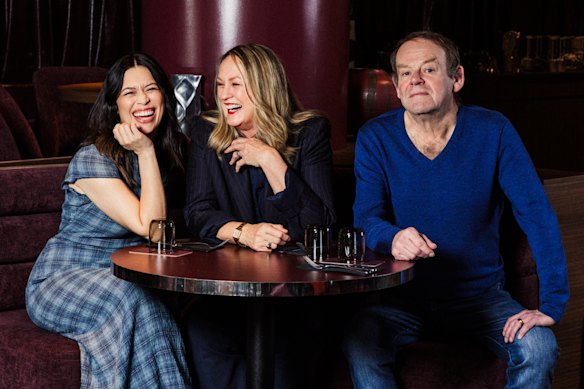
The Unfriend is Moffat’s first play and is now showing at Roslyn Packer Theatre for the Sydney Theatre Company. It seems almost strange Moffat had not written for the stage before, but writing for television kept him busy: Press Gang, Coupling, Sherlock, Dracula and Doctor Who are among his long list of credits.
To ice the cake, the play turned into a hit of its own. It has been mounted in London’s West End, in the United States – heaven help us all if the holidaymaker murderer ever sees it – and across Europe. There have also been more than 75 amateur productions in the UK, turning it into something of a vacationing parlour cousin to Agatha Christie’s The Spider’s Web, or Thornton Wilder’s Our Town.
Elsa – the murderess of our story – is a formidable creature. In that sense, she’s akin to Beverly Moss, the status-obsessed dinner party hostess of Abigail’s Party. She’s not as detached as Mrs Danvers in Rebecca, nor as wretched as Madame Thénardier in Les Misérables, but the more you stare at her, you realise she’s cut from the same hideous (also: fabulous) cloth.
“She’s a really awful person, she kills people, but, you can’t write someone that way,” Moffat says. “It’s that horrifying thing, the worst person you know is right sometimes, and Elsa is right sometimes. Her final monologue is relatively persuasive, you know … edit humanity a little bit, who says you can’t kill the occasional person?
“You can’t write as a judgment,” Moffat adds. “You can’t decide this is an awful person; therefore they will only say awful things and be wrong all the time. That is what all liberals like me want to do; we always want to make the people who don’t agree with us evil all the time, [and] well, that’s just not true. Everybody’s right sometimes.”
In that sense, it’s easy to overlay a modern-day context to The Unfriend and go searching for hints of the modern political divide: meeting a new neighbour, workmate or, indeed, a woman on a cruise, and discovering she wears different political colours and the friendship is instantly poisoned. Where do we all go from there?
The decade has changed, Moffat agrees, but the question is the same. “Go away, transplant yourself back in time and tell me what the lovely decade was,” he says. “What are you missing? Was it the Cold War, was that a breeze? How about World War II? Was everybody really placid about Ronald Reagan or Margaret Thatcher? No, they weren’t. They say it’s uniquely divisive now, I just don’t know when it wasn’t.”
The difference, he thinks, is survival. “We’ve survived the past; therefore we think it’s all tame and nice. We haven’t survived the present yet.”
Since its creation in 2020, the script has had to deal with tense changes – Donald Trump’s presidency, for example, went from present tense to past and then back again to present. And in the US production, which was staged in Florida, he was excised entirely. “Because, they said, whichever side of that divide you’re on, no one’s finding it funny,” Moffat recalls.
Having added playwright to an already long bow, it is also true that Moffat may never quite escape his own filmography. His iconic children’s series Press Gang is remembered – alongside Grange Hill, The Kids of Degrassi Street and Degrassi Junior High – for ambitious storytelling and sharp social commentary.
So, where’s this generation’s Press Gang? The answer, he says, is complicated. There’s funding. And there’s also the fact that kids watch grown-up TV anyway. And then there’s the extent to which “young people, even my kids who are in their 20s, [are] actually that bothered about television. It’s not necessarily their first choice for entertainment.
“We can’t expect the present day to be exactly the same as our childhood, any more than our childhood exactly resembled the childhood one generation before,” he says, adding: “If I’m to be traitorous to my own medium, I would say the best thing of all would be to read more. Where’s the new Harry Potter? To be very good at reading and to get joy out of reading is a massive skill.”
And then there’s Doctor Who, a series beloved of him as a child and which, extraordinarily, he steered as showrunner between 2010 and 2017. The series was acquired by Disney in a $US220 million ($316 million) deal in 2022. But it has not been renewed and its future is uncertain.
Moffat’s hot take on its future? “I assume there will be one,” he says. “I very much hope there is. It is, as I keep pointing out, a very, very old show. So it’s rather important that it’s always made out of new stuff, you know. You might say this thing is ancient, but it’s a new Doctor, it’s a new companion, it’s a new showrunner, it’s a new approach.
“That gives it a particular strength,” he adds. “It’s a great format. You have to be careful with it, and I’ve said that as well. You cannot bend it to your will. I am very fond of saying, the format of Doctor Who is cleverer than you are. So you do as you’re told.”
The same goes for Sherlock Holmes and James Bond, Moffat adds. “Just do as you’re told. If you think you’re going to fix it, you are going to get your arse handed to you. You can’t. You can’t make it what it isn’t.”
The Unfriend plays at Roslyn Packer Theatre for Sydney Theatre Company until October 31.
The Booklist is a weekly newsletter for book lovers from books editor Jason Steger. Get it every Friday.
 Michael Idato is the culture editor-at-large of The Sydney Morning Herald and The Age.Connect via X or email.
From our partners
Disclaimer : This story is auto aggregated by a computer programme and has not been created or edited by DOWNTHENEWS. Publisher: www.smh.com.au








