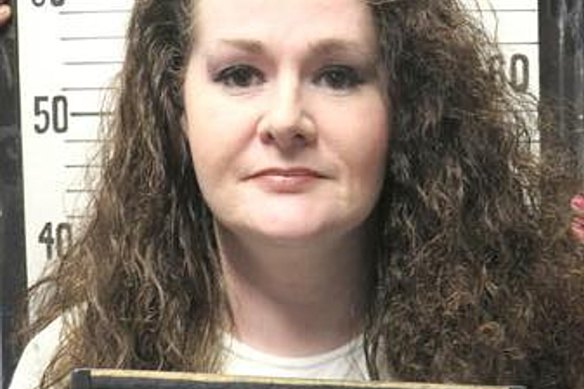
Kim Chandler
Warning: This story contains graphic content
Nashville, Tennessee: Christa Pike was scheduled to be executed. But after two injections, she kept breathing. She made snoring sounds, she talked, she said her arm was hurting.
Pike, sentenced to die for torturing and killing 19-year-old Colleen Slemmer in 1995, said as her scheduled lethal injection began that she was at peace.
Strapped to a gurney in the Riverbend Maximum Security Institution about 7.30pm on Wednesday (Tennessee time), Pike, who was allowed to give a final statement, said she was leaving the world with love.
“I’m ready to be free,” she said. “This is a happy day.”
Leaving prison in an ambulance, not a hearse
Pike, now 50, was 18 when she committed the murder and would have been the first woman executed in Tennessee in more than 200 years.
But instead she survived two doses of the pentobarbital meant to kill her. She left the prison in an ambulance instead of a hearse.
The Associated Press was among those who witnessed her failed execution. She was already strapped to the gurney, with IV inserted in her arm, when prison officials raised the curtain to the execution room at 7.27pm.
Her spiritual adviser was standing beside the gurney near her head. He spoke to her. They sang a song. The lyrics were not audible, but included repeating the phrase: “I love you.” The spiritual adviser stroked her forehead.
Minutes ticked by. She raised her head and looked around; she smiled. Then she said her arm was hurting and asked a prison official in the room if it was supposed to feel that way.
Ten minutes in, at 7.37pm, she sighed, the IV in her arm fed from a control room adjacent to the death chamber, separated by a ledge. At 7.41pm, a rock or paper weight about the size of a golf ball was placed on the ledge.
Prison officials have not confirmed what it means, but its placement appeared to coincide with a direction in the protocol that says after the drugs are administered, a five-minute countdown begins until the curtain is closed.
At 7.46pm, officials closed the curtain, blocking the witnesses’ view of the death chamber. Pike’s spiritual adviser left the chamber and sat briefly with her attorney in the media witness room.
The curtain rose again three minutes later. The Tennessee lethal injection protocol calls for a second round of pentobarbital if the inmate is not deceased after the first round.
An hour-plus of what sounded like snoring
Her spiritual adviser returned to the chamber and stood beside Pike with his hands folded. Pike appeared to begin to lose consciousness at some point and started making a sound like snoring. She continued to do so for the next hour, a sign that she was alive long after she was expected to be dead.
Her head raised slightly off the gurney and turned to the side about 7.56pm. She kept breathing.
Officials closed the curtain again at 8.06pm. For the next 40 minutes, Pike could be heard from behind the curtain. She sounded like she was snoring, a rhythmic, regular breathing pattern.
Inside the prison, Pike’s attorney, Randy Spivey, later told the media that, about 8.22pm, he demanded access to a telephone to contact other lawyers on the team.
He said he demanded the execution be halted and that life-saving medical care be given to Pike. He said he received confirmation about 8.50pm that an ambulance was on the way.
At 8.53pm, an announcement came: “Will witnesses please exit the area.” The media was escorted out, and a prison spokesperson said she had no information to provide about what had happened.
Fire trucks and ambulances arrived in front of the prison about 9.14m. Pike’s attorneys later issued a statement that she had been taken to a hospital and was being treated.
On Thursday afternoon, they said she was in critical condition receiving medical care.
The aftermath
Pike was critically ill and receiving “life-saving medical care” in hospital on Thursday (Tenessee time), Spivey said.
“Christa is alive right now,” he said. “We don’t have a sense of her prognosis or much update on her health at the moment, but we do know that she is alive right now.”
The Tennessee Department of Correction issued a statement saying the department followed protocol.
“The lethal injection chemical in the protocol has consistently been effective, and the protocol does not allow for additional procedures beyond what was carried out this evening,” the agency wrote. “Christa Pike has been transported to an off-site medical facility.”
The agency has not said what went wrong. It was the second time this year that Tennessee has been unable to complete an execution, though in the other case, officials couldn’t find a suitable vein for an IV line so the drugs weren’t administered.
Tennessee Governor Bill Lee – who on Monday denied Pike’s clemency appeal to commute her sentence to life in prison, paving the way for the execution to go ahead – ordered a suspension of all scheduled executions in Tennessee for the rest of the year and a third-party investigation of Wednesday’s failed attempt.
“There is no one that wanted what happened last night to happen,” Lee, a Republican, told reporters. “It’s a tragedy, and it’s deeply disturbing to me that that has happened in this state. The people deserve better and we’re going to make sure that happens.
“[The investigation] needs to be done thoroughly, however long that takes and whatever process is required to make sure we get to the very end of it and all the questions are answered.”
Pike’s lawyers called for the governor to now spare her life. “Christa has endured punishment greater than any other person in the history of the American death penalty. The governor must commute Christa’s sentence now,” Spivey said.
Slemmer’s mother, May Martinez, had also travelled to Nashville to see the sentence carried out.
“I didn’t get justice for my daughter,” Martinez said. “I watched the whole thing. She was awake.
“She was moving her head, moving her feet. She was trying to sit up. Didn’t work the first time they gave her a shot. It didn’t work the second time so she’s in the hospital and alive.
“This isn’t justice for Colleen.”
Pike’s lawyer ‘haunted’ by what he saw
Spivey called the process a cruel “chemical torture” and said he was “haunted” by what he saw as the execution team struggled to find a vein for the lethal drugs. He said he counted at least seven needles in her left arm.
During the struggle to locate a vein, Pike even suggested where they might find a spot, he said.
“Please try here, please try here,” Spivey recalled her saying. “She told them over and over, please try higher on my shoulder.”
What is pentobarbital?
The lethal drug has been used in multiple states that carry out the death penalty and by the US government after President Donald Trump resumed federal executions during his first term.
Pentobarbital is a barbiturate, a class of drugs that depresses the central nervous system. Approved medical uses include sedation, short-term treatment of insomnia, preparation for anaesthesia and emergency control of certain severe seizures. It is also used in veterinary euthanasia.
In an overdose, it can produce coma, suppress breathing and cause circulatory collapse and death.
Why is it used in executions?
For years, lethal injections commonly used three drugs: an anaesthetic, a paralytic that stopped breathing and potassium chloride to stop the heart.
That method drew criticism because if the anaesthetic failed, the paralytic could prevent a prisoner from communicating pain. It also became difficult to maintain after drugmakers restricted distribution for executions.
The pentobarbital protocol was adopted at the federal level during Trump’s first term to replace the three-drug mix used in the 2000s.
As with Tennessee’s guidelines, the federal death penalty protocol calls for administering a five-gram dose of pentobarbital; in medical settings, patients typically receive a fraction of a gram.
The federal government used pentobarbital in 13 executions between 2020 and 2021, contributing to making Trump the most prolific execution president in over 130 years. During the Biden administration, the Justice Department stopped executions with pentobarbital after a government review raised concerns about the potential for “unnecessary pain and suffering”.
After Trump came back to power, the Justice Department in 2026 reauthorised the use of lethal injections with pentobarbital.
What have experts said about the drug?
Experts quoted in the 2025 federal review argue pentobarbital can cause pulmonary oedema, a build-up of fluid in the lungs that may create a sensation of suffocating.
The review concluded that “there remains significant uncertainty about whether the use of pentobarbital as a single drug lethal injection causes unnecessary pain and suffering” and advised that the government should “err on the side of humane treatment”.
Other specialists quoted in a report released by the second Trump administration said a lethal dose causes unconsciousness before that occurs.
How did Pike survive?
Medical experts offered several theories that could explain why the two doses of a lethal drug proved not to be fatal, The New York Times reported.
The likeliest is that the pentobarbital went into the tissue surrounding the insertion site instead of entering her bloodstream.
That could have prevented the amount of the drug in her circulatory system from reaching the levels needed to stop her breathing, the Times reported.
Still, it may have lowered her oxygen levels or weakened her circulation enough to cause brain damage.
“She could be facing profound medical complications,” said Joel Zivot, a professor of anaesthesiology at the Emory University School of Medicine, who had previously been retained by Pike’s lawyers as a medical expert
Medical experts also said another possibility was that there was something wrong with the pentobarbital itself.
“Is it possible that the pentobarbital itself was somehow not constituted properly?” Zivot said. “Could it have degraded? Could it have expired? All of those things are possible.”
Early warnings
Pike’s legal team has previously told courts and Tennessee prison officials that she had medical conditions that would make death by lethal injection agonising.
They said Pike suffered from a condition with elevated platelets known as thrombocytosis. They argued the condition could cause issues with blood clotting at injection sites or bleeding that could affect her lungs.
Medical workers also had trouble drawing blood from her, and setting an IV line is a harder process, her lawyers said. Spivey said he counted at least seven spots where needles were put into her left arm on Wednesday and that at least one needle bent on an unsuccessful attempt.
Pike’s biggest fear from being executed wasn’t “a fear of dying. It was a fear of a prolonged, painful, traumatic death. And that’s what happened minus the death,” said Stephen Ferrell, an attorney for Pike.
From our partners
Disclaimer : This story is auto aggregated by a computer programme and has not been created or edited by DOWNTHENEWS. Publisher: www.smh.com.au