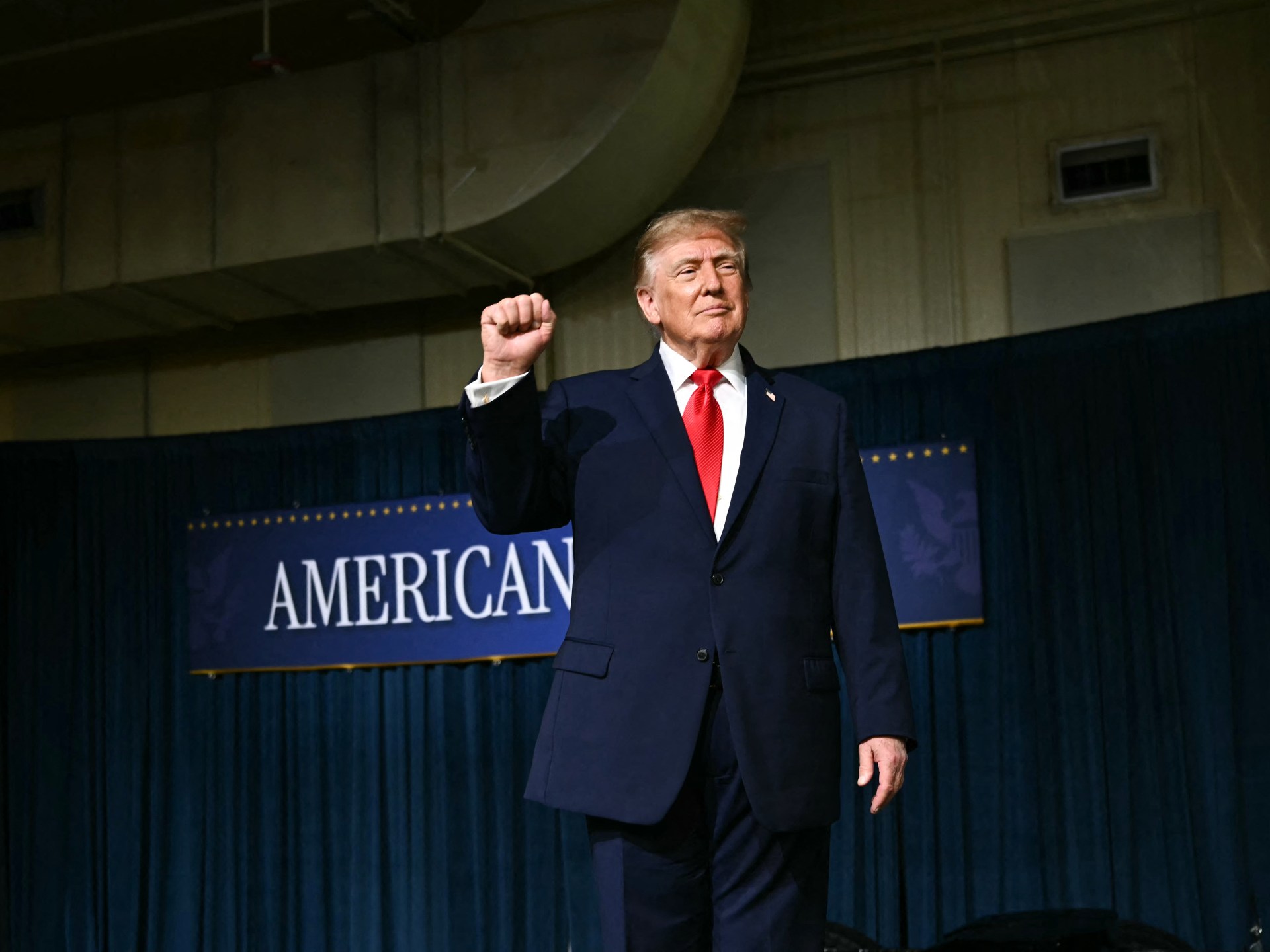
United States President Donald Trump has kicked off a 32-day campaign tour ahead of the November midterm elections that could see his Republican Party hurt by his handling of the war on Iran and the economy.
On Thursday, Trump travelled from Washington, DC, for back-to-back rallies in Texas and Oklahoma.
Recommended Stories
list of 3 itemsend of list
At his first stop in Denton, Texas, Trump sought to shift the narrative around his drooping approval ratings, offering a personal assessment of his administration’s performance.
“I give us an A+ on the government, on economics, on everything,” Trump told a crowd of supporters at the Peterbilt Motors Company, a truck manufacturer.
The president also blamed unfair media coverage for his growing unpopularity, arguing that his pre-election rally blitz was necessary to set the record straight.
“We’re doing an extremely poor job of promotion and an extremely great job of running the country,” Trump said.
But Trump’s poll numbers have raised concerns about Republican prospects ahead of the November 3 midterm election.
Trump himself is not on the ballot, but Republican candidates across the country are seeking to defend the right-wing party’s majorities in both chambers of Congress, as well as key state and local offices.
The economy and Trump’s war on Iran are expected to weigh heavily on the election outcome.
On Thursday, The Associated Press and the NORC Center for Public Affairs Research released new poll results showing that 71 percent of Americans disapprove of the war, which has driven up the price of fuel.
Advertisement
About half of survey respondents also said they were worried they would not be able to afford food and petrol. Only 26 percent approved of Trump’s handling of the economy.
Taking centre stage
Still, despite record low approval ratings, Trump has positioned himself as key to the Republican midterm strategy.
At a first-of-its-kind Republican midterm convention in September, Trump encouraged voters to consider his record while at the ballot box. “I’m asking you to pretend that I’m on the ballot,” he said.
During Thursday’s tour, he touted the impact of his tariff campaign, which he credited with creating thousands of manufacturing jobs.
“For decades, you were heartlessly betrayed by politicians, lousy politicians, who let foreign trade cheaters plunder your wages, loot your factories, close up your jobs,” Trump told Peterbilt workers. “They’d still be doing it if I wasn’t here, believe me.”
Trump’s tariffs, however, have been highly controversial, prompting a series of court challenges. Critics have argued that the sweeping import taxes surpass the president’s constitutional powers.
Trump also used his stump speech to ease concerns about the US-Israel war on Iran, which began on February 28. Both sides have declared victory, though a ceasefire remains elusive.
“Just as I promised, I’m ensuring that Iran will be very quickly ended. I will tell you the energy prices are going to be rapidly, rapidly coming down,” Trump said.
“We’ll win very easily right now,” he added. “I believe right after the election we’ll win, but maybe before the election.”
The war, however, resulted in Iran stopping commercial traffic through the Strait of Hormuz, a key waterway for the global fuel trade.
The price of diesel — the fuel the trucks built at the plant use — soared to record highs of more than $6 per gallon (3.8 litres) last week. Petrol prices have similarly skyrocketed.
Hurting or helping his fellow Republicans?
Trump, however, has acknowledged that the stakes are high for his presidency in the upcoming midterms.
All 435 seats in the House of Representatives are up for grabs, as are 35 seats in the 100-member Senate.
Losing Republican control of either chamber could create roadblocks for Trump’s legislative agenda during the final two years of his second term.
But Trump has also expressed concern that he could be impeached for a third time, after two prior impeachments during his first presidency.
At Thursday’s second stop, in Durant, Oklahoma, the Republican leader repeated that fear. “Pretend I’m running, please,” he told the crowd. “If we don’t win, they’ll end up impeaching me.”
Advertisement
Many of the places Trump is scheduled to visit this month are perceived as reliably Republican voting districts. Following his stops in Texas and Oklahoma on Thursday, Trump will be heading to Alabama, Ohio and Nebraska in the coming days.
Still, some elections that ordinarily would be considered shoo-ins for Republicans have grown more competitive in recent months.
In Texas, for instance, no Democrat has won a statewide race since the 1990s. But this year, Republican Ken Paxton, the state’s attorney general, is struggling to win a Senate contest against Democrat James Talarico.
During both of Thursday’s stops, Trump sought to bolster Paxton’s prospects. At the Peterbilt factory, for instance, he called Paxton “the greatest attorney general in the United States of America”.
“We gotta get this guy elected,” Trump said, before pivoting to criticisms of Talarico, whom Republicans have sought to paint as out of touch with Texas’s large beef industry.
“He’s a vegan,” Trump said of Talarico, repeating an unsubstantiated rumour. “And vegans don’t do well in Texas.”
But leaked audio appeared to show Paxton lamenting the negative impact Trump had by holding the Republican midterm convention in Texas last month.
“It dropped our numbers. Everybody’s numbers dropped,” Paxton reportedly said.
Trump touts social conservatism
Trump has nevertheless used his pre-election tour to highlight social issues he feels will help rally voters to the Republican cause.
On Thursday, he returned to familiar subjects like immigration and transgender rights, which he depicted as a part of the Democrats’ “radical” agenda.
“They want women in men’s sports. They want open borders. They want transgender mutilation for your children,” Trump said. “What the hell are you thinking about, you liberals?”
The president also used his Texas appearance to push back against critics of data centres, despite bipartisan concern.
Critics worry that the rapid growth of artificial intelligence (AI) has fuelled the proliferation of data centres, which require large amounts of electricity and water to process mass data quantities.
While Trump has dismissed fears about AI as largely unfounded, a poll last month found 53 percent of Americans are “extremely” or “very” concerned about the technology’s environmental impacts.
Even fellow Republicans in Texas are responding to public pressure about the growing number of data centres, more than 300 of which are operational, with hundreds more in progress.
In August, Governor Greg Abbott called for an audit of all data centres to map their water and electricity usage, and the following month, Paxton in his role as state attorney general launched an investigation into whether they were complying with water reporting requirements.
Trump nevertheless used his Texas rally to tout the expansion of such enterprises.
“It’s a huge thing. It’s bigger than the industrial revolution,” he said, dismissing the concerns as part of a “scam”. He then explained he had urged AI companies to “take care of the people”.
Advertisement
“They’re making a fortune for the communities,” he added.
Disclaimer : This story is auto aggregated by a computer programme and has not been created or edited by DOWNTHENEWS. Publisher: aljazeera.com