
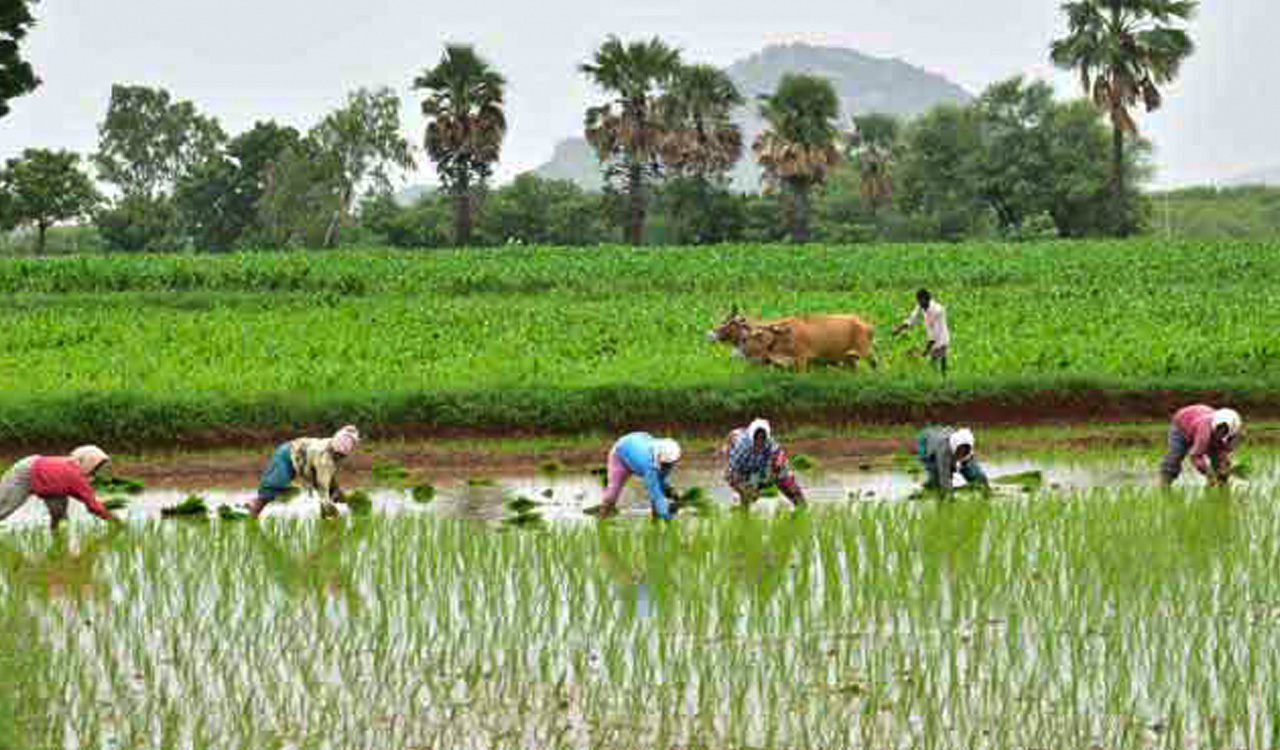
For decades, the story of the Indian farmer has been one of extreme vulnerability. Unpredictable monsoons, rapidly depleting groundwater and devastating pest attacks make agriculture a high-stakes gamble. As someone who has spent years on the ground in Gujarat, overseeing horticultural schemes, guiding farmers through the transition from traditional field crops to high-value horticulture and watching that vulnerability play out season after season, I can say with some confidence that something has quietly but fundamentally shifted. Through the Indo-Israeli Agriculture Project, a bilateral initiative that began in 2006, the principles of high-tech precision farming are being translated into the daily reality of the Indian farmer and the results are beginning to show at a scale that demands serious attention.
Israel’s agricultural achievement is well known. A nation more than half desert managed to become an agricultural powerhouse simply by innovating out of necessity, treating every drop of water as a precious commodity. What the Indo-Israeli partnership has done is take that desert-defying technology and calibrate it to India’s agro-climatic diversity, a task that required genuine adaptation, not mere transplantation. The Centres of Excellence or CoEs are the institutional expression of that principle. Today, 35 CoEs are operational across 12 states, with 8 more being jointly operationalised, together having trained over one million farmers. The concept is brilliantly triangular bringing applied research, government extension officers and progressive farmers onto a single, dynamic platform. In my own work across Sabarkantha, it is this triangular model that has proved most effective in breaking the psychological barrier of technology adoption among smallholder farmers.
The outcomes within these centres are concrete. Precision drip irrigation reduces water consumption by up to 60 to 70 per cent compared to flood farming, delivering water and soluble fertilisers directly to the root zone with a precision that traditional irrigation cannot approach. Farmers applying Israeli canopy management and pruning protocols report yield increases of 200 per cent or more for pomegranates and tomatoes alongside water savings of up to 65 per cent. For high-value crops including coloured peppers, parthenocarpic cucumber and cut flowers such as roses and gerbera, yields under protected conditions run three to five times higher than open-field cultivation, with reductions of over 80 per cent in synthetic insecticide usage. At the vegetable CoE in Pratij, Sabarkantha farmers have adopted polyhouse and mulching technologies to drastically cut pesticide use and overhead costs, reporting significantly higher productivity than was possible through conventional cultivation a decade ago. Perhaps the most crucial intervention, however, is the production of high-quality, pathogen-free planting material. One of the biggest risks an Indian farmer takes is buying saplings or seeds already infected with soil-borne pathogens. The CoEs function as state-of-the-art nurseries, distributing tens of millions of healthy vegetable seedlings and fruit grafts every year planting material with a far greater chance of survival, productivity, and long-term health.
These outcomes are real, but they are accompanied by an honest reckoning. India has grown to approximately 55,000 hectares under protected cultivation over two decades, yet much of that growth was driven by government subsidy rather than technically grounded adoption. Protected structures deployed without regional calibration often fabricated by small industries that sacrificed material quality for margin, have underperformed in the harsh climatic plains of northern India even as results in Bengaluru and Pune have been strong. China’s experience is instructive here: its approximately 3.5 million hectares under protected cultivation was built on technically grounded regional systems. India’s next phase must apply that lesson rigorously. The scale of what remains to be done is visible every day in districts like Sabarkantha, where farmer potential is high but the infrastructure to support technically sound protected cultivation remains uneven.
When Prime Ministers Modi and Netanyahu met in Jerusalem in February 2026 and elevated the bilateral relationship to a Special Strategic Partnership, agriculture occupied a central place in the outcomes. The Memorandum of Understanding between ICAR and MASHAV for the India-Israel Innovation Centre for Agriculture, the Villages of Excellence programme, and the jointly developed Five-Year Seed Improvement Plan together mark a partnership entering a genuinely new phase. The Villages of Excellence programme is the most significant downstream shift. The CoE model brought technology to demonstration farms and trained farmers who travelled to them. Villages of Excellence inverts that flow entirely carrying Israeli agricultural technologies directly into village ecosystems and integrating rural communities into a modern value chain. For a district-level administrator, this shift from demonstration to immersion is precisely what ground-level implementation has been waiting for.
For these models to deliver, however, clusters must link Villages of Excellence with input hubs, small-scale processing and value-chain infrastructure in public-private partnership mode. Subsidy structures should release support at the point of produce sale rather than structure construction alone. And the most binding constraint that remains must be addressed directly: the shortage of trained professionals for designing, fabricating and maintaining protected structures and for managing crop production within them. Large-scale development of rural youth in structural design and fabrication on one track and in protected crop production management on another is the investment the Villages of Excellence programme most urgently requires. What was established at Pusa in 1998 and built into a national network over two decades has produced a measurable transformation in Indian precision agriculture. The task now is to carry the rigour that made the CoEs succeed into the design of the next phase, so that the gains reach not just the farmers who visit demonstration farms, but every field, every village, and every harvest.
By Mr. D.M. Patel
(The author is a senior Agricultural administrative official currently serving as the Deputy Director of Horticulture for the Sabarkantha District under the Government of Gujarat.)
Disclaimer : This story is auto aggregated by a computer programme and has not been created or edited by DOWNTHENEWS. Publisher: deccanchronicle.com





