
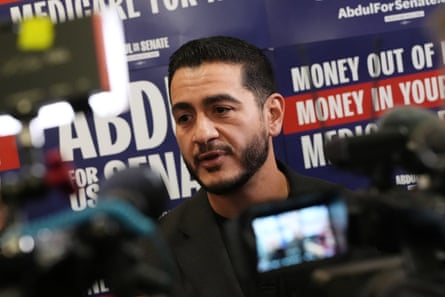
For Haley Stevens, the road from Democratic Senate candidate to campaigning alongside a Republican she once called a rubber stamp for Donald Trump has been remarkably short – and the issue running through almost every twist and turn has been Israel.
Having failed to stop Abdul El-Sayed in the primary, Stevens chose to back Republican Mike Rogers on Sunday, a candidate who she previously warned would enable Trump’s agenda – apparently because the Democrat who won refuses to share her position on Israel.
Stevens’s extraordinary reversal is about more than a personal feud or a bruised political ego. It is the culmination of a fight over Israel that has come to define the congresswoman’s political persona, seemingly eclipsing her commitment to the Democratic party and its opposition to Donald Trump.
It is also an issue that continues to dog the wider Democratic party, especially when it comes to candidates who accept money from Aipac, the biggest pro-Israel lobby in the country and one of the biggest spenders in US elections. But other Democratic candidates have sought distance from the baggage of the Aipac brand as US voters grow increasingly skeptical of the US-Israel relationship. Stevens, on the other hand, seems to have doubled down.
Earlier this year, Aipac and its affiliated groups poured around $30m into trying to secure Stevens’s Democratic primary victory, their largest ever investment in a single race, in their attempt to stop El-Sayed by any means necessary. She lost anyway, but continued the fight over Israel, demanding that El-Sayed distance himself from an outside group’s advertisement blaming rising grocery costs to American support for Israel just days before the election. The advertisement was not produced by his campaign, and El-Sayed explicitly rejected its contents. That was apparently not enough.
Stevens had been scheduled to appear alongside El-Sayed and the veteran congressman Jim Clyburn at a predominantly Black Detroit church on Sunday, an attempt to demonstrate Democratic unity before election day. Instead, she released a lengthy statement attacking El-Sayed over alleged antisemitism and his associations, and was told she was no longer welcome at campaign events, which she then took personally.
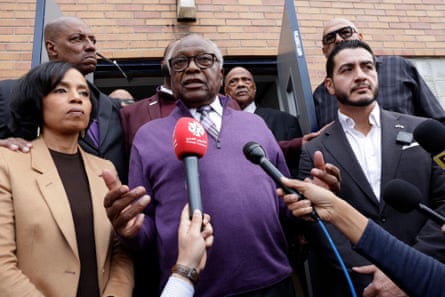
Her follow-up CNN interview with Anderson Cooper only deepened the questions about her decision. Asked repeatedly what had changed between her assurances to fellow Democrats the previous evening and her endorsement the following morning, Stevens struggled to offer a clear explanation. “This is just a weight off my shoulders,” she said, repeatedly returning to El-Sayed’s supposed anger and “lack of kindness”. Cooper pointed out that the criticisms she was making had been known for some time, including when she had agreed to campaign with him.
Despite all the intra-party divisions over Israel, the response from Democrats has been unified: across the spectrum, they are horrified. Senate majority leader Chuck Schumer, no progressive firebrand, called her move “a despicable betrayal”. Michigan representative Debbie Dingell, a close friend of Stevens, said: “She seriously hurt herself.” The Michigan Democratic party chair, Curtis Hertel, declared that Stevens was no longer a member of the party, and would not be in the future.
Many have also expressed concern about the influence of her fiance, Jason Turkish, a pro-Israel lawyer who long donated to Democrats before backing Rogers himself, and other Republican candidates like Maine senator Susan Collins.
But what is clear is that by supporting the Rogers’ campaign, Stevens is tying herself evermore deeply to Israel. The Republican was apparently skeptical of the Aipac’s support of his campaign, but the group reportedly spent $9m to support him after Stevens lost to El-Sayed. Over the weekend, Drop Site News reported a number of ties between his campaign and the Israeli government.
Yet Israel has never been the focus of the El-Sayed campaign. For a year he told Michigan voters the same three things: money out of politics, money in your pocket, and Medicare for All. On the trail, he has stirred controversy for saying US military aid to Israel was better used for domestic priorities, and campaigning with often incendiary progressive influencer Hasan Piker. El-Sayed has continued to focus his message on the cost of living crisis as Stevens made news in recent days.
Stevens, who tweeted “Medicare for all. NOW.” in 2018 now opposes the proposed system of universal healthcare. She has also consistently taken corporate political action committee (Pac) money, so she is no natural ally on his signature issues. But she is a Democrat who, by her own account, impeached Trump twice, and on almost everything else she sits far closer to El-Sayed than to Rogers, a Trump-endorsed Republican with a record of voting for abortion restrictions. She picked Rogers anyway.
El-Sayed, meanwhile, has repeatedly affirmed his commitment to Jewish safety. “My commitment to Jewish safety is the same as my commitment to the safety of my own daughters,” he has said. He has condemned antisemitism while arguing that the United States should stop providing military assistance to Israel.
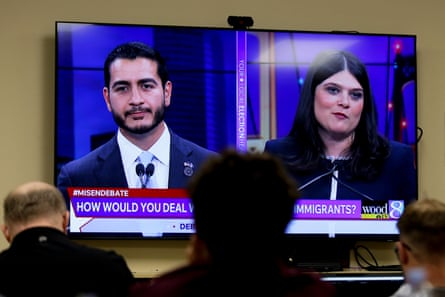
That distinction matters particularly now. A United Nations independent commission of inquiry concluded in September 2025 that Israel had committed genocide in Gaza. Around the same time, Democratic senators Chris Van Hollen and Jeff Merkley concluded after a fact-finding mission that Israel is pursuing a systematic campaign to destroy and ethnically cleanse Palestinians from Gaza, accusing the US of complicity through its continued support for the Israeli government. Now far from a fringe position, a May New York Times/Siena poll found 74% of Democratic voters oppose further military and economic support for Israel.
Stevens’s intervention, which has drawn criticism from top Democrats across the party, threatens to undermine the effort to unite Democrats behind El-Sayed after a divisive primary. It also appears to have reinforced his argument that the party establishment has been too willing to make support for Israel a condition of political acceptance.
Donald Trump celebrated her endorsement of Rogers, calling her highly respected and suggesting she should join the Republican party.
But El-Sayed’s response was a different story: “I actually don’t think about Haley Stevens.”
Disclaimer : This story is auto aggregated by a computer programme and has not been created or edited by DOWNTHENEWS. Publisher: theguardian.com






