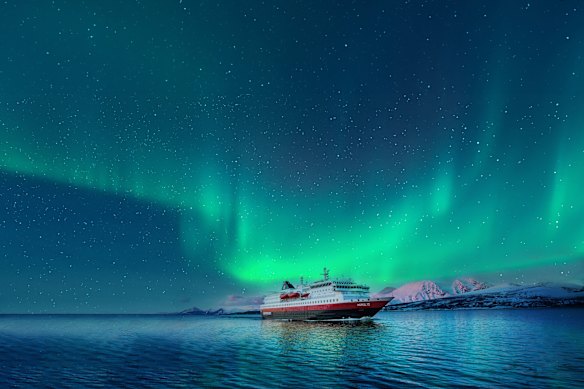

Off Norway’s Arctic coastline, a crowd of passengers gather on the top deck of a cruise ship. The sky is streaked with a hooping green band of light, and the winter temperature is well below zero, though nobody seems to notice as they stare up at the celestial vision that flares and flickers overhead.
It’s a scene that takes in two phenomena at once – one in the sky and one on the sea. The aurora borealis, or Northern Lights, is arguably the planet’s greatest light show, shimmering brightly as particles from the sun are drawn through the Earth’s magnetic field towards the poles. And just as remarkable is the tourism that now accompanies this dark-sky spectacular. Only a few decades ago, the concept of Northern Lights tourism was all but unknown, but today it’s a global industry worth around $1 billion a year. And Norway is at its forefront.
iStock
I’m sailing aboard Hurtigruten’s inaugural Astronomy Voyage Signature cruise. Part of the Norwegian company’s premium-end Signature Voyages concept, the Astronomy Voyage brings the long Arctic winter nights, and their brilliant aurora displays, into full focus with a dedicated Northern Lights and astronomy program.
Guiding this focus is astronomer Tom Kerss, a Fellow of the Royal Astronomical Society and author of a dozen astronomy books, including a guide to the Northern Lights. As Hurtigruten’s “chief aurora chaser”, Kerss is one of the public faces of the inexorable rise of Northern Lights tourism.
Sign up for the Traveller Deals newsletter
Get exclusive travel deals delivered straight to your inbox. Sign up now.
“The 2014 solar maximum was the tipping point for aurora tourism,” says Kerss. “That was the first solar maximum where the aurora was regularly on the news. It was so widespread that people were keen to make it an actual trip, rather than just a bucket-list item. And it’s been trending upwards since. Aurora tourism exploded from something a few hundred thousand people would do each year to many millions making a journey each year.”
I’ve joined the Astronomy Voyage on Signature cruise in the city of Tromso, 350 kilometres inside the Arctic Circle. Midwinter has passed and daylight now stretches to about five hours each day, but night is still king.
Of the 350 passengers aboard MS Trollfjord on this North Cape Line sailing, 25 are on the dedicated astronomy program, with capacity to expand this to 70. For 10 of the 15 days aboard, Kerss delivers lectures and masterclasses – technical but intriguing talks that range from the serene green ribbons of the Northern Lights to eclipses, the moon and far-flung nebulae.
During days along the convoluted Norwegian coastline, these lectures are interspersed with shore excursions, but even when ashore the Northern Lights are never far from mind. In Tromso, a private astronomy group shore excursion heads to the city’s planetarium, while there’s a day-long stop in Alta, one of the world’s most northerly cities and the self-proclaimed City of the Northern Lights.
The world’s first scientific research into the aurora borealis was conducted in Alta, and even the whimsical design of the city’s cathedral is styled on the curtain-like appearance of the Northern Lights.
But ultimately, we’re on a quest for the Lights themselves as we traverse these Arctic waters. Such is their reliability that Hurtigruten sails under a winter Northern Lights Promise – if the aurora isn’t sighted during a cruise, passengers are offered another cruise free of charge.
Aboard the ship, the astronomy group has Kerss on call as he monitors data and the sky, sending out regular aurora predictions and alerts.
“We’re always ahead of the curve because we have data that even the bridge can’t access,” he says.
The first night that the clarion call comes, we dash for the Trollfjord’s top deck with hope flaring as brightly as the finest aurora.
The Trollfjord is perfectly equipped for Northern Lights viewing. On the open top deck, the captain can shut down the lighting, replacing it with red lights that assist with night vision, while other decks are lined with floor-to-ceiling windows to enhance the viewing even within the ship. Kerss likens it to a floating observatory.
This first Northern Lights sighting is a muted display, a tease rather than a torrent of light, but there are still days and, more importantly, long nights of sailing ahead.
Sailing days fill with Kerss’ lectures and masterclasses, while the Trollfjord is a floating gourmet kitchen of sorts, with up to 80 per cent of the produce in its three restaurants sourced at ports along the journey.
Even the ship’s bars bring a unique spin to the Trollfjord’s offerings, pouring drinks such as Hurtigruten’s own Bubbles of the Sea, a sparkling wine matured in craters more than 30 metres below the surface of the Arctic Sea.
Also new to the Trollfjord in 2026 is what’s billed as the world’s first Northern Lights cocktail, a blend of Norwegian blueberry juice, citrus, sugar, pear, a spinach potion and edible glitter concocted by the ship’s head bartender, Nicolai Trevland.
As I’m trying the cocktail for the first time, with mainland Europe’s northernmost town, Honningsvag, falling away behind us, that word comes again of lights in the sky. The ship’s deck fades to red, while the sky brightens to green. We’re far from any town lights or other light pollution and the darkness is almost pure. It’s this ability to sail far from intrusive light that is a cruise ship’s aurora advantage.
As we weave through channels past North Cape, the aurora is faint at first, but quickly it brightens. Each time I think the lights have reached their most luminous moment, they glow even more intensely until they’re tearing a long green strip across the black sky.
Rays of light seem to rain down on us, a twisting green ray stretches from horizon to horizon. Briefly, we’re directly beneath the corona – the space storm now immediately above the ship – so that we’re looking directly into the haunting eye of the aurora.
I’ve seen the Northern Lights several times before, but this hour in the Arctic Sea – a greatest-hits album from the Arctic sky – is beyond anything I’ve witnessed before.
“Seeing a corona is one of the white whales of aurora chasing, and I’ve witnessed dozens of these since sailing with Hurtigruten – far more than I ever saw in any of my other aurora work,” Kerss says.
I look around me and see perhaps 200 people gathered on the deck, seemingly oblivious to the icy temperatures. An hour has passed, and only now do I realise that I haven’t been able to feel my fingers or toes for some time. And I’m not about to move. The heavens have delivered an hour of power.
FIVE NORTHERN LIGHTS EXPERIENCES
THE DETAILS
Cruise
Hurtigruten runs a 15-day, 13-stop North Cape Line cruise that starts and ends in Oslo. The Astronomy Voyage on Signature program costs from $7489 a person twin-share for a Polar Inside cabin. See hurtigruten.com
Fly
Thai Airways flies daily to Oslo from Sydney and Melbourne, transiting through Bangkok. See thaiairways.com
More
visitnorway.com
The writer travelled as a guest of Hurtigruten.
 Andrew Bain is a Hobart-based writer and author who has been writing about travel and adventure for more than 25 years, and is most at home in the outdoors and remote places.
From our partners
Disclaimer : This story is auto aggregated by a computer programme and has not been created or edited by DOWNTHENEWS. Publisher: www.smh.com.au