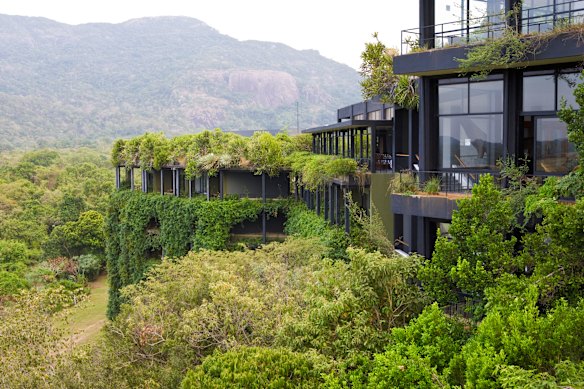
Trees growing in the bathroom, monkeys on your balcony … staying at a Geoffrey Bawa-designed hotel is an immersive, aesthetic treat.
It’s my birthday on New Year’s Eve and while fireworks are par for the course (even if not strictly staged for me), in 2025 I went one better. We were staying at Heritance Kandalama in Sri Lanka’s cultural triangle, an area in the middle of the country rich with World Heritage sites like Sigiriya and the relics of ancient cities Anuradhapura and Polonnaruwa. Designed by Geoffrey Bawa, Sri Lanka’s most celebrated architect, the 152-room hotel is set in a jungle overlooking a lake, with monkeys on your balcony (and in your room if you don’t keep the windows locked), friendly staff everywhere you look, and the national culinary delight that is hoppers on high rotation. So far, so Sri Lankan.
But on NYE, the hotel sets up a lavish banquet that’s a veritable United Nations of food, with little stands offering dishes from more than a dozen countries. America and England, ho-hum, but there. China, Russia, Japan, Italy, France, Poland, Germany; that’s more like it. India, no surprise. And of course, Sri Lanka; curries and hoppers galore. (Quintessentially Sri Lankan, hoppers are small, bowl-shaped pancakes made from rice flour, sometimes with an egg in the middle. They’re harder to make than a Westerner might assume. A foodie friend bought a hoppers pan street-side a few years ago and tried it back home. Disaster!)
Between multiple trips to the UN buffet, and wearing the silver and gold party hats provided to all 300-odd guests, we danced in the new year to a band belting out Olivia Newton-John’s Let Me Be There, Bryan Adams’ Summer of ’69 and Tom Jones’ Green Green Grass of Home. I love cheesy music. Naturally, I loved this band.
We were staying at Heritance Kandalama on the advice of an architect friend who’d visited Sri Lanka the previous year. She told us there were numerous Bawa hotels dotted around the country and that we should try to stay in some of them if we could. It was a winning tip; not only were they lovely in a simple, pared-back way, and not always big or over-the-top expensive (many had less than half a dozen rooms, and we paid anywhere from about $250 a night up to $600ish), but we learnt many fascinating snippets about the man architecture writer David Robson calls “one of the most important Asian architects of the 20th century”.
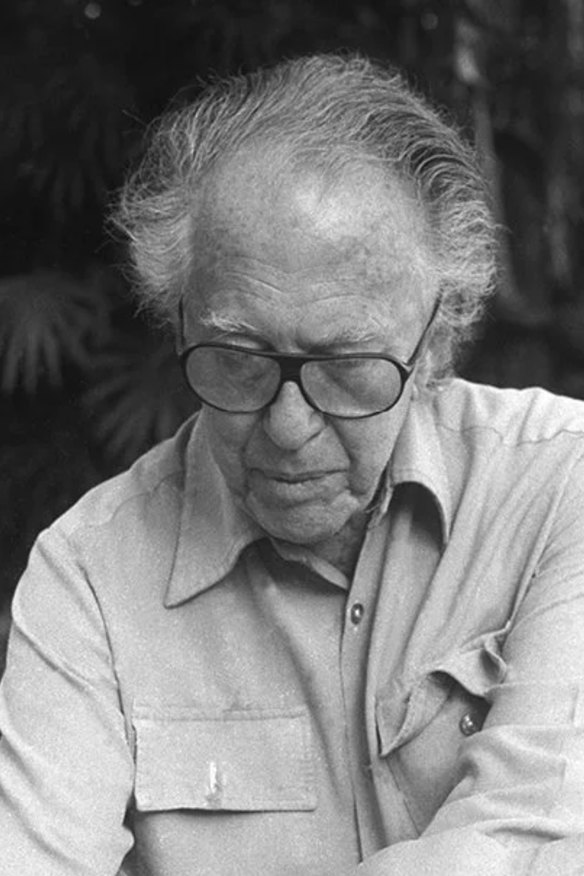
They include that at Heritance Kandalama, Bawa liked to stay in room 507, overlooking the lake, and that architecture students from around the globe often request this room, too. And that in 1991, when hotel group Aitken Spence commissioned him to design it, they flew the then 72-year-old architect in by helicopter. When he wanted to scout the jungle to get a sense of the terrain, they carried him through it on a chair.
Geoffrey Bawa was born in 1919, the second son of a well-to-do family of mixed European and Sri Lankan descent, a family of lawyers, doctors, artists and writers. In his 2002 book, Geoffrey Bawa: The Complete Works, Robson grapples with how to describe his heritage. “Eurasian? Burgher? Moor? … Perhaps the only label that accurately described [him], and the one that Geoffrey himself came to prefer in later years, was ‘Ceylonese’.”
A traveller throughout his life, Bawa studied English and law at the University of Cambridge, then trained as a barrister in London, coming to architecture only in his late 30s. His defining strokes include a melding of the indoors and outdoors, building around nature, utilising natural breezes and light, and preferencing materials like wood and stone, terracotta and cast iron. The kind of design that, despite being conceived half a century ago, feels utterly contemporary today. Heritance Kandalama is carved into a rock face, and in more than one of our hotels there was a tree growing in the bathroom, which poked effortlessly through the ceiling. (Nature, as a result, sneaks in. In our room at Lunuganga, Bawa’s country estate, a chunky orange centipede hung disconcertingly around the shower area for days.)
Bawa had a penchant for found objects, too. At Kandalama, the reception desk was made from an old door from a bank in Colombo that burnt down. The burnt end has been retained, with a metal cap put over it to hide the scorched wood from all but those interested in this kind of thing. (Our tour guide took the cap off with glee: “Look what’s under here!”)
While best known for his private homes and hotels – Bawa designed 70-odd houses, about 50 of which were built, and 35 hotels, 20 of which were built – he also designed the Sri Lankan parliament building, a university campus and various other public and private buildings, mostly in his home country but also elsewhere in Asia.
Bawa bought Lunuganga as a weekend getaway in 1948, when he was not yet 30, and it was this former rubber plantation at Bentota, near the country’s west coast, that sparked his decision to re-train as an architect. The property’s original home overlooks a lake, and numerous other buildings have been added along the way, including a Colombo home he designed for friends which was disassembled in 2009 and transported to Lunuganga, where it was reassembled, brick by brick, over many years. But the gardens are the thing, set over 10 hectares, full of moss and lily ponds, patios and grazing cows, rolling lawns and a ha-ha, a dip which hides a path going from one side of the property to the other, such that the view from above is unimpeded by the path.
We took a tour of the gardens with Krishna, who started working here when he was 21 and, now 49, remembered the owner well. Mr Bawa was strict, he said, and very specific, including directing the gardeners to take different routes across the lawn each day so as not to create tracks. The architect would drive his Rolls-Royce 95 kilometres south from Colombo to get here, where along with relaxing, he’d meet with clients.
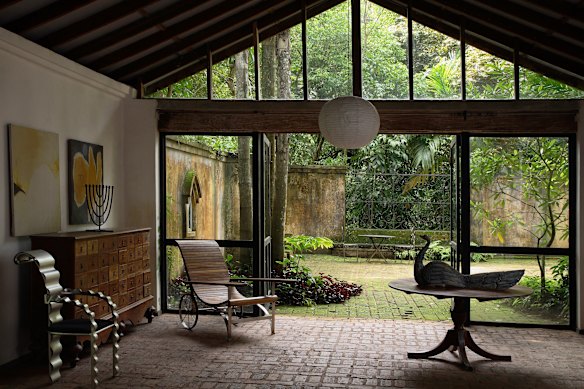
Krishna showed us the spot in the garden where Bawa would drink his gin and tonic of an evening, and the bell he imported from “Burma” (now Myanmar), which he’d ring at G&T time, to have it delivered. We saw, too, the breakfast table where he’d eat his morning hoppers, gazing over a rolling green lawn towards the water. Krishna told us of Bawa’s cigarette habit – apparently up to 100 a day – and of the time the then Prince Charles came to visit. What luck, to have someone so personally steeped in all things Bawa, still here and able to tell visitors first-hand stories that really bring the place to life.
The final commission that Bawa received before his death in 2003, aged 83, was for the aptly named The Last House, a five-room guest house near Tangalle on Sri Lanka’s south coast. Situated right on the beach, it’s all butter yellow and aqua, with bougainvillea-draped walls and doorways, and French shutters framing stunning vistas, from the frangipani tree and swimming pool where tiny birds swoop and drink to the palm-fringed lawn where dinner is served among fairy lights. You can hear the waves as you drift off to sleep in your four-poster bed, surrounded by romantic white gauze that serves as a utilitarian mosquito net. If I had a weekend retreat, I wouldn’t mind it being a bit like this.
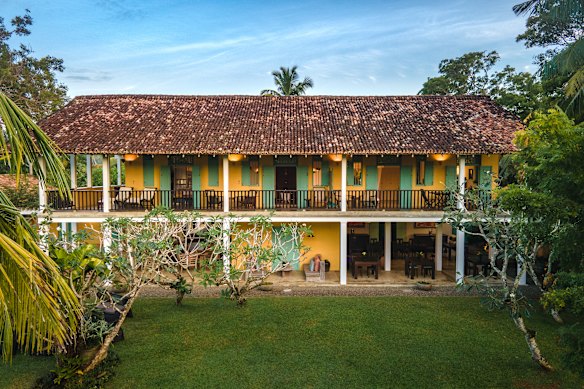
In a stroke of luck, owner Tim Jacobson was there when we visited, so I got the chance to ask him about its history. He explained that he bought the land in 1996 and commissioned Bawa to design this small hotel on it the following year. The civil war was raging in the north but Jacobson, a British financier living in Hong Kong at the time, was not put off. “Of course there were risks,” he says. “When we were building, one guy said to me: ‘Why are you doing this? We’re all trying to leave.’ ” But once he got from Colombo to Tangalle, he says, all that became a distant thing, “and I knew tourism would pick up when the war ended.” (He was right; the war ended in 2009 and tourism did pick up. In between, there was the 2004 Indian Ocean tsunami, which severely damaged The Last House, along with decimating much of the Sri Lankan coast. The property reopened in 2006.)
Jacobson travelled to Lunuganga to meet with Bawa and his number two, Channa Daswatte, now chair of the Geoffrey Bawa and Lunuganga Trusts, to work on the designs. “We would sit outside, look over these big plans,” he says. “I hadn’t built a property before so it was a novel and rewarding experience.” He feels lucky to have met them, particularly given Bawa had a stroke in 1998, after which Daswatte took over much of the work executing the designs.
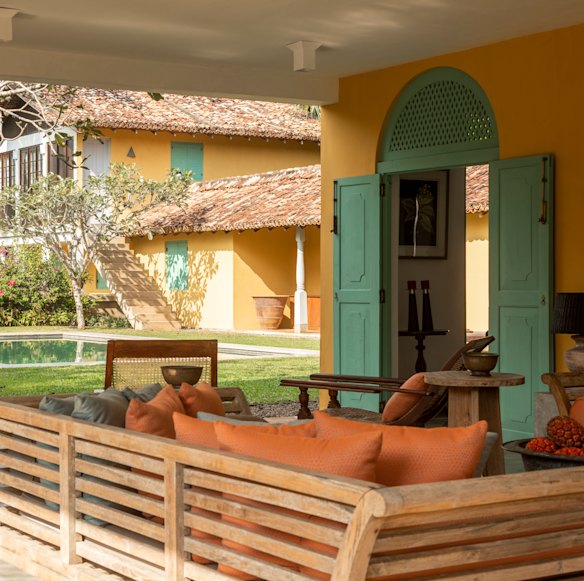
Jacobson went on to build and/or manage numerous hotels around Sri Lanka under his Manor House Concepts group, but The Last House, signifying his personal pivot away from finance and into tourism, remains a favourite. “The brief was open spaces, using as little glass as possible, with a flow through of air,” he says over coffee on the patio. “The cross breezes are terrific and a lot of the bedrooms open both ends. The idea was that fresh air would act as a natural cooling agent. We only put air-conditioning in four or so years ago, because it was getting hotter at certain times of the year.”
When Jacobson began the project, his youngest son was a baby. He’s now all grown up. The Last House is part-family property, part-boutique hotel, and what he loves the most, he says, is hearing from guests. “This will sound cheesy but I’ll say it anyway, with my hotelier hat on,” he says. “I take a lot of pleasure from the pleasure people get from not just a comfortable and satisfactory stay but all the things that go into the design and sense of place.” For a lot of that, we can thank Geoffrey Bawa.
Get the best of Good Weekend delivered to your inbox every Saturday morning. Sign up for our newsletter.
Read more from Good Weekend:
Disclaimer : This story is auto aggregated by a computer programme and has not been created or edited by DOWNTHENEWS. Publisher: www.smh.com.au