With the arrival of digital assistant apps like Gemini and Siri, most of us have grown used to talking to our phones. But conversing with your Android or iOS device can go way beyond interacting with AI. You can also use your voice to launch apps, fill out text fields, and do just about everything that was previously only possible with your fingers and thumbs.
Of course, the traditional touchscreen input will often be the way to go. But there might well be scenarios—when you’re cooking, repairing something, looking after children, or doing anything else that keeps your hands busy—where it’s easier and more convenient to use voice input instead. The usefulness of voice control is of course well known to those who have impairments that keep them from controling a touchscreen phone with the usual taps and swipes.
Here’s how you can set up the feature on your phone, whether you’re running Android or iOS.
Voice Control on Android
To configure voice control on an Android device, you need to install the free Voice Access app from the Google Play Store. You also need to have the Google app installed, but this should’ve come preinstalled on whatever Android handset you’ve got.
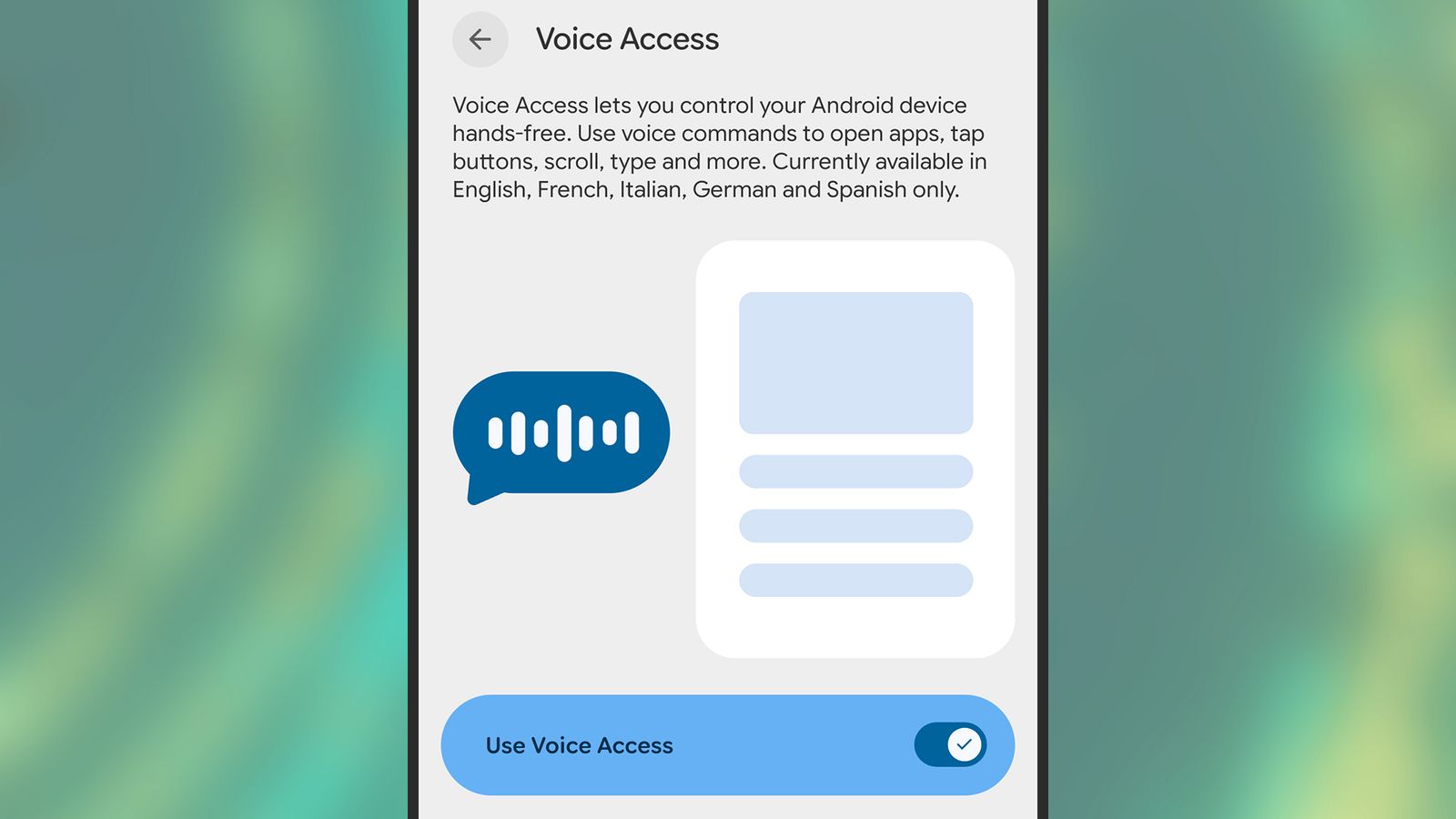
Once you’ve installed Voice Access, you can enable this feature from Settings. On a Pixel phone, head to Accessibility > Voice Access. The exact location of the feature may vary on other handsets, but it’ll be somewhere in the Accessibility menus. For Samsung devices, for example, it’s under Accessibility > Interaction and dexterity > Voice Access.
During the setup of the feature, you’ll be able to tweak a few of the options, including whether to display a persistent button onscreen for launching Voice Access, and whether the feature is always listening for commands whenever the screen is on (which is recommended for convenience).
The same Voice Access screen where you enable the feature also gives you access to a few more key settings. These include options for how long your phone should wait before it stops listening for commands, how precise your phrasing has to be for instructions, and how the Voice Access shortcuts are displayed on screen.
Voice Access can be launched by saying, “Hey Google, start Voice Access,” or via any of the shortcuts you’ve configured in the Voice Access settings (including an on-screen button and a gesture shortcut). When the feature is active, you’ll see an icon showing four dots up in the top left corner, and you can then start speaking to control your phone.

There are a host of different commands you can use; Google has a full list here. You can also see the full list from Accessibility > Voice Access > Voice Access Settings > Voice Access commands. To help with navigating menus, say “show labels” to put numbers on each menu item—you can then just say the relevant number. Use the “Show grid” command, and you get a numbered grid across the screen you can then work with.
Instructions such as “Go back” and “Go home” can help you get around on your phone, and if you’re in a text input field, you can just say “Type …” followed by what you want to type. Swipe and scroll gestures can also be spoken out, so there’s a lot you can do using just your voice. To disable the feature, use the same shortcut you used to launch it, or say “Stop voice access.”
Voice Control on iOS
Before you can use voice control on an iPhone (which is actually called Voice Control), you may need to download some additional files. From iOS Settings, open up Accessibility > Voice Control, then tap Set Up Voice Control and follow the instructions. Along the way you’ll be asked to choose the language for voice commands, and then the feature will be enabled straight away.
Before you actually start talking to your phone, it’s worth reviewing the options that appear on this same screen. You can tap Language to change the voice input language, and Commands to see all the different instructions available to you. Apple also has a list of some of the commands you can use.

The toggle switches farther down the same screen let you control how you want Voice Control to work and give you feedback. You can have onscreen confirmations of your commands, as well as accompanying sounds and hints for what to say next. Enable Attention Aware, and Voice Control will be automatically enabled and disabled as you look at and look away from your iPhone.
There’s also the option of a continuous overlay on the display, which can be switched on via the Overlay menu. You can get numbers or names next to all the elements on screen, to make it easier to identify them with your voice, as well as overlay a numbered grid so you can simulate a tap in specific regions just by saying a grid number.
When Voice Control is active, you’ll see a blue sound wave icon up in the top left corner, next to the iOS clock. Just tell your iPhone what you want it to do or what you want to select, and it will oblige. You can also use commands such as “Scroll down,” “Swipe left,” or “Tap and hold” to control what’s happening on screen.

The available commands cover text selection and editing, as well as device-level controls. You can give instructions such as “Lock screen,” “Turn up volume,” and “Take screenshot” for example. iOS also lets you create your own commands via Commands on the Voice Control screen, and teach the tool new words via the Vocabulary option.
The same toggle switch that turns on Voice Control also turns it off, and you can also say “Turn off Voice Control” to go back to the normal way of working with iOS. Ultimately there isn’t much you can’t do with your voice on an iPhone—and typically the words you need to say for each command are the most obvious and intuitive ones.
Disclaimer : This story is auto aggregated by a computer programme and has not been created or edited by DOWNTHENEWS. Publisher: wired.com