Somewhere in India, right now, a dog has just bitten someone. The moment itself passes in seconds. What happens in the next 15 minutes — and over the next five years — is the difference between a state that manages rabies and one that ends it.
Only one Indian state has actually ended it. This is a blueprint of how, structured the way an engineer might read a build — not as a story to admire, but as a set of modules another state could genuinely lift, in the order they need to go up.
Diagnosis first: 99% of human rabies deaths in India begin with a bite from an infected dog. Every rupee spent treating bite victims without also reducing the number of infected dogs is money spent standing still.
Goa’s model works because it was built to attack the problem at two ends at once — the person already bitten, and the dog that hasn’t bitten yet — with a third module built to shrink how often either happens at all.
Three modules. One build order. Here’s each one, what it does, and what it would take to install elsewhere.
-
The response layer
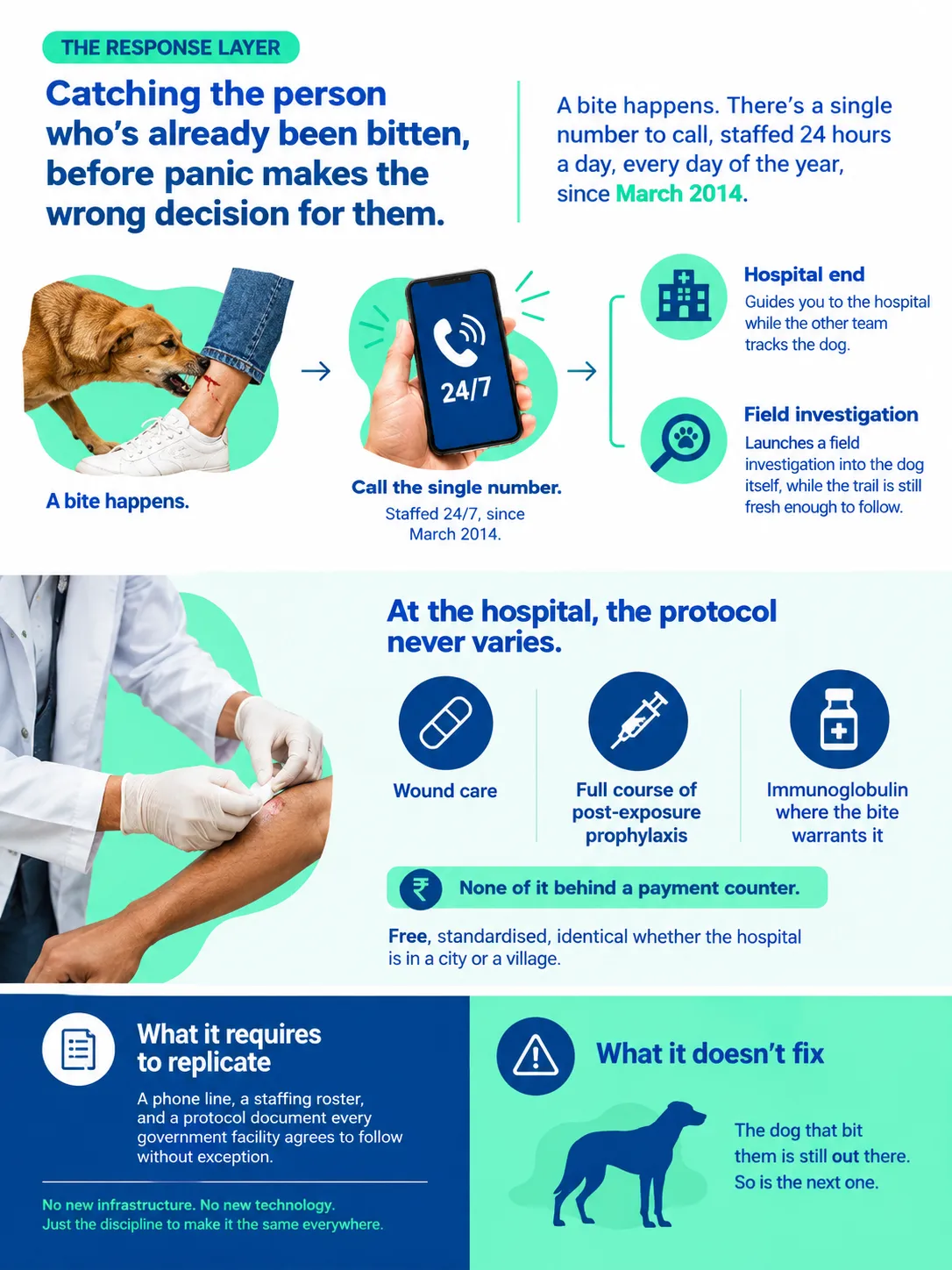
What it’s for: Catching the person who’s already been bitten, before panic makes the wrong decision for them.
Picture it running: a bite happens, and there’s a single number to call, staffed 24 hours a day, every day of the year, since March 2014. The call does two things simultaneously — it walks the caller toward the hospital, and it launches a field investigation into the dog itself, while the trail is still fresh enough to follow.
At the hospital end, the protocol never varies. Wound care, a full course of post-exposure prophylaxis, immunoglobulin where the bite warrants it — and none of it behind a payment counter. Free, standardised, identical whether the hospital is in a city or a village.
What it requires to replicate: A phone line, a staffing roster, and a protocol document every government facility agrees to follow without exception. No new infrastructure, no new technology — just the discipline to make it the same everywhere.
What it doesn’t fix: The dog that bit them is still out there. So is the next one.
-
The source layer
What it’s for: Shrinking the population that’s actually causing the bites, until the disease can no longer sustain itself.
The number that matters here is 70%. Vaccinate at least seven in ten dogs in a free-roaming population, and transmission collapses under its own weight — too few susceptible hosts left for the virus to keep hopping between them. Fall short, even by a little, and rabies persists indefinitely, no matter how well Module 1 is running.
Seventy percent of a population nobody has ever formally counted is the hardest number in this entire blueprint to hit — harder than funding, harder than staffing. What made it achievable in Goa wasn’t more vaccine.
/filters:format(webp)/english-betterindia/media/media_files/2026/09/25/2-2026-09-25-17-51-11.png)
It was better information: tracking coverage closely enough, block by block, that “we vaccinated a lot of dogs” became “we vaccinated 70% of the dogs in this specific taluka, verified” — a level of precision that turns a vaccination drive into a vaccination system.
What it requires to replicate: Not a bigger vaccine budget. A tracking discipline — knowing, continuously, which areas have crossed the threshold and which haven’t, so effort goes where the gap actually is instead of wherever teams happened to walk.
What it doesn’t fix: A population that’s never been taught the first 15 minutes still panics when a bite happens. That’s the third module.
-
The prevention layer
What it’s for: Making sure the next generation doesn’t need Module 1 as often, and knows what to do in the moment it does.
Starting in 2014, rabies education officers moved through Goa’s schools ahead of each vaccination cycle, teaching four ideas built for the age of the child in front of them: rabies is serious, here’s how you avoid provoking a bite, here’s what to do in the first minutes if one happens anyway, and — the idea underneath all three — none of this is inevitable.
By 2020, it wasn’t a side programme anymore. It was written into the state science curriculum for 11- and 12-year-olds, with community sessions reaching over 150,000 people a year beyond the classroom. A child taught the 15-minute rule at eleven doesn’t freeze at twenty-five.
/filters:format(webp)/english-betterindia/media/media_files/2026/09/25/3-2026-09-25-17-51-56.png)
What it requires to replicate: A curriculum slot and a state board willing to grant it. The cheapest module in the blueprint, and the one with the longest payoff horizon.
What the full build produced
Run all three modules together, for long enough, and this is what came out the other end: human rabies deaths in Goa fell from 17 in 2014 to zero by 2018. Canine rabies cases dropped 92% over the same period. In 2018, Goa became India’s first rabies-controlled state — the first geography in the country to earn that status for any zoonotic disease.
An independent cost analysis priced the entire three-module system at roughly USD 526 per disability-adjusted life year averted — comfortably inside the WHO’s own threshold for a “very cost-effective” public health intervention. This wasn’t an expensive fix. It was a well-sequenced one.
The build order, for a state starting from zero
-
Stand up Module 1 first. It’s the fastest to deploy and saves lives immediately — a hotline and a free, standardised PEP protocol need no new infrastructure, only political will and a staffing roster.
-
Layer in tracking before scaling Module 2. Vaccinating dogs without knowing which areas have crossed 70% is effort spent blind. Build the measurement system alongside the vaccination drive, not after it.
-
Write Module 3 into the curriculum early, even though it pays off last. The five-year lag is the cost of waiting — a state that starts the school programme in year one sees its dividends by year six, not year one.
-
Don’t treat any module as optional. Goa’s numbers came from running all three at once, for years, without gaps. A state that only builds Module 1 will keep saving bite victims while the dog population — and the disease — stays exactly where it was.
/filters:format(webp)/english-betterindia/media/media_files/2026/09/25/5-2026-09-25-17-52-50.jpg)
India’s National Rabies Control Programme has started building toward this same structure nationally: a dedicated tracking platform launched in March 2024, and a Rabies-Free Cities initiative is now underway across 15 cities in six states, working toward the same standard — reliable Module 1 infrastructure running alongside systematic, trackable Module 2 vaccination drives of their own.
None of the three modules need anything unique to Goa.
That’s what makes this a blueprint, and not a story about a state that got lucky.
Sources
‘Elimination of human rabies in Goa, India through an integrated One Health approach‘: A. D. Gibson et al., Nature Communications, 19 May 2022
‘Goa State and Mission Rabies – achieving rabies-free status together’: United Against Rabies Forum
‘Can India finally eliminate rabies? A state-level study from Goa offers hopeful signs‘: Gavi, the Vaccine Alliance
Disclaimer : This story is auto aggregated by a computer programme and has not been created or edited by DOWNTHENEWS. Publisher: thebetterindia.com