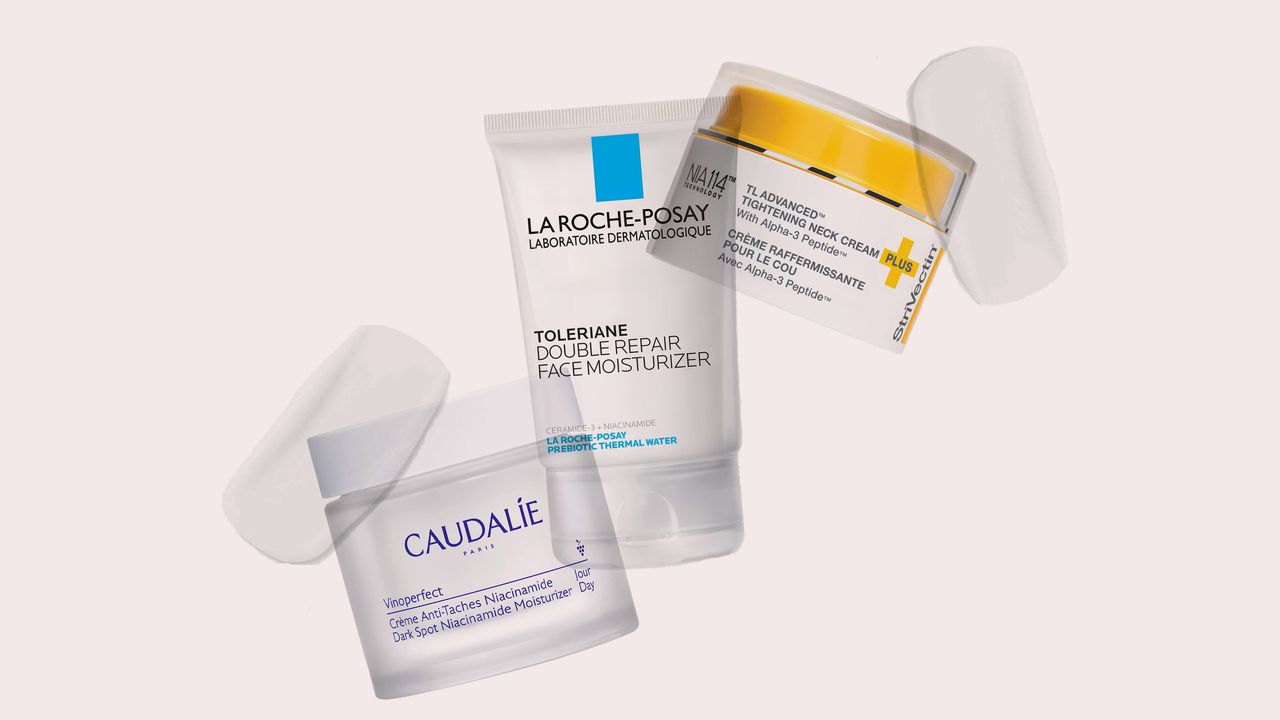
But the real selling point is the texture: ceramides and other emollients “create a nice skin feel that is unlike more common mineral sunscreens,” says cosmetic chemist Amanda Lam who is based in LA. And while some mineral formulas take some wrestling to blend in, this pick glides onto skin without leaving any cast.
Frequently asked questions
What do dermatologists recommend for menopausal skin?
When choosing a face moisturizer for menopausal skin, prioritize ingredients that replenish hydration and support the skin barrier. Look out for “ceramides, hyaluronic acid, glycerin, peptides (particularly copper peptides for collagen support), niacinamide for barrier repair, and squalane,” recommends Dr. Shokeen. If you want to incorporate actives into your routine, retinoids can also help address collagen loss. “Retinoids remain the best-studied for collagen stimulation, but they need a strong moisture foundation underneath them, or they’ll worsen the dryness,” says Dr. Shokeen.
How can I stop dryness during menopause?
You need a two-pronged approach that pairs hydration with moisture. To that end, “look for a combination of humectants, which draw water into the skin, and barrier-supporting or occlusive ingredients that help keep it there,” says Dr. Kobets. Think about how you dress in colder weather—it’s all about layers. The same approach applies to your skin-care routine.
Dr. Shokeen recommends applying a humectant first to damp skin, such as a hyaluronic acid- or glycerin-based serum, followed by a peptide or ceramide treatment, and then sealing everything in with a richer moisturizer or facial oil at night. In the morning, you can keep the routine lighter and finish with sunscreen to fend off sun damage. “Sun protection is non-negotiable because the thinner barrier is more vulnerable to UV-induced moisture loss and irritation,” says Dr. Shokeen.
How does menopause affect the skin, and why does it often become drier?
It’s not just in your head if your skin suddenly feels tighter, drier, or less supple; hormonal changes can have a direct impact on skin. “As estrogen declines, the skin loses some of that water-holding capacity and transepidermal water loss increases, so it can become thinner, drier, and less elastic,” says Dr. Kobets. Collagen loss is another major piece of the puzzle: “It can decline by as much as 30% during the first five years after menopause and then continues to decrease more gradually,” says Dr. Kobets. These changes can make it feel as though your skin has transformed almost overnight, even though the underlying changes have been building over time.
Meet the experts
- Kseniya Kobets, MD, a board-certified dermatologist and director of cosmetic dermatology at Montefiore Einstein Advanced Care, based in Elmsford, New York
- Divya Shokeen, MD, a board-certified dermatologist and founder of OSVI Dermatology and Surgical Institute, based in California.
- Amanda Lam, a cosmetic chemist based in Los Angeles, California.
How we test and review products
When Allure tests a product, our editors look at it from every angle in an effort to best serve you. We review ingredients, scrutinize brand claims, and, when necessary, examine peer-reviewed scientific and medical studies. In addition to testing each and every product that’s included in each and every review, we rely on experts who shape their fields, including dermatology, cosmetic chemistry, and medicine, to help us vet the ingredients and formulas.
For our list of the best moisturizers for dry menopausal skin, we considered each product’s performance across five primary categories: product ingredients and efficacy, packaging, fragrance, texture, and product wear. Every product was determined to have excelled in each category by our editorial team, which is composed of in-house writers and editors as well as contributors—along with special consideration from dermatologists. To learn more information on our reporting and testing processes, read our complete reviews process and methodology page.
Our staff and testers
A beauty product is a personal purchase. You might be searching for a face cream to address persistent dryness or a new nail product to add to your Sunday self-care routine; you may simply be browsing around for the latest launches to hit the hair market. No matter what you seek or your individual needs and concerns, Allure wants to ensure that you love anything we recommend in our stories. We believe that having a diverse team of writers and editors—in addition to the wide range of outside testers and industry experts we regularly call upon—is essential to reaching that goal.
After all, can we really say a skin-care product is the “best” for people over 50 if the only testers we’ve solicited opinions from folks who have yet to hit 30? Can we honestly deem a high-end diffuser worthy of your hard-earned cash if it’s never been tested on curls? We’re proud that our staff spans a wide range of ages, skin tones, hair textures, genders, and backgrounds, which means that we are able to fairly assess any beauty product that comes into the beauty closet.
Disclaimer : This story is auto aggregated by a computer programme and has not been created or edited by DOWNTHENEWS. Publisher: www.allure.com