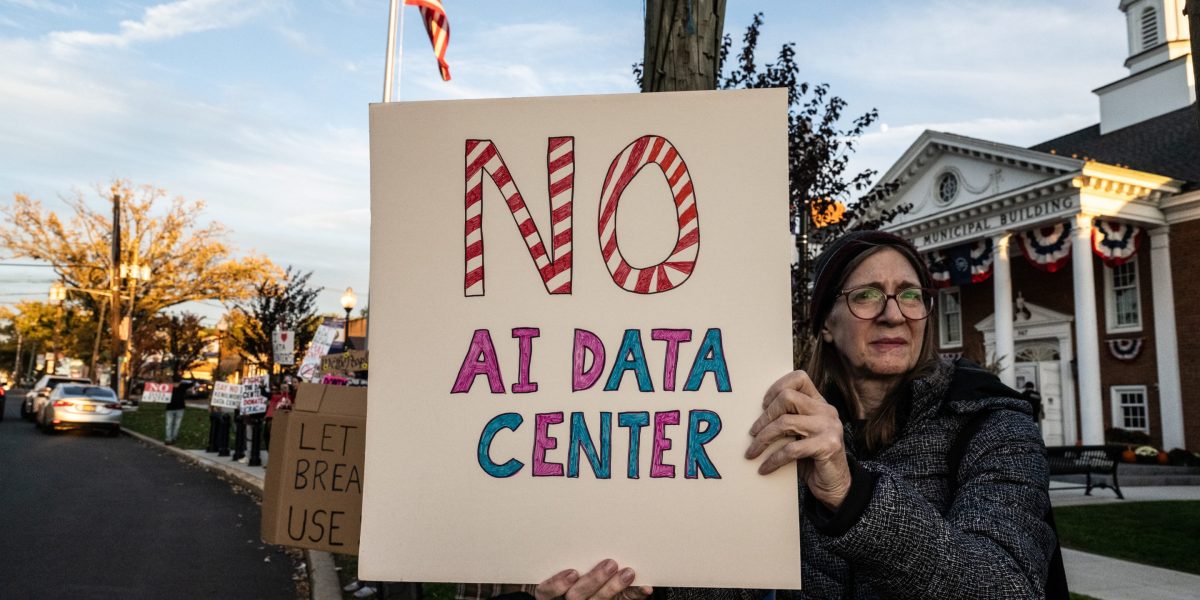
It’s a question that will define the next phase of the economy’s AI transformation: How will tech giants solve their PR problem with data centers?
The demand for data centers in the U.S. alone is huge, as is the capital expenditure on them. McKinsey estimates that between 2024 and 2030, demand for data centers will nearly quadruple, from 25 GW to more than 80 GW.
In the first half of last year, AI-related spending accounted for almost one percentage point of real U.S. GDP growth, Goldman Sachs noted, “Without it, U.S. GDP growth would have almost flatlined.”
But there’s a snag: Communities don’t want data centers on their doorsteps. A Pew Research study from September suggests environmental concerns are a leading factor in the negative perception of the builds, followed by home energy costs and the quality of life for people living nearby.
Some experts say that the tension between an aversion to data centers and the economic need will find its own balance. Professor Jeremy Siegel, emeritus professor of finance at Wharton, suggests: “If one community rejects a data center, another will welcome the investment, jobs, and tax revenues.”
But Stavros Gadinis, a law professor at UC Berkeley, suggests history has already provided a “playbook” for next steps. Gadinis, faculty director of the Berkeley Center for Law and Business, says there is a “better way.”
Speaking exclusively to Fortune on the sidelines of Web Summit in Lisbon, Professor Gadinis explains: “So, that playbook involves, first off, outreach to impacted parties and impacted communities. I don’t mean just the local [communities]—although obviously these are key—but also nonprofits, academics.”
Concerned parties need to be given a stake in the development, he added, but the impetus needs to come from large investors who have the power to lay down conditions before putting their hands in their pockets. Only when these terms are met can builders “get the ball rolling” on developments, Professor Gadinis added.
“The final part, I think, has to come through accountability from these companies to try to show how they respected the policies and the goals, and how they’re moving ahead and what they’re contributing.”
Public pushback to data centers is spreading rapidly across the U.S.—even in Texas, home to Elon Musk’s SpaceX, which merged with Musk’s AI-specific firm, xAI, earlier this year.
If conflicts and permit delays are bubbling up in Texas, Professor Gadinis adds, such gridlock is “possible everywhere.” The author of Corporate Ordering added that neither AI companies nor the White House want to see a breakdown, explaining, “The biggest advantage that we have against our global competitors is our ability to build compute, of which data centers are a very important part. So we actually need to take some steps to bring everyone closer together in that question.”
The regulation issue
The other question hanging over the AI sector is regulation.
The Democratic landslide at the midterms is likely to result in more scrutiny of companies that have enjoyed significant freedoms under the Trump administration, with the market sliding last week on those prospects, analysts suggested.
A back-and-forth has been played out between AI hyperscalers and policymakers in Washington, D.C.: Some founders want government regulation, but figures like Treasury Secretary Scott Bessent have insisted the government will not become a “liability shield” for tech giants.
Professor Gadinis suggested that whether the government or AI sector acts first to establish frameworks is largely irrelevant, as long as “it is built on the right foundations.”
“My prediction would be that once practice is crystallized, then the government is going to say: ‘OK, we found it, now do this, and everybody does it,” he added.
Indeed, it’s already too late to decide whether the liability buck stops with AI companies or the government, the academic added: “The investment we have is so huge as a percentage of the [U.S.] GDP that they’re already too big to fail. They became too big to fail almost instantly in 2023.”
It’s “very hard” to imagine the government not being a backstop in any potential crisis, he added, “especially in an issue that the government itself has elevated into a national security concern. If a batch of subprime mortgages can cause a financial crisis, AI is looming large.
“So I think it’s too late, and I think that realization also explains why people are asking for more regulation, because to some extent we’re all in it—whether we want it or not.”
Disclaimer : This story is auto aggregated by a computer programme and has not been created or edited by DOWNTHENEWS. Publisher: fortune.com