
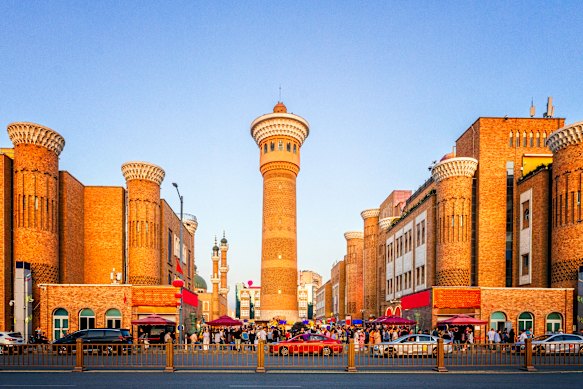

A hefty camo-coloured drone hovers over a gargantuan Bactrian camel festooned in Central Asian finery. The animal lollops from within Kashgar Ancient City’s arched gate, red-caped jockey astride. A fenced-in crowd of mainly Chinese domestic tourists watches the (daily) opening ceremony, in turn watched by conspicuous nests of CCTV cameras.
The carnivalesque parade is an abridged history lesson, an apparent tribute to the local Uyghur culture. The historical cross-section of southern Silk Road colours, adornments and patterns overwhelm. Warriors trot by on horseback, bows dramatically drawn. Turbaned men wearing black pointy boots twirl dervish-like alongside women in red-velvet gowns.
Atop the city’s turreted walls, a costumed ensemble plays the Uyghur Muqam – a UNESCO-recognised “masterpiece of the oral and intangible heritage of humanity” – on a consort of instruments, such as the rawap, a pear-shaped string instrument. The 169-metre Kashgar Kunlun Tower looms surreally in the distance, a mechano-like braggadocio rising over the modern sprawling cityscape. After a dynamic, mellifluous flourish, the parade concludes. The drone buzzes down onto a pedestal; covers closing over it.
Two-millennia-old Kashgar – the unofficial cultural/spiritual capital of the Uyghur people – is located in a far-west corner of the huge Xinjiang Uyghur Autonomous Region in China’s north-west. The province-level region – on the cusp of the Pamir Plateau, the “roof of the world”, and immense, arid Tarim Basin – borders eight countries, including Kyrgyzstan, Tajikistan and Afghanistan.
Unlike elsewhere in Han-majority China, Xinjiang’s population comprises significant numbers of “ethnic minorities”, mostly Turkic-speaking Muslim cultures, of which the Uyghurs are the largest (there are Tajik, Hui, Kyrgyz, Uzbek, Kazak and Mongolian communities). I feel privileged to have the opportunity to tour Xinjiang’s lesser-touristed cities and astounding landscapes but, honestly, I’m still perplexed about one thing: I’m here as a guest of the Chinese National Tourism Office.
Sign up for the Traveller Deals newsletter
Get exclusive travel deals delivered straight to your inbox. Sign up now.
Why perplexed? The UN Office of the High Commissioner for Human Rights (OHCHR) claims that Xinjiang is a sight of “systematic human rights violations” of the Uyghurs with “credible allegations of patterns of torture or ill-treatment, including forced medical treatment and adverse conditions of detention, incidents of sexual and gender-based violence, and indications of coercive enforcement of family planning and birth control policies”. All such claims are denied by the ruling Chinese Communist Party.
Why send this travel writer/journalist into this politically vexed region? To attend the 19th Xinjiang Winter Tourism Industry Expo and, more broadly, to check out the fast-developing skiing opportunities in the region’s phenomenal trio of mountain ranges: Altay, Kunlun and Tianshan. Curiously, I am encouraged to “immerse [myself] in ethnic folk customs”.
First stop is Xinjiang’s capital, Urumqi, population 4.1 million, a six-hour flight from Hong Kong. The city officially adheres to Beijing time (4000 kilometres west) but people have their own timetable here; rarely beginning work before 10am in winter. At a cursory glance, Urumqi could be anywhere in industrious regional China; with a bigger-than-it-needs new airport, boisterous streets dense with electric cars, and surprisingly connected to the outside world (I roam using my Australian Vodafone plan, thus bypassing the “Great [internet] Firewall”).
A meander around Urumqi’s main bazaar unveils the city’s Central-Asian heritage. Mosque minarets thrust skyward. Turkic-faced stallholders predominate, flabbergasted to see my pasty Anglo countenance. They sell food you’ll find in the nearby “Stans”: nang flatbread and truckloads of dried fruit.
Next stop is Altay, a mountain-snuggled city a 90-minute flight away, in the “Ili Kazakh Autonomous Prefecture” (within Xinjiang). Again, the shopping precinct paints a faithful picture of the culture: burly, affable Kazakh men sell camel, horse and sheep milk products, alongside knock-off perfumes and fake Nikes. In restaurants, salty milk tea and horse dishes are on the menu (local lore says that the eaten animal gallops into paradise).
Xinjiang’s winter-tourism highlight, Hemu village, is a five-hour (4WD-only) drive north from Altay. The enthralling road trip parts snowy, yurt-dotted plains, winding up into the Altay Mountains, via nationally celebrated beauty spots such as Kanas Lake. Home to the Tuva people (who rode in Genghis Khan’s army), Hemu is unmistakably tourist-focused, but the low-rise wooden village, bowled in by snow-thick peaks, retains a small-world ambience of yore.
Nearby Hemu Jikepulin is a genuine “big-mountain” ski resort with a hastily expanding village (including the flashiest Holiday Inn Resort I’ve seen). From the top lift station, I see Russia, Kazakhstan and Mongolia in a single twirl. This is the best of Xinjiang’s claimed 101 ski areas (China reportedly now has around 700, including indoor venues).
However, last stop Kashgar – also, Kashi, “place where jade is gathered” – best encapsulates Xinjiang’s Uyghur culture and Central Asian Islamic aesthetic (The Kite Runner was filmed here). Its Gaotai Residential Area is a centuries-old snapshot of streetscapes as they were (despite a 2016 earthquake levelling sections, forcing a partial rebuild, reportedly, causing hundreds of family relocations).
Artfully intricate, colourful front doors pop out of rendered-earth walls in shadowy, anachronistic passageways; bricked streets are literally patterned with meaning. A hexagonal layout, for example, denotes “unimpeded access”. I browse offbeat emporiums, such as Aini’s Antique Shop, with its wall of vintage ghetto-blasters, and tourist shops selling Uyghur cultural keepsakes, including merch celebrating Xinjiang’s fat-tailed sheep (aka the viral Kardashian sheep). Some tourists visit Kashgar’s livestock market just to touch the animals’ derrieres.
Much of Kashgar’s Ancient City area has been rebuilt/renovated in the Uyghur/Arabic-style. Some say it’s ersatz and tacky but, for me, the inner city radiates a souk-like, exploration-inspiring energy. Locals live, hang out and shop here – a great place to buy “cool” warm headwear. A guide leads us deep into the Ancient City’s tourist trail. We visit a blacksmith’s shop, where a dance troupe uses his products as percussion instruments.
We tour a 300-year-old Uyghur (gold/pottery/carpet) merchant’s residence. A full-bearded, wool-hatted man with a commemorative-coin face poses for photos with generous jocularity. The cavernous white-poplar-beamed house harks back to a period of Silk Road prosperity. Among its 20 rooms, some adorned with handmade wool carpets from Hotan (to the south-east), is one reserved for pigeons.
At Hundred-Year-Old Tea House, we sup ginger, rose and saffron tea, seated on cushions, as a trio plays songs you’ll hear at Uyghur weddings and a traditional dancer flows around the bubbling space. Outside the city centre, we visit the Xiangfei (Fragrant Concubine) Garden to see the green-tiled-domed Apak Hoja Tomb and witness complex Uyghur dance routines.
The faces here, as everywhere, radiate a watchful warmth but, knowing what I know, I instinctively question every interaction. I wonder what is missing from what I’ve seen and heard, and just how much autonomy these folk have – in this supposedly “autonomous” region – once tourists look away.
A sign in the Kashgar (Silk Road) Museum hints at the underlying power dynamic: “Xinjiang has long been an inseparable part of Chinese territory … the various ethnic groups have long been part of the Chinese nation. It is the common interest for all ethnic groups to achieve the Chinese dream of national rejuvenation.”
That dream, say critics, is singular and homogenised, with no space for the Sunni Muslim Uyghurs to practice religion, for example. In my few moments away from the entourage, I whisper questions to English-speaking locals. “Are you allowed to worship,” I ask, in the stunning (and densely CCTV’d) Id Kah Mosque, for example? Mostly, I receive wordless, reticent smiles, until one young man whispers: “Some old people are allowed to; the young are not”.
As an information-gathering exercise, my visit to Xinjiang was fraught from the beginning. Flanked by a government-linked group, I was unlikely to see (or be taken to places) off the metaphoric peace-and-harmony trail. It was an ethical conundrum, too. Would I be a culture-washing puppet? Or, perhaps, should I leave the complexity and politics out of what, after all, is a travel story.
I couldn’t. You see, the story of Kashgar and Xinjiang is the story of the Uyghurs and others. I think travel can be a possible force for good here. One of my whispering sources tells me that the Chinese government’s recent focus on tourism here is starting to put real money into the pockets of Uyghur-owned business owners.
As each foreign visitor gets to see the situation for themselves – albeit a stage-managed version right now – a slowly swelling light potentially shines on this place and its people, a place with a very shallow pool of reliable, independent on-the-ground information for English-speaking outsiders.
Tourism-wise, Xinjiang region is a genuine sleeping tiger, so far kept slumbersome (and on the frontier) by the abovementioned and more than I can discuss here. Its mountains are incredible. Its compound of cultures, left to their own devices, are visit-worthy for their own sake. Sure, “they” will be watching you, too, when you visit, but my eyes and my mind felt free to do some exploring of their own.
DETAILS Cathay Pacific flies from Sydney to Xinjiang capital Urumqi, via Hong Kong. China Southern Airlines flies from Urumqi to Altay. Chengdu Airlines flies from Altay to Kashgar; room rates at five-star Yifei Hotel, Kashgar, start from $150.
The writer travelled as a guest of the China National Tourist Office.
From our partners
Disclaimer : This story is auto aggregated by a computer programme and has not been created or edited by DOWNTHENEWS. Publisher: www.smh.com.au





