When a young doctor was asked which armed force she wished to join, Padmavathy Swaminathan chose the Indian Air Force. She assumed the choice would put her in a cockpit.
As she later said, “I thought I would fly a plane if I join the Air Force”, and she learnt only afterwards that not everyone in the service is a pilot. That assumption preceded a 37-year career that reached its highest rank on 1 October, 2004, when Dr Padmavathy Bandopadhyay became the first woman Air Marshal of the Indian Air Force (IAF).
A song, a stipend and a wrong guess
Born in Tirupati on 4 November, 1944, she looked after her ailing mother from the age of three until she was 13, moved to Delhi, and learnt English from a college teacher before she topped the medical entrance examination.
After the 1962 war with China, the song Aye Mere Watan Ke Logo prompted her to tell her father that she wanted to join the army, although she did not yet know how the three forces differed.
At a time when very few women thought of joining the defence forces, the Military Nursing Service was her only option, and it required her to leave if she married. She therefore chose the Armed Forces Medical College in Pune, which also paid a stipend.
There she won the Chief of Air Staff’s Silver Medal for topping Physiology and a gold medal for Medicine, and on 22 January, 1968 she was commissioned as a flying officer.
The doctor who finally flew
Aviation medicine, the study of how flight affects the human body, soon placed her at the heart of the service. She completed a postgraduate diploma in the subject at Bangalore University in April 1975 and worked on hypoxia and the design of flying clothing.
Her wish to fly was eventually met in a different way. She told the Deccan Chronicle that male officers at first would not share their medical problems with her, so her husband asked her to fly with them, and that made them comfortable with her. As a researcher she later flew the Gnat, the Hunter and the MiG-21.
In the early 1970s she improvised an incubator that helped three premature babies, weighing 0.75 kg, 1 kg and 1.20 kg, survive. During the 1971 war, while posted at Air Force Hospital, Halwara in Punjab, she volunteered for hazardous duties in the operational areas. She and her husband both received the Vishisht Seva Medal in the same investiture parade, which The Tribune described as unmatched among couples in the armed forces.
From soldiers’ lungs to the Arctic
Her research then moved to high altitude. She contributed to the acclimatisation schedule for armed forces personnel posted at such heights and studied High Altitude Pulmonary Oedema, a condition in which fluid collects in the lungs.
In 1989 and 1990 she joined an expedition to the Arctic, a 10-week trip that evaluated the physical and psychological problems linked to extreme cold. She became the first Indian woman to conduct scientific research at the North Pole. The Tribune reported that temperatures there, normally around -35 degrees Celsius, can fall to -55 degrees Celsius when the wind blows.
Three stars and a wider sky
In 1978 she had already become the first woman officer to successfully complete the Defence Services Staff College course at Wellington. She became the first woman Air Commodore in 2000, when she also became the first woman to command the Air Force Central Medical Establishment in Delhi.
/filters:format(webp)/english-betterindia/media/media_files/2026/10/12/3-2026-10-12-14-04-05.png)
She became the first woman Air Vice Marshal in 2002, and in 2004 she took charge as Director General Medical Services (Air) at Air Headquarters.
Her rise came while women were still new to the flying branch. Women had piloted IAF transport aircraft and helicopters only since 1991, and they went on to fly helicopter sorties through the Kargil war zone in 1999.
The first three women fighter pilots were commissioned on 18 June, 2016, nearly 12 years after her promotion.
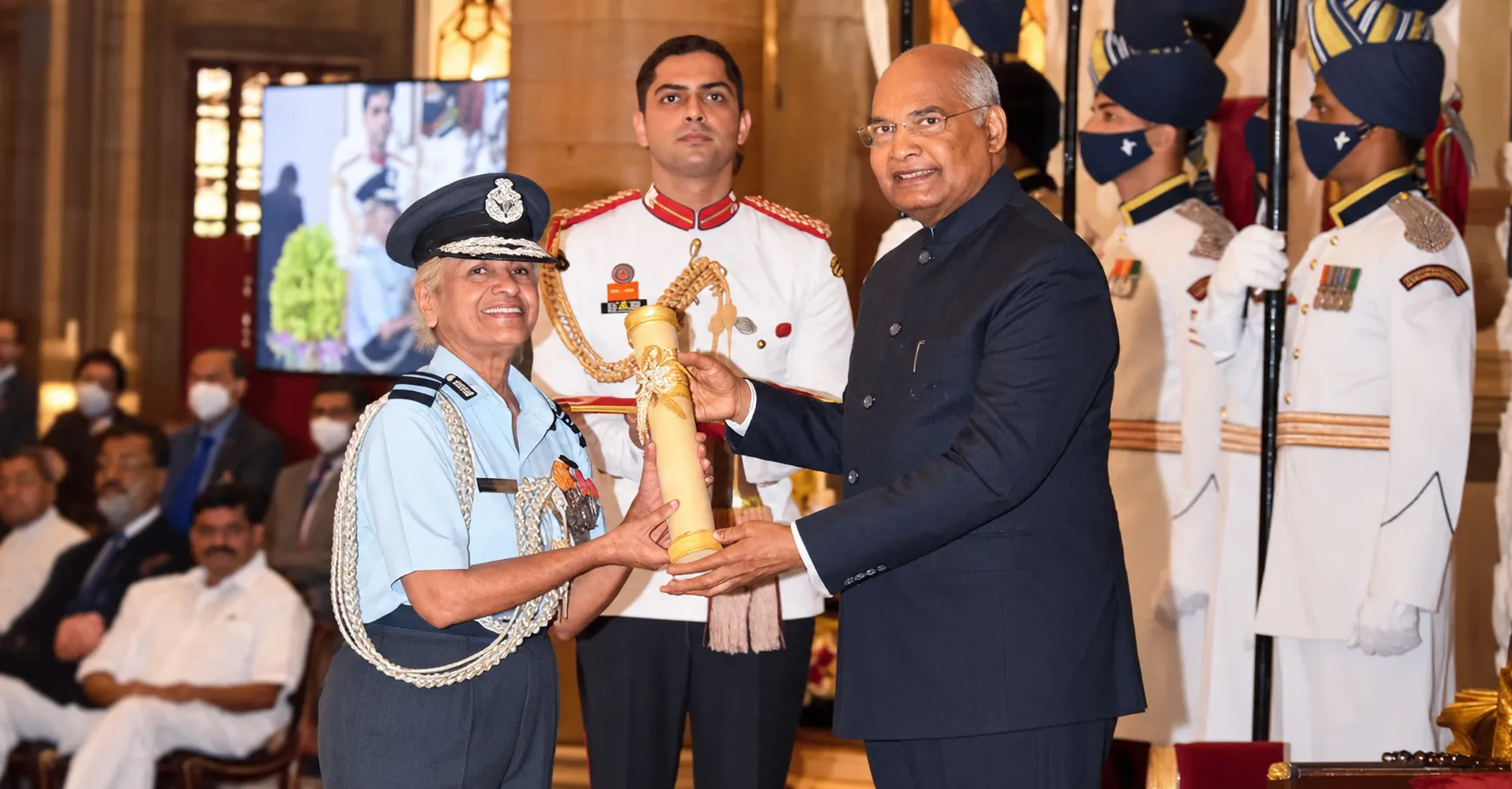
On 8 November, 2021, President Ram Nath Kovind presented the Padma Shri for medicine to a woman who had once stood outside a college classroom every day because she did not know English. She never got the cockpit she imagined as a doctor.
She spent 37 years keeping the people in cockpits fit to fly, rose to a rank no woman in the IAF had held, and became, the Deccan Chronicle reported, the first defence officer to receive a civilian honour.
Sources:
‘Woman of many heights‘: by Priyanka Chandani for Deccan Chronicle, Published on 1 April, 2020
‘Always a high-flier‘: by Girja Shankar Kaura for The Tribune, Published on 10 October, 2004
‘India’s first woman Air Marshal Dr Padma Bandopadhyay awarded Padma Shri‘: by ANI for ANI News, Published on 8 November, 2021
‘India gets its first women fighter pilots‘: by IANS for Morung Express, Published on 18 June, 2016,
‘Meet Air Marshal Padma Bandopadhyay: The First Woman to Reach Three-Star Rank in the IAF‘: by SSBCrack Editorial Team for SSBCrack, Published on 28 May, 2026
Disclaimer : This story is auto aggregated by a computer programme and has not been created or edited by DOWNTHENEWS. Publisher: thebetterindia.com