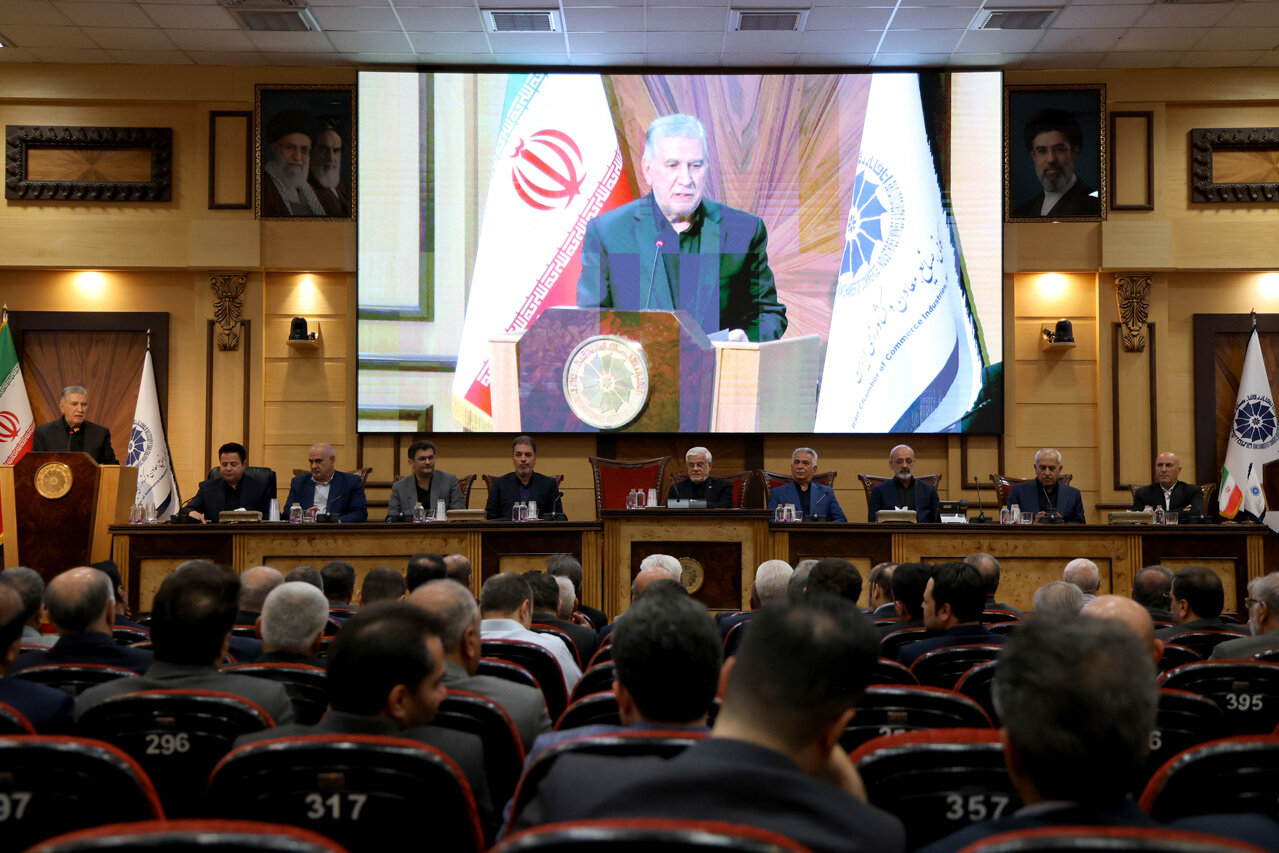
TEHRAN- During the 33rd session of the 10th term of the Board of Representatives of the Iran Chamber of Commerce, Industries, Mines and Agriculture (ICCIMA) while issuing a statement centered on appreciating the warriors and veterans of the Ramadan War and supporting the negotiation process and the agreement, entrepreneurs hosted Mohammad Reza Aref, the First Vice President of Iran.
In the latest meeting of the Board of Representatives of the Iran Chamber, which was held with the presence of the First Vice President, in addition to three reports being presented in the areas of trade and currency, transportation and transit routes, and how to optimally utilize resources that are likely to be freed up, the members of the Board of Representatives issued a statement regarding the appreciation of the warriors and veterans of the Ramadan War and support for the negotiation process and the agreement.
In this meeting, Samad Hassanzadeh, head of the Iran Chamber, cited the measures and recommendations of the heads of chambers across the country to economic enterprises regarding maintaining production and employment capacity during the recent imposed war as important factors in maintaining social stability and noted: “During the 12-day war and the Ramadan War, we witnessed epics created by economic activists in the continuation of production, especially in the production of basic goods, and today no problems are seen in the people’s livelihood and the supply of essential needs, and this is due to the support of economic activists, all officials of the country, ministers, and heads of all organizations that have always provided great cooperation.”
Iran Chamber’s plans for post-war and reconstruction era
In another part of his speech, the head of the Iran Chamber of Commerce, Industries, Mines and Agriculture, spoke about the Iran Chamber’s plans for the post-war period, saying: “The Iran Chamber of Commerce, Industries, Mines and Agriculture has made plans for the post-war era, the recent agreement, and negotiations with the United States, aimed at rebuilding Iran and compensating for the damages suffered by entrepreneurs and enterprises during the war, which have caused production difficulties.”
He stated that the Iran Chamber’s plan for the reconstruction period will soon be sent to the heads of the three branches of government and other senior officials of the country.
Appreciating the sincere efforts of the negotiating team and announcing the full support of private sector for peace and security, he said: “Entrepreneurs have always announced their rational support for the policies and programs of the serving government, and alongside the government, with national consensus, they have provided support in the field of economic activities aimed at creating peace, security, tranquility, and improving the livelihood and lives of the people.”
Referring to the conditions of sanctions, restrictions, and problems that the country’s economy has been grappling with for several years, Hassanzadeh said: “Despite all the problems, to this day, with the prudence of all officials, conditions have been created so that problems are solved scientifically and expertly. However, in some issues, entrepreneurs have problems that we are interested in solving through dialogue and consultation, and measures should also be taken to resolve ambiguities.”
Stating that some economic activists are concerned about fulfilling foreign exchange commitments due to the increase in the exchange rate, he continued: “Therefore, economic activists who have exported and today want to fulfill their foreign exchange commitments do not have the ability to provide these amounts, and it is necessary, in consultation with the Governor of the Central Bank and the Minister of Economic Affairs and Finance, to reconsider the issue of fulfilling foreign exchange commitments, especially in the field of technical and engineering services, which have faced problems in this area for several years.”
In another part of his speech before the Board of Representatives of the Iran Chamber, in the presence of the First Vice President, Hassanzadeh said: “Good approvals, decisions, and circulars are issued in the country, but they face very big problems in implementation – meaning they are either not implemented at all or are implemented insufficiently. Therefore, a central command for decision-making on some important economic issues in the country is strongly felt, and it is necessary for you, Excellency, to pay more attention in this regard.”
Country’s governance in post-war conditions is different from the past
Mohammad Reza Aref, the First Vice President, also emphasized the decisive role of the “technology front” in the third imposed war, saying: “The achievements of this war are owed to the officers of the science and technology front, and Iran stood firm against pressures to stop nuclear technology, because being limited in this area could have led to the cessation of other advanced technologies.”
He also stressed: “The country’s governance in post-war conditions is different from the past, and the Chamber of Commerce, as the parliament of the private sector, has an important responsibility in realizing the country’s progress goals.”
Referring to the activity of five fronts – the battlefield, diplomacy, service, the streets, and technology – during the war, Aref considered the technology front to be one of the main factors of the country’s success and said: “Iran, relying on its scientists and elites, has achieved important accomplishments in fields such as nuclear technology, nanotechnology, biotechnology, and radiology.”
The First Vice President also said: “Iran has never retreated from its red lines and national interests in the negotiations, and ‘surrendering is not in the nature of Iranians.'”
According to him, the enemy was forced to retreat due to weakness in the diplomatic arena, and its opposition to Iran’s nuclear program stems from concerns about the country’s technological progress, not the issue of nuclear weapons.
Also referring to the new conditions after the war, Aref emphasized utilizing national capacities, including the Strait of Hormuz and receiving transit rights, and concluded: “To achieve the region’s top position in advanced technologies, appropriate internet without development-impeding restrictions must be made available to economic activists and technologists.”
Statement by Iran Chamber’s Board of Representatives regarding support for the agreements
Following this meeting, the statement of the Board of Representatives of the Iran Chamber was read. In this statement, it is stated: “The community of private sector economic activists of the country believes that prudence, rationality, and the preference of the supreme national interests necessitate welcoming any initiative, understanding, and agreement that can lead to the end of hostilities, reduction of tensions, stabilization of security, and opening new horizons for the country’s economic and commercial interactions.”
Based on this statement, the Iran Chamber of Commerce, Industries, Mines and Agriculture condemned the unjustified unilateral sanctions imposed on a number of entrepreneurs, traders, and private enterprises of the country.
EF/MA
Disclaimer : This story is auto aggregated by a computer programme and has not been created or edited by DOWNTHENEWS. Publisher: tehrantimes.com