
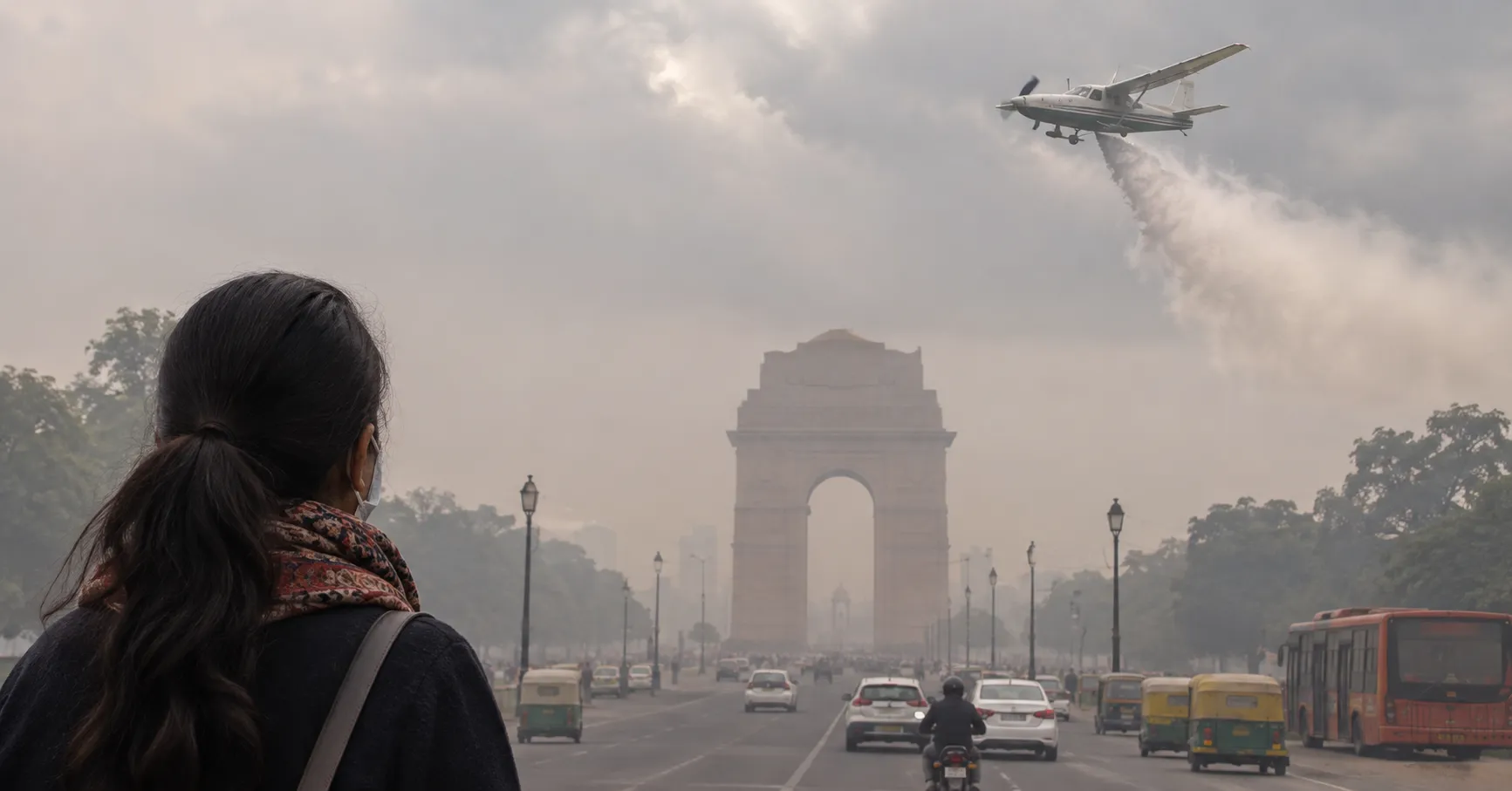
Every winter, Delhi struggles with worsening air pollution. As smog settles over the city, efforts to clear the air raise an unusual possibility. What if it rained? Could artificial rain wash away pollutants and make the air easier to breathe?
The idea gained attention after the United Arab Emirates (UAE) invested in cloud seeding, a technique that encourages existing clouds to produce rainfall. Research in the region has also highlighted how rain can reduce airborne dust and particulate matter.
This raised hopes that the same technology could help Delhi tackle its pollution. In October 2025, the Delhi government partnered with the Indian Institute of Technology (IIT) Kanpur to conduct a cloud-seeding experiment. However, the operation failed to produce meaningful rainfall in the capital.
So, why did a technique associated with improved air quality in Dubai fail in Delhi? The answer lies in differences in weather conditions, cloud formation, and the limitations of cloud seeding.
What happened in Dubai?
The UAE has invested in cloud seeding for decades to increase rainfall in a country that receives very little natural precipitation. Its programme primarily aims to improve water security and replenish groundwater.
Researchers have also examined whether rainfall could help reduce air pollution in the region.
A study published in the journal Environmental Pollution examined atmospheric dust and particulate matter around Dubai and Abu Dhabi. It found that dust storms contributed to higher concentrations of suspended particles, while rainfall helped bring these levels down.
A January 2021 report by The National highlighted these findings.
When raindrops fall through the atmosphere, they collect suspended particles and carry them towards the ground. This process, known as wet deposition, helps remove some pollutants from the air. However, the research established the benefits of rainfall in reducing airborne dust. It did not conclusively prove that cloud seeding alone was responsible for improving Dubai’s air quality.
How does cloud seeding work?
Cloud seeding does not create clouds or produce rain from a clear sky. It works by introducing tiny particles into existing clouds to encourage water droplets or ice crystals to grow. Depending on the cloud type and atmospheric conditions, scientists use materials such as silver iodide or salts, including sodium chloride and potassium chloride.
These particles act as nuclei around which water droplets or ice crystals form. As the droplets grow heavier, they may eventually fall as rain.
The UAE uses specially equipped aircraft to release seeding materials into suitable clouds.
However, the technique needs naturally occurring clouds with sufficient moisture. According to the World Meteorological Organization, cloud seeding cannot create rain clouds or bring moisture into an otherwise dry atmosphere.

Why did the experiment fail in Delhi?
On 28 October 2025, aircraft carrying cloud-seeding flares conducted two sorties over parts of Delhi, including Burari, Karol Bagh, and Mayur Vihar. The experiment was part of a pilot project undertaken by the Delhi government in collaboration with IIT Kanpur.
However, it did not produce rainfall in Delhi. Only negligible precipitation was recorded in neighbouring Noida and Greater Noida, at 0.1 mm and 0.2 mm respectively.
The biggest obstacle was insufficient moisture in the clouds.
According to NDTV’s report on the experiment, IIT Kanpur director Manindra Agarwal explained that the clouds had moisture levels of around 15 to 20 percent, which were insufficient to trigger the desired rainfall.
A second attempt scheduled for 29 October was also put on hold because atmospheric conditions were unsuitable. The problem was not simply the technology or the material released by the aircraft. The clouds themselves lacked the conditions needed to produce rain.
Delhi’s winter weather adds to the challenge
Delhi’s weather makes cloud seeding particularly difficult during the months when pollution is at its worst.
During winter, the city frequently experiences low wind speeds, temperature inversions, and limited atmospheric mixing. These conditions trap pollutants close to the ground instead of allowing them to disperse.
At the same time, the atmosphere often lacks the moisture and suitable cloud formations required for artificial rainfall.
A study by IIT Delhi researchers titled ‘Can Cloud Seeding Help Tackle Delhi’s Air Pollution?’ examined weather and pollution data collected between 2011 and 2021.
The researchers found that suitable conditions for cloud seeding are relatively uncommon during Delhi’s winter pollution season. Western disturbances, which bring moisture and precipitation to north-western India, can occasionally create favourable conditions.
However, these opportunities are limited.
The researchers concluded that cloud seeding could be considered an emergency measure when suitable weather conditions exist, but it cannot serve as a dependable pollution-control strategy.
Can artificial rain really clear the air?
Rainfall can help remove suspended particles, but the relief is generally temporary.

The IIT Delhi research found that heavy rainfall can wash out PM2.5 and PM10 more effectively than light rainfall. However, pollutant concentrations can return to earlier levels within one to five days as vehicles, industries, and other sources continue releasing emissions.
Delhi’s pollution comes from several sources, including vehicular exhaust, construction dust, industrial emissions, waste burning, and agricultural residue burning. Even if cloud seeding successfully produces rain, it cannot stop these sources from adding fresh pollutants to the atmosphere.
There is also no conclusive evidence that cloud seeding consistently improves air quality in every region. A 2022 study published in the International Journal of Environmental Science and Technology examined particulate matter during cloud-seeding operations in the UAE and raised questions about the possible contribution of seeding materials to airborne particles.
What does this mean for Delhi?
Dubai’s experience shows how rainfall can help remove airborne dust, but it does not establish cloud seeding as a reliable way to reduce AQI. Delhi’s failed experiment highlights an important limitation. Technology can encourage clouds to produce rain, but it cannot compensate for unsuitable weather conditions.

Cloud seeding may offer temporary relief when sufficient moisture and suitable clouds are available.
For Delhi, cleaner air will depend less on waiting for artificial rain and more on preventing pollutants from entering the atmosphere in the first place. Better control of vehicle emissions, construction dust, industrial pollution, and agricultural burning will do far more for long-term air quality than waiting for the right clouds to arrive.
Disclaimer : This story is auto aggregated by a computer programme and has not been created or edited by DOWNTHENEWS. Publisher: thebetterindia.com




