Srinagar: Work on India’s first Petroglyph Conservation Park at Sindhu Ghat in Leh has gathered strong momentum, marking a historic effort to safeguard Ladakh’s invaluable archaeological legacy.
The project has entered an active phase, with the systematic and meticulous relocation of ancient rock carvings—petroglyphs—from vulnerable sites across the region. Officials in Ladakhi capital said this pioneering initiative builds on the foundation stone laid by Lieutenant Governor Vinai Kumar Saxena on April 18, World Heritage Day, underscoring Ladakh’s status as a cradle of ancient art and human history.
Situated along the banks of the Indus River, the park is envisioned as a dedicated conservation space that will protect, curate, and showcase centuries-old carvings increasingly threatened by natural weathering, unregulated tourism, infrastructure development, and human interference.
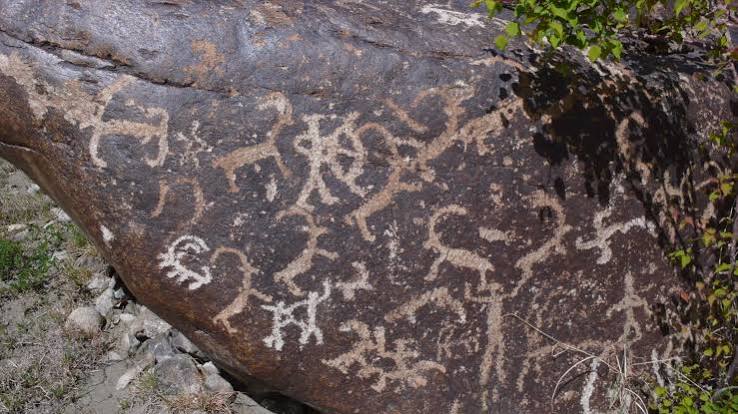
Petroglyphs—images and symbols carved directly into rock surfaces—are among the most enduring expressions of early human creativity. In Ladakh, these carvings span thousands of years, from the Palaeolithic Age to later historic periods, offering rare insights into migration patterns, trade linkages, belief systems, and ecological knowledge.
The conservation park aims to relocate endangered petroglyphs from isolated and damage-prone locations into a scientifically managed environment. This will ensure long-term preservation while making them accessible to scholars, researchers, and visitors through a curated and educational setting. An interpretation centre is also planned to enhance public understanding of this unique heritage.
The park is targeted for completion by September this year, reflecting the administration’s commitment to fast-tracking this landmark initiative.
So far, 31 petroglyphs from Saboo Thang have been successfully relocated to the site. These carvings range from 4 to 17 feet in circumference and weigh between 500 kilograms and 10 metric tonnes, highlighting the scale and precision involved in their transfer.
The engravings vividly depict Ladakh’s distinctive wildlife, including ibex, yak, argali, blue sheep, and dogs, alongside scenes of hunting, warriors, footprints, and symbolic motifs. Their distribution across the region reflects Ladakh’s ecological diversity—ibex figures dominate the lower valleys of Sham and Purig, while yak and argali are more common in the higher Changthang plateau.
The first phase of the project involves the relocation of 155 petroglyphs from multiple sites, including Phyang Thang (13), Stakmo Thang (30), Likir Hill (28), Likir Thang (14), and Taru Thang (10).
Additional carvings are being sourced from Thiksey, Igoo, Ganglas, Khaltse, Saspol, Ranbirpur, Nimoo, Spituk, Tsogsti, and other locations. Altogether, Ladakh is home to nearly 400 known petroglyph sites, many situated along riverbanks where they face heightened risks from development and human activity.
On the occasion of the foundation ceremony, a Memorandum of Understanding (MoU) was signed between the Ladakh Department of Archives, Archaeology and Museums and the Archaeological Survey of India (ASI) to strengthen collaborative conservation efforts.
Some of the oldest petroglyphs in the region even bear inscriptions in Chinese, Arabic, Sanskrit, and other ancient languages, reflecting Ladakh’s historic role as a cultural crossroads connecting Central and South Asia.
Describing the initiative as a “historic step,” Lt. Governor Saxena emphasised that relocating vulnerable petroglyphs into a protected space will preserve “an invaluable chapter of India’s civilisational legacy.” He highlighted that these carvings function as “open-air museums” and “civilisations carved on stone,” narrating the story of early human life—from hunting traditions to the emergence of Buddhist symbolism such as stupas and inscriptions.
The administration also aims to develop curated heritage circuits, including petroglyph and Buddhist circuits, to promote responsible tourism while easing pressure on over-visited sites. At the same time, strong emphasis has been placed on community participation, with local residents, monks, and youth encouraged to act as custodians of this shared heritage.
Spread across altitudes ranging from 2,500 to over 5,000 metres, Ladakh hosts one of the richest repositories of prehistoric rock art in South and Central Asia. Found in regions such as Domkhar, Dah Hanu, Alchi, Chilling, and Tangtse, these carvings provide a continuous visual record of human adaptation, belief systems, and cultural evolution.
The Petroglyph Conservation Park at Sindhu Ghat brings these scattered fragments of history under one protective umbrella, ensuring that this extraordinary legacy is preserved, studied, and appreciated for generations to come.
Disclaimer : This story is auto aggregated by a computer programme and has not been created or edited by DOWNTHENEWS. Publisher: deccanchronicle.com