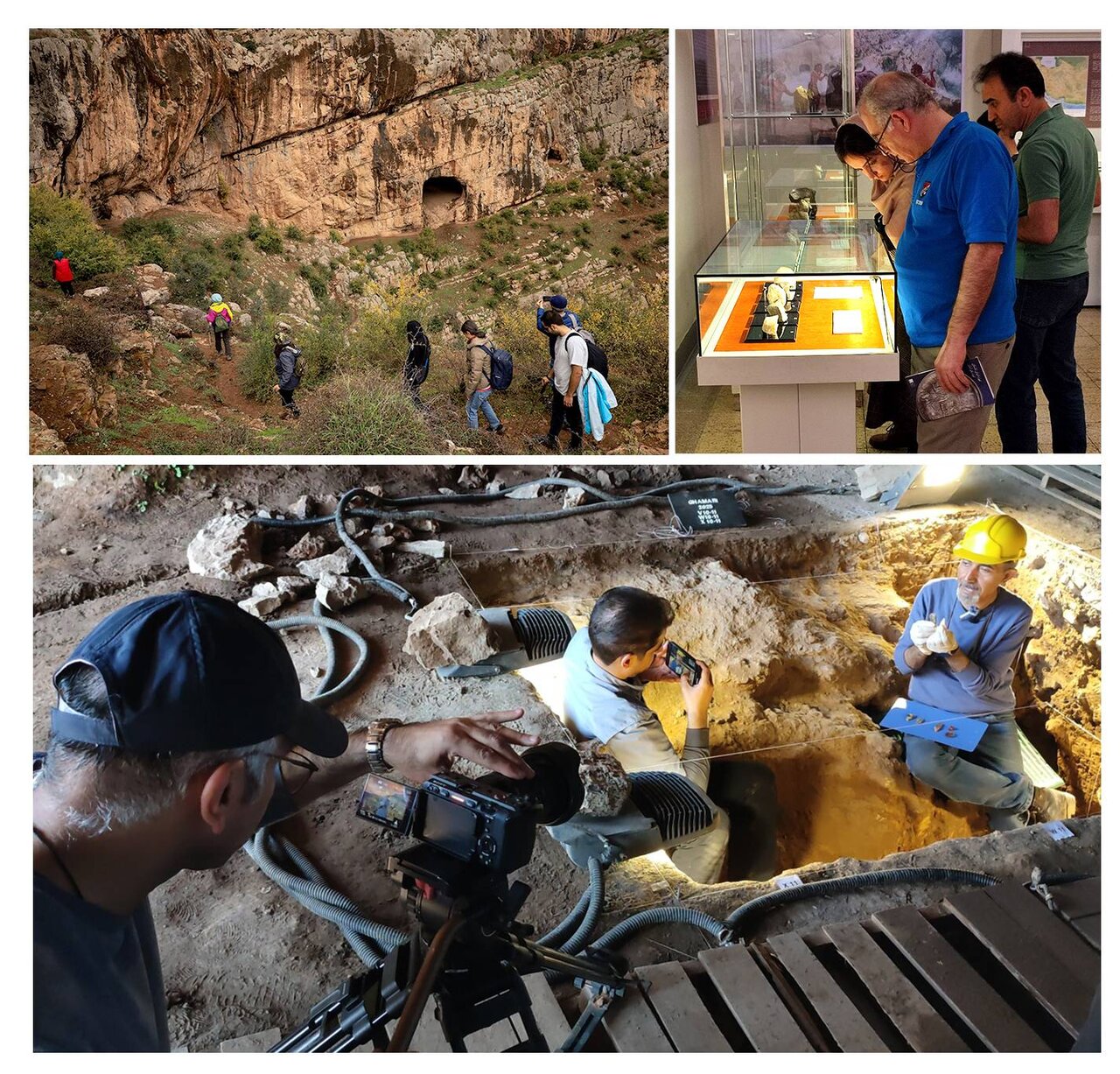
TEHRAN – On 17 October, archaeologists and cultural institutions worldwide mark International Archaeology Day, highlighting archaeology’s contribution to our understanding of the human past. The occasion also invites reflection on the broader role of archaeology in reconstructing human history, investigating changing relationships between people and their environments, and communicating scientific knowledge to the public through museums and other cultural institutions.
In Iran, this day offers a valuable occasion to recognize a heritage that extends far beyond monumental architecture and written records. Long before the emergence of urban centers, human groups inhabited the Iranian Plateau and its mountain ranges, developed stone-tool technologies and other early technologies, adapted to changing climatic conditions, and exploited a wide range of environments. The Paleolithic represents the longest period of this history, and it places Iran at the center of important debates concerning human evolution, hominin dispersals across Eurasia, and adaptation during the Pleistocene.
Situated between Southwest Asia, the Caucasus, Central Asia, and the Indian subcontinent, Iran encompasses a remarkable diversity of landscapes and ecological settings. These environments formed part of the geographical context in which prehistoric populations moved, settled, and adapted to changing conditions. Iran should therefore be understood not just as a corridor between better-known prehistoric regions, but as a distinct archaeological landscape with real potential to contribute to future research on the early human occupation, Neanderthal behavior, and the dispersal of Homo sapiens.
The earliest chapters of Iran’s Paleolithic record are documented primarily through stone-tool assemblages recovered from open-air sites and sedimentary contexts. Sites such as Kashafrud in northeastern Iran and Dehtal, north of the Persian Gulf, have contributed to discussions of Lower Paleolithic occupation. Nevertheless, questions concerning chronology, stratigraphic integrity, and the relationship between artifacts and their depositional contexts remain important. Addressing these issues requires carefully designed field investigations, critical reassessment of existing collections, and reliable dating wherever suitable materials and archaeological contexts are available. Darband Rashi Cave is a key example, where modern dating methods and lithics associated with faunal remains in stratigraphic context help advance understanding of Iran’s Lower Paleolithic.
The Zagros Mountains are particularly important for understanding the Middle and Upper Paleolithic in Iran. Caves, rockshelters, and highland valleys preserve archaeological sequences that provide evidence of Neanderthal technology, subsistence strategies, and responses to environmental change. These records are also essential for investigating the arrival and subsequent expansion of modern humans, as well as the cultural and demographic processes associated with the Middle-to-Upper Paleolithic transition. Together, they offer a valuable basis for examining how human populations occupied and adapted to the varied environments of the Iranian highlands.
Over recent decades, Iranian archaeologists have advanced Paleolithic research through independent projects as well as, in some cases, collaboration with international colleagues. Their work has expanded field investigations, strengthened analytical capabilities, and brought Iran’s prehistoric record to greater attention within the international archaeological community.
The contributions of Iranian women archaeologists have been particularly significant, advancing scientific knowledge, broadening research perspectives, and strengthening the foundations of the discipline. Dr Marjan Mashkour has made major contributions to zooarchaeological research, deepening our understanding of past subsistence strategies, human–animal relationships, and interactions between human populations and their environments. Through her teaching and mentorship, she has also trained and helped shape a new generation of Iranian zooarchaeologists, many of whom are now conducting research at institutions across Iran, contributing to the development of the field nationally. Her work illustrates how specialist research can enrich museum collections and exhibitions, helping visitors understand how animal remains recovered from archaeological sites provide evidence of past diets, economies, and relationships between people and animals. Dr Sonia Shidrang has also made important contributions to Paleolithic research and to the international recognition of Iran’s prehistoric heritage, notably through her involvement in the UNESCO nomination of the Prehistoric Sites of the Khorramabad Valley, which were inscribed on the World Heritage List in 2025. Beyond research and heritage management, her commitment to teaching and organizing workshops at Shahid Beheshti University and other institutions has helped transmit specialized knowledge and practical skills to a new generation of archaeology students. Their work illustrates how Iranian women archaeologists contribute not only to scientific research and international collaboration, but also to the development of national research capacity and the future of the discipline.
Field archaeology matters just as much for heritage management, particularly when development projects threaten archaeological sites and landscapes. The Darian Dam Archaeological Salvage Programme in the Sirwan Valley, conducted in 2015–2016, demonstrated the importance of archaeological investigation in a landscape undergoing substantial transformation. Although salvage archaeology cannot replace the preservation of sites in situ, it can document threatened remains and recover information that would otherwise be lost. The project also underscores why prehistoric landscapes, even when they lack monumental structures or visible architectural remains, must be recognized as integral components of Iran’s cultural heritage.
The Khorramabad Valley occupies an exceptional place within this broader archaeological landscape. Its caves, including Kunji, Yafteh, and Ghamari, preserve important evidence for reconstructing Paleolithic lifeways and investigating the long-term human occupation of the Zagros. In 2025, the inscription of the Prehistoric Sites of the Khorramabad Valley on the UNESCO World Heritage List marked a major achievement for Iranian archaeology. As a member of the nomination team, I witnessed firsthand the importance of a rigorous scientific foundation in securing international recognition for archaeological heritage. This inscription provides an important opportunity to advance archaeological research, strengthen site management and conservation, and communicate the valley’s significance to local communities and international audiences.
My work in Gilan Province similarly brought prehistoric research into dialogue with broader questions of cultural heritage through my involvement in the UNESCO nomination of the Cultural Landscape of Masouleh. This experience highlighted the value of examining cultural landscapes across different timescales, taking into account the environmental and historical processes that have shaped them. Archaeological research can extend this perspective beyond standing architecture and documented history to explore the deeper relationships between people and their environments.
Museums play an essential role in connecting archaeological research with public understanding. In 2001, I led the establishment of the Paleolithic Gallery at the National Museum of Iran to present archaeological evidence in a form accessible to a wider audience. Stone tools may appear simple at first glance, but their technological characteristics, raw materials, and archaeological contexts can reveal important aspects of past human behavior when interpreted carefully. The challenge for museums is to communicate these findings clearly while preserving the scientific context essential to their interpretation.
The establishment of the Zagros Paleolithic Museum in Kermanshah extended this work into the region whose archaeological record constitutes a major part of Iran’s Paleolithic heritage. Regional museums are particularly valuable because they connect archaeological discoveries with the landscapes and communities from which the evidence originates. More recently, Paleolithic displays developed at the Archaeological Museum of Lorestan in 2024 have further strengthened the presentation of western Iran’s prehistoric heritage within its regional context. Together, national and regional institutions can help audiences appreciate the diversity of Iran’s archaeological record and its contribution to our understanding of the human past.
Museums also play a central role in the responsible management of archaeological collections. An artifact’s scientific value depends not only on its physical characteristics, but also on its provenance, stratigraphic position, and association with other evidence. When these relationships are lost, important opportunities for interpretation and future research are diminished or disappear altogether. Documentation, conservation, and responsible curation must therefore remain integral to archaeological practice.
International Archaeology Day provides a moment to recognize the scientific and public value of Iran’s Paleolithic heritage. Advancing research requires sustained fieldwork, renewed investigation of existing collections, interdisciplinary collaboration, and stronger connections between research institutions and the public. Such efforts can integrate Iran’s archaeological record more fully into international scholarly debates while ensuring that future generations of researchers have the evidence, expertise, and institutional resources needed to investigate it.
As head of the Paleolithic Department at the National Museum of Iran, my experience in field research, museum development, and UNESCO nominations has reinforced the importance of connecting scientific investigation with public interpretation and long-term heritage management. Archaeology achieves its greatest value when discoveries contribute not only to scholarly understanding but also to a broader appreciation of humanity’s shared past. Iran’s Paleolithic record offers an exceptional foundation for advancing that understanding, connecting the history of human adaptation across deep time with the responsibilities of scientific research and cultural stewardship today.
AM
Disclaimer : This story is auto aggregated by a computer programme and has not been created or edited by DOWNTHENEWS. Publisher: tehrantimes.com