
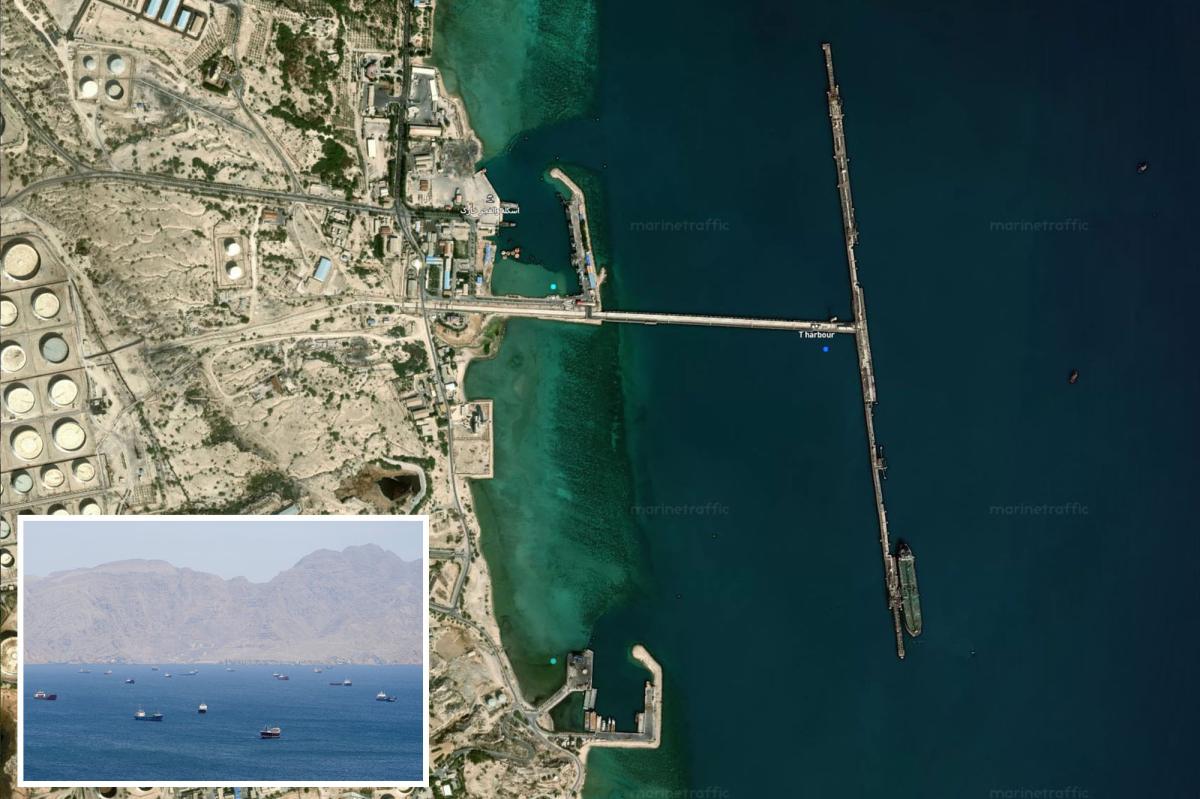
Iran is rapidly running out of space to store its oil as President Trump continues his naval blockade in the Strait of Hormuz — which could lead to “irreversible” damage to the regime’s biggest industry and lifeblood of its economy.
Massive supertankers have been spotted at Kharg Island, an oil-critical hub which controls roughly 90% of Iranian crude oil exports, Bloomberg reported, citing satellite imagery.
But with nowhere for the crude carriers to go with the US blockade around the Gulf of Oman, experts say it is a sign that the regime is using the vessels as floating storage.
Iran has repeatedly tried to push its ships through the US naval blockade, but its ships are routinely intercepted, with six tankers forced to turn back in recent days, ship-tracking data shows.
President Trump warned Sunday that the Islamic Republic had until Wednesday before Tehran reaches maximum capacity, putting billions of dollars at risk. Iran has been producing about 2 million barrels of oil a day during the war.
“If the Iranians have to shut down oil and gas production due to a lack of storage capacity, there will be permanent damage to the productivity of the oil fields,” said Derek Reisfield, Co-Founder of Marketwatch and a former McKinsey consultant.
“The damage will be irreversible,” he added. “The loss in capacity could easily be half a million barrels in daily production.”
The Critical Threats Project at the American Enterprise Institute think-tank also estimated to The Post that Tehran likely has until April 29 before its onshore storage facilities are filled.
The AEI’s estimates were matched by Energy Aspects, a UK-based fuel analyst firm, with FGE NextantECA, an energy and chemicals advisory company, claiming that Iran had about 122 million barrels of storage space, giving Tehran less than seven weeks before it has to shut down production.
But shutting down the oil fields also carries a handful of risks for the Islamic Republic.
Sudden and prolonged halts at oil production plants risk lasting damage to fuel reservoirs and make it increasingly difficult to restart operations and return to the same level of output as before.
“When you shut down production across an entire oil field, you will get water intrusion, chemical instability, which can cause things like clay swelling,” Reisfield explained.
“To regenerate production, you will have to spend money.”
An Iranian parliamentarian, Ahmad Bashesh Ast Ardastani, warned on Friday that the cost of restarting production should the oil fields shut down would be an enormous burden on Tehran’s already struggling economy.
“We must do something about this maritime siege, because if we are forced to shut down our oil wells, we will need billions of dollars to restart them,” he said, according to an Iran International translation.
“Shutting down our oil wells is not as simple as turning off a water tap,” he added.
Homayoun Falakshahi, the head of Kpler’s crude oil analysis team, said Iran has long suffered from underinvestment and reservoir management challenges, leaving the regime with an average recovery rate of 25% when production plants are shut.
While Iran has historically dealt with export disruptions by rotating which plants get their production curbed, the National Iranian Oil Company is “already under pressure as a growing share of oil revenues is diverted toward Islamic Revolutionary Guard Corps-linked channels, reducing funds available for upstream maintenance and recovery,” Falakshahi wrote in an analysis.
Experts have said that as Iran runs out of storage, it will likely tap its fleet to hold the overflow, with evidence of such a tactic appearing last week.
On April 23, maritime trackers reported that Iran recommissioned the retired Very Large Crude Carrier (VLCC) Nasha around Kharg Island.
Trump has seized the latest strain on Iran’s oil production to pressure the Islamic Republic into re-entering negotiations with the US, touting the storage limit on Sunday as a veritable ticking clock.
“When you have, you know, lines of vast amounts of oil pouring through your system, if for any reason that line is closed because you can’t continue to put it into containers or ships, which has happened to them — they have no ships because of the blockade — what happens is that line explodes from within, both mechanically and in the earth,” Trump told Fox News’ “The Sunday Briefing.”
“It’s something that happens where it just explodes. And they say they only have about three days left before that happens. And when it explodes, you can never, regardless, you can never rebuild it the way it was.”
A halt to Iran’s oil production, however, would also lead to soaring fuel prices in the global market, adding to the already 12 million barrels a day disrupted by the war.
Disclaimer : This story is auto aggregated by a computer programme and has not been created or edited by DOWNTHENEWS. Publisher: nypost.com








