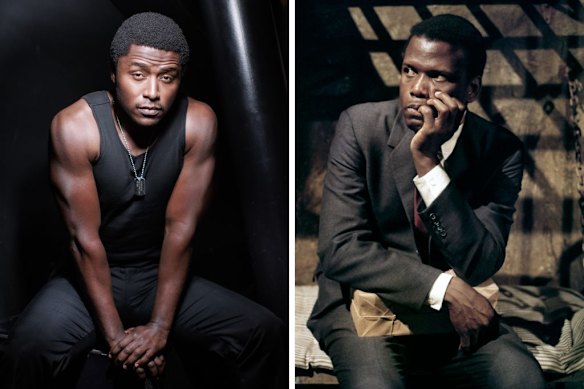
When Donné Ngabo auditioned to play Hollywood star Sidney Poitier, director Bert LaBonté knew he’d found his star.
The life of Donné Ngabo bears uncanny parallels to the celebrated actor Sidney Poitier, whom he depicts in the acclaimed stage play Retrograde. It’s four years since Poitier’s death, close to 60 since his meteoric streak of groundbreaking films: Lilies of the Field (1963), for which he became the first African American to win the Academy Award for best actor; In the Heat of the Night (1967), renowned for “the slap heard around the world” when Poitier’s Detective Tibbs returned a racist white man’s slap; Guess Who’s Coming to Dinner (1967), the still-sparkling romantic comedy about a feisty young woman who surprises her establishment parents with news of her engagement to a widowed black doctor.
When 24-year-old Ngabo was tapped to play Poitier in Retrograde, like any Zoomer he went straight to Poitier’s Wikipedia page. He knew Poitier’s name, as colleagues had often compared him to the Bahama-born actor. “I heard of him when he passed. I was like, ‘I should know who this person is.’”
Ngabo then watched all his films, Reginald Hudlin’s documentary Sidney (which was completed just before Poitier’s death in 2022) and interviews.
Director Bert LaBonté remembers Ngabo’s audition. “He was wearing this suit, I looked at Janine [Snape] the casting director and I was like, ‘Please, please, please.’”

LaBonté was quickly sold on Ngabo. “He brought that essence of Sidney. There’s a certain confidence to the man that is not cocky or of ego. It’s just, I’m certain of who I am. And I’m going to tell you what it is. When you ask me a question, I’m going to answer you. You might not like the answer, but it’s the truth. He doesn’t do it in an aggressive manner, either.
“When Donné did the read, he just brought … that integrity immediately.”
Retrograde is the brainchild of British writer Ryan Calais Cameron. Set in the 1950s to the backdrop of Hollywood wheeling-dealing, the McCarthy witch-hunts and the burgeoning civil rights movement, it imagines a high-level powwow between the struggling young actor, his screenwriter friend Bobby (Josh McConville) who wants to make a socially progressive film with Poitier, and a brutal, manipulative studio lawyer, Parks (Alan Dale), who wants to sign Poitier to a contract that requires him to name names.

It’s a dynamic, fast-paced three-hander bristling with razor-sharp dialogue, abrupt shifts and Hollywood history. It’s only part-fiction – key events in Retrograde are taken directly from interviews with Poitier and from his memoirs – and the contemporary resonances about power, subjugation and loyalty are impossible to ignore.

While the play is very much about the social and racial contours of America in the 1950s, its power lies in how it prises apart the moral dilemma Poitier faced and the hideous ways in which Parks bullies and vilifies both of the men under his thumb. It describes the wellspring from which Poitier’s activism both on and off the screen would grow.
For Ngabo, one of the keys to conveying Poitier is his vulnerability and charisma. He says his job isn’t to impersonate Poitier but to communicate the message of the play. “His triumph was maintaining his dignity as a man, not as a black actor or a black man, but as a man. That has given me the comfort to work out his physical habits, his tics, the way he speaks, the way he holds himself.”
He believes Poitier wasn’t necessarily political at this stage of his life. “To me, the fact is his coincidental protest was just that. ‘I’m going to live my life as a good man’ is what has stood the test of time. He wasn’t necessarily driven by any political agendas. He wasn’t driven by social agendas or trying to please his people or other people; he was doing what made sense to him, which was just being a good man. The fact that that was a problem is what makes this play interesting.”
Ironically, one decade later Poitier would be criticised by the progressive movements he had propelled. “Why Does White America Love Sidney Poitier So?” was the headline of an excoriating article published in The New York Times in 1967.
Ngabo believes Poitier was a contradiction to both white and black Americans. “To the whites it doesn’t make any sense. How can a black man be intelligent and in a position of power? And then to blacks, why are you acting white? Why aren’t you speaking up about our stuff?”
At the time Retrograde is set, parts of America were still segregated. “What’s interesting about Sidney’s life is he grew up in a place where there was a lot of black people and not many whites,” says LaBonté. “But no one cared. He came to America [thinking] it’ll be the same and it wasn’t. And that was his biggest shock.”

Ngabo was 11 when he and his family came to Australia in 2011 under a refugee humanitarian program. His parents are originally from Rwanda and fled to Zambia, where Ngabo was born, in the wake of the civil war and 1994 genocide.
“For me growing up in Zambia as a Rwandan, racism was a big part of it because I was an immigrant. It wasn’t based on something as arbitrary as my skin colour. People would find out I’m not from Zambia. That was always a foreign thing, racism just for the sake of skin colour. Part of growing up was realising, accepting that it’s part of human nature.”
The family settled in a multicultural area of Brisbane. After high school, Ngabo began what he thought would be a career in business law, but found it wasn’t for him. He was offered a place at the Western Australian Academy of Performing Arts, from which he graduated in 2023. He says the three years in Perth away from his family was a difficult but rewarding time. “I’m glad I did it. It’s opening up opportunities like this, being theatre trained.”
Film, TV and stage roles quickly followed, including Queensland Theatre Company’s A Few Good Men (based on the original 1989 play by Aaron Sorkin), The Great Gatsby and the feature Last Days.
In a twist that parallels one of Poitier’s early experiences described in Retrograde, the first film Ngabo was offered was an “amazing role” worth what he says was the most money he’d ever seen in his life, in Spartacus. But he turned it down. “It’s a hyper-sexualised film, but the core of what the film was about to me was meaningless. It was just me being fit and sexy and toned and, yeah, whipping out members.”
Ngabo says he has no fears about stepping into such big shoes in his first headline role. “I’m not daunted at all, mainly because Ryan Calais Cameron has done all the heavy lifting with the play. You could not know anything about Sidney Poitier, watch the play and come out of it understanding his life. I’m confident in my ability and work ethic to put out a great play, and I’m confident I have a great team surrounding me.
“I don’t approach it as my play. I approach it as a play that I have a big part to play in, but I’m just a part of the play. It’s not all on me. I’m very confident that we are gonna pull out a banger.”
Retrograde is at Arts Centre Melbourne, May 16 to June 27.
Disclaimer : This story is auto aggregated by a computer programme and has not been created or edited by DOWNTHENEWS. Publisher: www.smh.com.au