NAGOYA –
Japan collected another 12 medals on Day 3 of the Aichi-Nagoya Asian Games on September 21, with 17-year-old swimmer Shin Ohashi and karateka Kakeru Nishiyama winning gold, while the host nation also advanced strongly in women’s volleyball, baseball, soccer, handball and hockey.
The day’s haul of two gold, five silver and five bronze medals lifted Japan’s overall total to eight gold, 12 silver and 12 bronze for 32 medals after September 21. Japan stood second in the medal standings behind China.
One of the performances of the day came at the Tokyo Aquatics Centre, where Ohashi shared the men’s 100-meter breaststroke gold medal with China’s Dong Zhihao after both touched in 58.64 seconds.
Ohashi, still only 17, defeated a field that included Chinese world champion Qin Haiyang, who finished third. The victory gave Japan its first gold in the event at the Asian Games in two editions and continued the country’s strong start in the swimming competition.
Japan added two more swimming medals during the evening session.
Mio Narita took bronze in the women’s 200-meter individual medley in 2 minutes, 10.40 seconds, while Japan finished second in the men’s 4×200-meter freestyle relay with a Japanese record of 7:01.05.
The relay team consisted of Tatsuya Murasa, Katsuo Matsumoto, Issa Kuroda and Tomoyuki Matsushita. Matsushita had won the men’s 200-meter individual medley the previous day and therefore collected his second medal of the Games.
Swimming has quickly become one of Japan’s richest sources of medals at the home Games. On September 20, Japan had already collected seven swimming medals, including Matsushita’s gold, and another three were added on September 21.
Japan’s second gold of Day 3 came in karate.
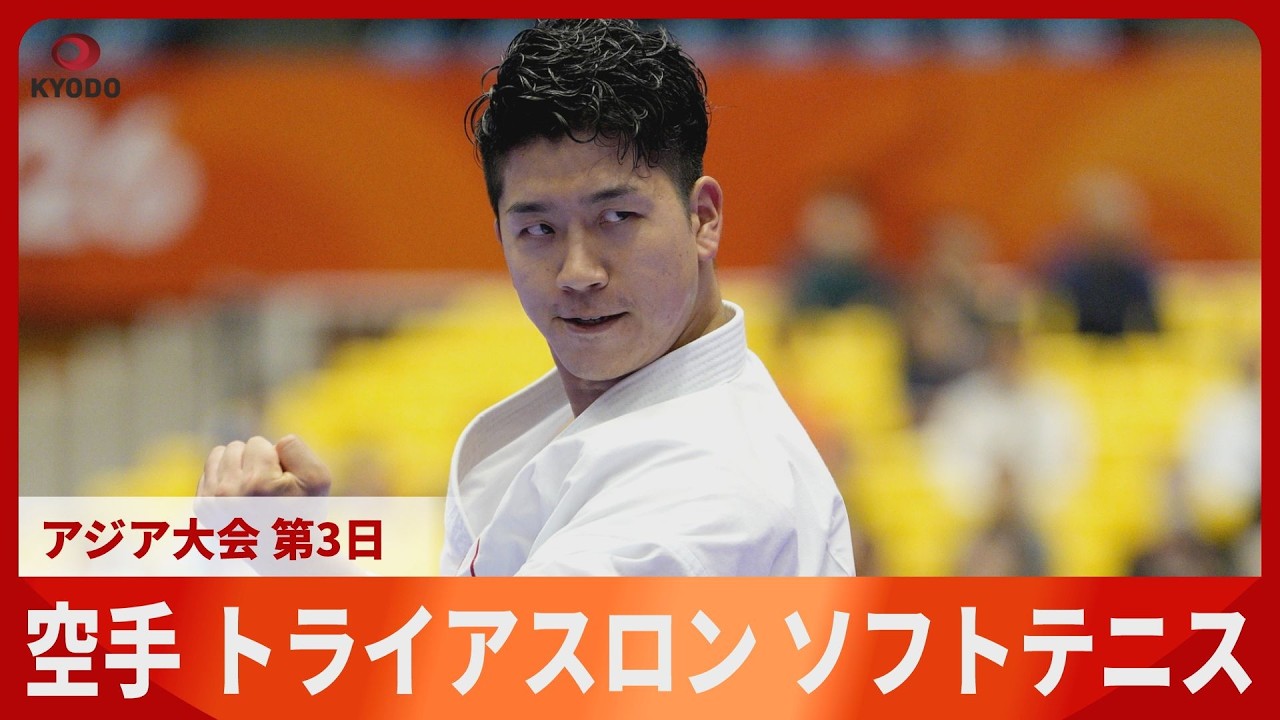
Nishiyama won the men’s individual kata, extending Japan’s dominance of the event and following Maho Ono’s victory in the women’s individual kata one day earlier.
The 31-year-old Nishiyama entered the Games having won five successive Asian championships and secured Japan’s third consecutive Asian Games title in the men’s individual kata.
Karate produced two additional Japanese medals.
Yugo Ozaki finished second in the men’s 67-kilogram kumite division, while Sarara Shimada took bronze in the women’s 61-kilogram category.
The men’s artistic gymnastics all-around produced one of the highest-quality contests of the Games so far, bringing together three of the world’s leading gymnasts.
China’s Zhang Boheng successfully defended his Asian Games title with 85.065 points, narrowly defeating Paris Olympic all-around champion Shinnosuke Oka, who took silver with 84.698.
Daiki Hashimoto, the Tokyo Olympic all-around champion and a three-time world all-around champion, finished third with 83.865.
The result gave Japan both silver and bronze but denied the hosts what would have been a particularly prestigious gymnastics gold.
Japan nevertheless also qualified second behind China for the men’s team final, keeping alive another major medal opportunity. Hashimoto also emerged from qualification as the leading performer on pommel horse, with apparatus finals still to come later in the competition.
Japan narrowly missed retaining another title in the triathlon mixed relay.
China won the race at Gamagori in a combined time of 1 hour, 25 minutes, 54 seconds, with Japan taking silver in 1:26:45.
Japan’s quartet consisted of Takumi Hojo, Rishin Jozuka, Aimi Hayashi and Mahoro Hiraizumi. Hojo had won the men’s individual triathlon gold on September 20, while Hayashi had collected bronze in the women’s individual event.
The silver ended Japan’s attempt to win a fourth consecutive Asian Games mixed-relay title but completed a highly successful triathlon program in which the hosts collected medals in all three events involving Japanese podium contenders.
Soft tennis, traditionally one of Japan’s stronger Asian Games sports, produced another two medals.
Toshiki Uematsu and Reina Tenma reached the mixed doubles final but lost a dramatic deciding game to Chinese Taipei’s Yu Kai-wen and Huang Shih-yuan.
The match reached 4-4 in games before the Chinese Taipei pair won the final game 7-5 to take the title, leaving Uematsu and Tenma with silver.
Japan’s second pair, Kaito Maruyama and Rio Maeda, earned bronze after reaching the semifinals. Japan had already won both the men’s and women’s soft tennis team titles earlier in the Games, with the women completing a third consecutive Asian Games championship.
Mixed martial arts, appearing on the Asian Games program, also brought Japan onto the podium.
Daisuke Murayama won bronze in the men’s traditional 65-kilogram division after reaching the semifinals, giving Japan another medal from one of the Games’ newer combat disciplines.
Beyond the medal events, several Japanese team sports produced important victories.
The women’s volleyball team moved to within one victory of a first Asian Games gold medal in 48 years by sweeping South Korea in the semifinals.
Japan won 25-22, 25-22, 25-16 at Park Arena Komaki, controlling the match in straight sets after two competitive opening frames.
The result sent Japan into the September 22 final against China, which defeated Thailand in five sets in the other semifinal.
China won that match 23-25, 25-21, 25-11, 26-28, 15-6, setting up a repeat of the previous Asian Games final. Japan will be attempting to capture the women’s title for the first time since 1978.
Japan’s women’s soccer team also completed a perfect group stage.
Nadeshiko Japan defeated Chinese Taipei 4-0 in its third Group E match, recording a third successive victory and advancing to the quarterfinals as group winner.
Japan entered the tournament seeking an unprecedented third consecutive Asian Games women’s soccer title. Its knockout campaign begins with the quarterfinals on September 25.
Baseball began on September 21, and Japan’s corporate-league-based Samurai Japan side made a convincing start by beating China 11-3 at Toyohashi Municipal Stadium.
Japan initially struggled against China’s starting left-hander before breaking through in the middle innings. Ryosuke Aizawa delivered a game-tying hit before Kenta Yamada drove in the decisive runs as Japan’s offense took control.
Japan is attempting to win its first Asian Games baseball gold medal in 32 years.
The hosts are grouped with China, the Philippines and Palestine in the opening round, with the leading teams progressing to the Super Round before the medal games on September 27.
Men’s handball also continued its strong opening.
Japan defeated Hong Kong, China, 44-17 to improve to two victories from two matches in the preliminary round.
Japan led 19-10 at halftime before overwhelming Hong Kong 25-7 in the second half. The victory followed a 31-27 win over China in Japan’s opening match.
Women’s hockey produced another convincing result.
Sakura Japan beat Singapore 5-0 to record its second victory of the tournament after opening with a 7-0 win over Indonesia.
Japan, ranked 11th in the world entering the tournament, is competing in a group that also includes India, Thailand and Uzbekistan, with tougher tests still ahead.
Japan was also active across a broad range of other disciplines on September 21, including sepaktakraw, table tennis, badminton, rowing, equestrian eventing, wushu, boxing, beach volleyball, water polo, 3×3 basketball and kabaddi as the Asian Games program expanded rapidly following the opening ceremony.
Day 3 featured 18 gold medals across eight sports, including swimming, karate, shooting, wushu, soft tennis, triathlon and gymnastics, illustrating the scale of a Games that includes 43 sports and 469 medal events.
Japan ended September 21 with its medal strength spread unusually widely.
Ohashi and Nishiyama supplied the day’s gold medals, while gymnastics delivered two podium finishes, swimming contributed three medals, triathlon and soft tennis added further silverware, and karate and mixed martial arts deepened the total.
The hosts had eight gold, 12 silver and 12 bronze medals after Day 3, for 32 overall. China remained firmly ahead in gold medals, while Japan’s total medal count kept it among the leading nations of the Games.
September 22 promises another heavy schedule for Japan.
Women’s volleyball will face China for gold, the swimming program continues with the women’s 100-meter freestyle, men’s 400-meter individual medley, women’s 200-meter backstroke, women’s 400-meter freestyle and men’s 4×100-meter medley relay among the medal events, while men’s road cycling, fencing, karate, shooting and wushu also offer medals.
Japan’s baseball team faces Palestine in its second preliminary-round game, the men’s hockey team plays Bangladesh, women’s basketball meets the Philippines, and the women’s water polo team continues its round-robin campaign against Uzbekistan.
After three days, the home Asian Games has already produced Japanese medals in swimming, triathlon, karate, gymnastics, soft tennis, shooting, modern pentathlon, teqball, basketball and mixed martial arts, while several of Japan’s leading team sports remain firmly in contention.
With athletics, judo, wrestling and a number of other traditionally productive Japanese disciplines still to come, the host nation’s medal campaign is only beginning to broaden.
Disclaimer : This story is auto aggregated by a computer programme and has not been created or edited by DOWNTHENEWS. Publisher: newsonjapan.com