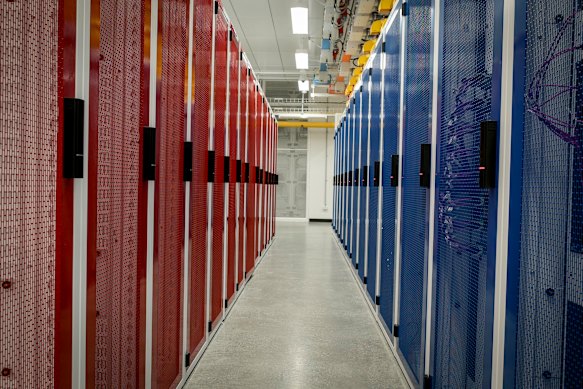

Telstra says Australia has a natural advantage in the global race to build artificial intelligence data centres, and wants to see more of them built here despite growing community backlash.
Nathan Gumley, the telco’s executive for software engineering and IT, said the country’s combination of renewable energy and water set it apart from much of the United States, where developers are often forced to choose between the two.
“If you look here in the US, you can go where power is cheap because renewables exist, but there’s no water,” Gumley said in an interview at Salesforce’s Dreamforce conference in San Francisco. “Or you can go where water exists and there’s no renewables and power’s really expensive.”
“We’re kind of blessed that we have both.”
Large data centres use significant volumes of water for cooling, and electricity costs are among the biggest determinants of whether a site is commercially viable. Gumley, who has spent time working on renewables for Telstra, said that cost profile made Australia ideal for an accelerated data centre build-out.
“I think it’s a very natural competitive advantage for Australia,” he said. “With the right settings and the right partnerships, huge potential.”
The debate over whether Australia should be courting the build is reaching fever pitch, with Anthropic signing its first Australian data centre lease on Wednesday. It’s taking the entire capacity of a proposed $32 billion development in Queensland’s Western Downs, about 250 kilometres north-west of Brisbane. Premier David Crisafulli called it a major win for the state.
Queensland secured an exemption from the federal requirement that AI data centres be fuelled exclusively by new renewable energy. Planning documents for the site say the first stage could be powered by gas, with three major gas power plants within two kilometres.
Treasury has estimated $150 billion could be spent on Australian data centres by 2030. There are 162 already operating and about 130 more at the planning stage.
Community resistance is building alongside the investment. Residents are campaigning against a $1.47 billion facility proposed for Spotswood in Melbourne’s inner west, which would draw 240 megawatts, roughly the consumption of 250,000 Victorian households.
In the United States, 18 states have passed moratoriums on new data centres.
The company stands to benefit directly from any expansion of the build. It is constructing the Aura Network, a terrestrial fibre network connecting Australian capital cities, and has deployed more than 8500 kilometres of fibre with six routes ready for service. It owns or operates about 400,000 kilometres of subsea cable.
“We’re just incredibly well-placed to be able to connect to those things, particularly with intercity network,” Gumley said. “I’d love to see more of it.”
Telstra has signed long-term contracts across its fibre and subsea assets with Google, Amazon Web Services and Australian AI infrastructure company Firmus. Microsoft is the foundational partner on Aura.
The company lifted its expected investment in Aura and a related satellite project to about $1.8 billion through to FY28 in results released last month, up from a previous estimate of $1.6 billion, citing inflation and site conditions. It expects a mid-teens internal rate of return and a payback period of around nine years.
Chief executive Vicki Brady told investors the sales pipeline for Aura had increased significantly over the past six months.
Dayle Stevens, who leads Telstra’s data and AI function, said the national resilience question for Australia lay in that infrastructure rather than in developing local AI models.
“Telstra’s role is connectivity,” she said. “It is not our job to be building sovereign models.”
Stevens said the critical infrastructure underpinning AI, including subsea cables, would matter more as the broader economy adopted the technology.
Inside the company, Telstra has deployed AI agents built on Salesforce’s Agentforce platform to process customer refunds and check security permissions, targeting internal processes staff had complained about for years.
Gumley said the refunds agent removed 15 to 20 steps from what a call centre worker must complete while holding a conversation with a customer. Telstra keeps a person accountable end to end for each automated process, he said, with thresholds determining when a human must intervene.
Not every deployment has gone smoothly. Gumley said staff given an internal assistant to navigate about 5500 knowledge articles reported that it was producing poor results.
“Unsurprisingly, it wasn’t the agent that was broken, it was actually the knowledge articles,” he said.
Late last year Telstra deployed what it calls an AI control plane, monitoring cost, performance, risk and compliance across its AI systems in real time. Stevens said it had not stopped any deployment yet, describing it as early days.
Telstra executives have said reductions in software engineering came largely through attrition and slower hiring rather than redundancy, and that the company expects to be smaller again by 2030. Telstra’s direct workforce fell by 1219 roles over the past year, to 29,334.
“Most people at most companies have some amount of uncertainty about what the future of their roles are,” Salesforce’s chief product officer for Agentforce John Kucera told this masthead. “All of our roles are impacted by AI, and they evolve every day, which is uncomfortable.”
Kucera argued that automating repetitive tasks is meant to free up staff rather than eliminate them: “You want to have the human when you need them most, while having the agent handle all the routine things.”
Stevens declined to discuss July’s network outage, which cut off Triple Zero. She said Telstra was examining what AI could do for network resilience and for the staff who work on it.
David Swan travelled to San Francisco as a guest of Salesforce.
Get news and reviews on technology, gadgets and gaming in our Technology newsletter every Friday. Sign up here.
 David Swan is the technology editor for The Age and The Sydney Morning Herald. He was previously technology editor for The Australian newspaper.Connect via X or email.
From our partners
Disclaimer : This story is auto aggregated by a computer programme and has not been created or edited by DOWNTHENEWS. Publisher: www.smh.com.au