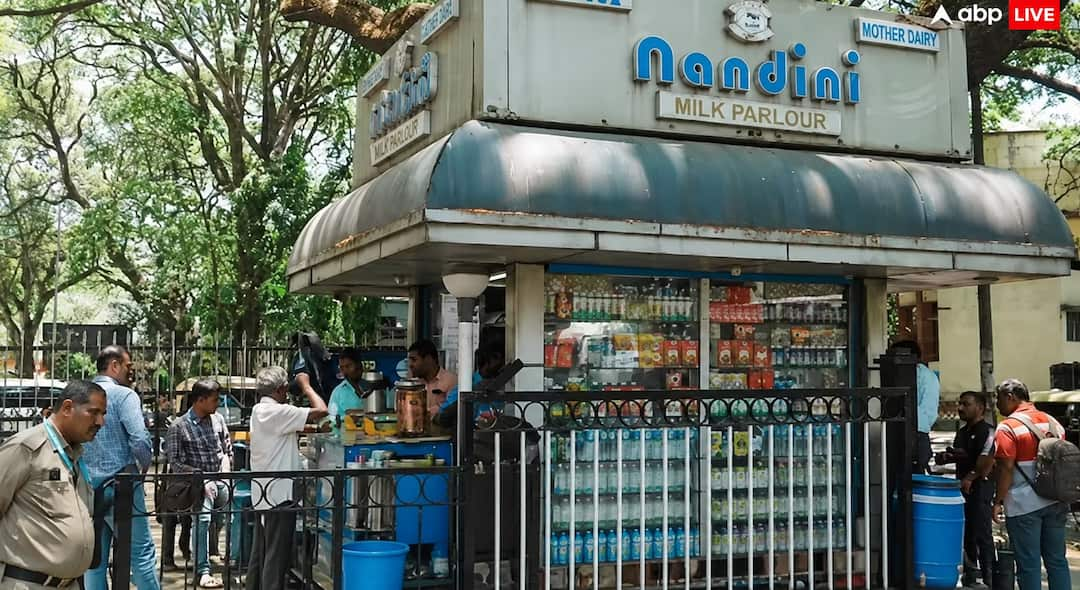
Bengaluru, Oct 29 (PTI) The Karnataka Cabinet on Thursday decided to hike Nandini brand milk prices by Rs 8 per litre, Minister Krishna Byre Gowda said.
He said Rs 7 would go to farmers and Re 1 to the cooperatives (Karnataka Milk Federation). The price hike will be effective from November 1.
“Given the crisis faced by farmers, members of all parties in the Legislative Council had called for measures to support them. Milk producers themselves had taken to the streets in protest, and the cooperatives had also pressed for an increase,” Gowda said.
Speaking to reporters after the Cabinet meeting, he said, “Respecting these demands, the Cabinet has today decided to increase the price paid to milk-producing farmers by Rs 7 per litre. Additionally, the cooperatives will receive an increase of Re 1 per litre. Thus, the total increase will be Rs 8 per litre.”
Karnataka Milk Federation (KMF) markets its dairy products under the Nandini brand.
Noting that the issue of the price hike was discussed in the Cabinet on two or three occasions, the minister said, “We have taken this decision unanimously.”
He said that while farmers were protesting, representatives from their cooperatives met the chief minister, the minister concerned for animal husbandry and the cooperation minister. They insisted that the price should be increased by at least Rs 10 per litre.
“Although farmers demanded an increase of Rs 10 per litre, it was felt that so much increase cannot be done. After discussions in the Cabinet today, under the chairmanship of Chief Minister D K Shivakumar, we decided on an increase of Rs 8 per litre, of which Rs 7 will go to the farmers and Re 1 to the milk cooperatives,” he said.
Gowda said that currently, farmers in Karnataka receive around Rs 35 per litre, in addition to the government’s incentive of Rs 5 per litre. Going forward, the price paid to farmers will increase from Rs 35 to Rs 42 per litre. The government’s incentive of Rs 5 per litre will continue.
“This means farmers will receive a total of Rs 47 per litre, including the government incentive. This will benefit lakhs of farming families,” he added.
Gowda said, the current selling price of milk is Rs 46 per litre, and with this increase of Rs 8 per litre, it will be Rs 54 per litre.
Even at Rs 54, Karnataka’s price would remain lower than that in several other states, he said, explaining, “In Delhi, Amul sells milk at Rs 59 per litre, while Mother Dairy sells it at Rs 60. Even after the revision, Karnataka’s price would be Rs 6 lower than Mother Dairy’s price in Delhi. Gujarat’s price is already Rs 57, so ours would be Rs 3 lower. Amul milk in Maharashtra costs Rs 59, which is Rs 5 higher than the revised Karnataka price.”
In Karnataka, the Gokul brand sells milk at Rs 58 per litre, which is Rs 4 more than the revised price of Rs 54 for Nandini milk, the minister pointed out.
“In Rajasthan, the Saras brand sells milk at Rs 56, which is Rs 2 higher. In Telangana, the Vijaya brand sells milk at Rs 64, making it Rs 10 more expensive, while Heritage sells milk at Rs 66, or Rs 12 more. Kerala’s price is Rs 56, which is Rs 2 higher than ours,” he said, adding that therefore, even after the price revision, Karnataka’s milk price will remain lower than that of neighbouring states and several other markets.
Gowda said farmers cited prices in other states to substantiate their demand. The average selling price across India is around Rs 57 per litre, he said, while pointing out that Tamil Nadu has a lower price of Rs 40 per litre.
He also highlighted that over the past four to five months, since drought conditions intensified, daily milk procurement by cooperatives has declined by around 10 lakh litres.
Cooperative Minister Laxman Savadi said if the prices were not increased, it would have led to scarcity of milk locally.
“If the price increase was not done on one hand it would have affected farmers. Additionally, since prices are higher in other states, the milk produced here would have gone to those states, leading to scarcity here,” he said.
Responding to a question, Savadi said, once milk increases, the prices of butter, ghee, curd and buttermilk will also increase.
The government has considered the consumers’ interests while taking this decision, he further said otherwise, the increase could have been Rs 10 per litre, as demanded by farmers and cooperatives. “We discussed the matter with them and convinced them to settle for this amount, keeping consumers’ interests in mind.”
To a question on Re 1 per litre to cooperative unions, Savadi said their expenses have increased because diesel and petrol prices have gone up, plastic and packaging costs have risen, and transportation has become more expensive.
“They had demanded Rs 3 per litre, but that entire amount has not been granted. We have calculated their additional expenses, including fuel, plastic packaging and transportation, and decided on Re 1 per litre,” he said.
(This report has been published as part of the auto-generated syndicate wire feed. Apart from the headline, no editing has been done in the copy by ABP Live.)
Disclaimer : This story is auto aggregated by a computer programme and has not been created or edited by DOWNTHENEWS. Publisher: abplive.com