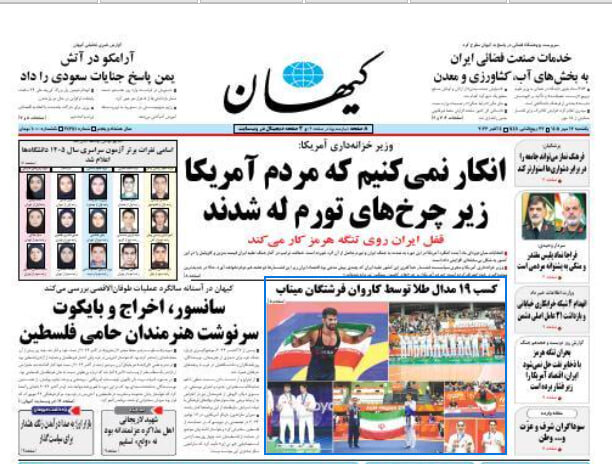
In a note, Keyhan argued that the continued closure of the Strait of Hormuz has directly affected the US economy by driving up inflation and fuel prices. The newspaper said President Trump and his administration are working hard to prevent Republicans from losing the November midterm elections, which it says have become closely tied to the conflict with Iran and its economic consequences.
According to the article, the war against Iran caused gasoline and diesel prices to rise sharply across the United States. Keyhan further asserted that most Americans blame Trump for the situation. Although administration officials continue to promise that conditions will improve soon, the paper argued that inflationary pressures linked to Hormuz are increasing every day. Referring to comments from the US Treasury Secretary about the burden of inflation on ordinary citizens, Keyhan concluded that Iran’s leverage over the strait remains effective and that, despite American claims, Hormuz continues to be closed in an economic sense to the West.
Shargh: The hidden clock of tension
Shargh analyzed the possibility of a new conflict in the region and argued that many observers make the mistake of viewing developments solely through Washington’s political calendar. While US midterm elections are often seen as a key factor, the newspaper suggested that events in Israel may be even more important. It pointed out that Israel’s Knesset elections will take place before the American elections and could be critical for Netanyahu’s political future. According to Shargh, if fears of electoral defeat increase within Netanyahu’s camp, there may be greater motivation to alter political and security conditions. In such a scenario, military escalation would not necessarily be an end in itself but could serve as a tool to shift public attention, change political priorities, create a stronger security atmosphere, or influence the electoral process.
Siasat-e-Rooz: US -Iraq exit would have major strategic implications
In its editorial, Siasat-e-Rooz examined the importance of a potential American withdrawal from Iraq. The newspaper argued that such a move would have major strategic implications and should be viewed as an opportunity. It said Iraqi Kurdistan has become a base for groups threatening regional security and that the presence of Israeli military and intelligence networks there poses risks not only to Iran but also to Iraq’s sovereignty and territorial integrity. According to the paper, the United States continues to maintain considerable influence in Iraq, as shown by measures such as the temporary suspension of Iranian flights. Ongoing regional developments will eventually force American forces to leave the region. The paper argued that a new regional order is emerging based on resistance rather than American preferences and that any US withdrawal would be the result of pressure rather than a voluntary decision.
Javan: Factors shaping the future of the war
Javan focused on the indicators that could determine the future course of the US war on Iran. Rather than predicting a definite outcome, the newspaper recommended closely monitoring three factors: US 10-year Treasury bond yields, global oil prices, and the volume of tanker traffic through the Strait of Hormuz. According to the article, the key question is whether the United States can simultaneously manage oil prices above $100 per barrel, bond yields above 5 percent, and high fuel costs for consumers. These indicators, together with developments around Bab al-
Mandab and the official positions of Washington and Tehran, were described as useful measures of the war s direction. Javan argued that a war of attrition involving intermittent attacks, tougher sanctions, and sharp energy-market fluctuations remains a likely possibility. While acknowledging the costs for Iran, it maintained that accepting unlimited external demands would be even more harmful.
Resalat: Iran’s doctrine in Hormuz Strait
In an article, Resalat examined what it described as Iran’s complete control over the strategic Strait of Hormuz. The newspaper argued that the strait has evolved from a simple shipping route into one of the central arenas of geopolitical confrontation. According to the article, the United States seeks to bring tanker traffic under its military dominance, using various justifications to expand its influence and undermine the independence of regional states. In contrast, the paper stated that Iranian officials responsible for Persian Gulf security have made the full reopening and security of the Strait of Hormuz conditional on an end to economic pressure and respect for Iran’s sovereign rights. The article also referred to the reported targeting of a large oil tanker by an unidentified projectile in the strait, describing it as a serious warning to Western countries.
Resalat argued that any future round of conflict would not remain limited in scope. Instead, it said further escalation could trigger a wider crisis involving disruptions to maritime traffic, instability in regional energy markets, intensified security tensions, and broader economic consequences across the region and beyond.
Disclaimer : This story is auto aggregated by a computer programme and has not been created or edited by DOWNTHENEWS. Publisher: tehrantimes.com