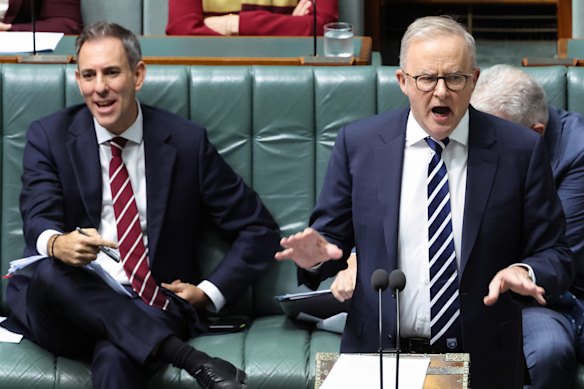

Treasurer Jim Chalmers is resisting loud calls to limit his CGT overhaul to investment properties, as Labor MPs lobby the cabinet to move quickly to protect worried business owners.
A day before Labor begins the process to rush its changes through parliament with minimal scrutiny, Chalmers defended the rationale behind Labor’s move to equalise treatment of labour and capital income, which has opened up a political brawl on wealth creation and economic growth.
The treasurer, two weeks on from his boldest budget to date, fielded questions from Labor MPs in a closed-door meeting in which it became clear that a broad cross-section of the caucus wanted new measures to avoid a backlash from an army of business owners, many of whom vote Labor.
Sources familiar with this week’s caucus economic committee meeting said it was more lively than a subdued general caucus meeting where Prime Minister Anthony Albanese praised his team’s unity and discipline.
That solidarity, however, belies MPs’ private anxieties. Some are pushing for expansions of existing capital gains tax exemptions for small firms, as reported on Tuesday, and others are telling colleagues they want the 50 per cent discount retained for everything but investment properties.
Repeatedly citing support from former prime minister Paul Keating, Chalmers said it was unwise to create different arrangements for income earned from property investments and businesses/shares.
“It doesn’t make a lot of sense to replace one big distortion with another big distortion,” he said, making the well-understood case that the combination of the generous CGT discount and negative gearing had caused a house price bubble.
But Chalmers was pressed by reporters who asked whether his budget was ill-thought-out because it made little sense to seek to push people away from investment properties by taxing shares and private business at a higher rate as well.
Chalmers said the new inflation-adjusted model would make some investments, particularly lower-growth assets, more attractive. That, he said, would steer capital away from housing, though likely not by as much as if the 50 per cent discount were retained for non-housing investments.
“A fairer, more neutral treatment of capital gains in the system makes more sense than the current distortion, which has been left in place for the same 25 years that we’ve seen young people’s prospects in the housing market materially deteriorate,” he said.
Many economists have said the budget contained good measures, but the list of economists, business people and peak bodies asking Labor to change tack on its CGT overhaul is growing by the day. All major business bodies say the inflation-adjusted model will hurt fast-growing businesses, despite Albanese selectively quoting the groups in parliament to portray them as supportive.
CBA chief Matt Comyn said on Tuesday that only passive assets such as housing should be targeted. That view is shared by Labor figure Lachlan Harris, Seek founder Paul Bassat, and several frustrated Labor backbenchers who are remaining tight-lipped to avoid blowback from their more senior colleagues.
Labor MPs said it was self-evident that the government was unprepared for questions about why it decided to extend the CGT changes to non-housing investments. This masthead previously reported that the move blindsided some ministers and raised concerns at high levels immediately before the budget, leading to a line in the budget documents which committed to consult the “tech and start-up sector”.
Albanese shifted gears on Monday, saying the government was speaking to small business groups, rather than just start-ups.
Asked if Labor had come to realise unintended consequences of its changes were wider than first thought, Chalmers said, “that’s your interpretation of it”.
Albanese and Chalmers have repeatedly said the aim was to equalise the tax treatment of income for assets and labour.
But the Henry tax review, which guided much of the debate on tax reform since its release in 2010, stated that “comprehensive income taxation, under which all savings income is taxed the same as labour income, is not an appropriate policy goal or benchmark”.
“The essential reason for treating lifetime, long-term savings more favourably is that income taxation creates a bias against savings, particularly long-term savings,” it said.
Albanese is hoping to speed through exemptions for small business and separate changes to protect start-ups. The opposition is desperate to create a longer political battle by threatening to delay the government’s NDIS legislation if Labor does not allow the tax changes to go to an inquiry.
Shadow treasurer Tim Wilson used question time to highlight the more generous treatment of businesses under the Paul Keating’s CGT model.
Albanese was not keen to engage in the detail and sought to highlight the trap he had created by bundling income tax cuts with the more contentious tax concession changes.
“We know that when it came to the tax cuts that were in last year’s budget … they voted against it,” Albanese said. “They took it to an election, and they got smashed.”
Venture capitalist Paul Bassat, who founded Seek and runs the Amplify public policy institute, said the existing 50 per cent discount should be retained for non-housing assets to ensure investment was not sapped.
Bassat supports the negative gearing changes and has been campaigning for progressive housing reform. He said it was surprising that Labor had grandfathered negative gearing instead of phasing it out, which could have given it a more compelling narrative on housing affordability.
“Two elements of this budget were surprising: firstly they have implemented significant tax changes that have obvious immediate losers and no winners, and second they would do something so fundamental in a really short period of time and without any outside consultation,” he said.
Cut through the noise of federal politics with news, views and expert analysis. Subscribers can sign up to our weekly Inside Politics newsletter.
 Paul Sakkal is Chief Political Correspondent. He previously covered Victorian politics and won a Walkley award and the 2025 Press Gallery Journalist of the Year. Contact him securely on Signal @paulsakkal.14.Connect via X or email.
From our partners
Disclaimer : This story is auto aggregated by a computer programme and has not been created or edited by DOWNTHENEWS. Publisher: www.smh.com.au