
Good luck with the idea that politics should be kept well away from the justice system (“Keep politics separate from the justice system”, July 9). Politicians appoint judges and politicians determine by legislation when judges should retire. Many judges are former politicians and their political leanings are often reflected in their judgments. In fact, judges are part of the government no less than politicians. Since the early days of the penal colony in New South Wales, politicians have been overruling judges. Politicians pass laws that certain specified prisoners should stay in jail despite the rule that legislation should be general in its application and not ad hominem. What we need is an independent criminal cases review commission to keep judges and politicians in their lanes. Similar review bodies exist in every common law jurisdiction comparable to Australia, but like the bill of rights issue, NSW politicians are reluctant to let go of their penal colony power to call the shots. Peter Breen, Bellingen

Are you unserious?
I thought that Angus Taylor was talking about his own Liberal Party when he described “an unserious outfit with a grab bag of poorly defined, contradictory and constantly changing positions”, though it does also accurately describe One Nation (“‘Eternity of pain’: Angus Taylor’s clearest attack on Pauline Hanson”, July 10). It’s one thing for him and Matt Canavan to criticise One Nation publicly, but their cynical decision to preference Pauline Hanson’s party in the Farrer byelection when they had no chance of winning themselves resulted in One Nation winning the seat and gave it the credibility it wouldn’t have otherwise had. The Liberals’ words have not matched their actions for years, and it’s that hypocrisy and lack of integrity that has voters abandoning both Coalition parties in droves. Alan Marel, North Curl Curl
Telstra’s been told
The federal government, as telecommunications regulator, can be blamed for maximising the impact of Telstra’s outage by not mandating domestic roaming in Australia (“Telstra boss: ‘We have let our customers and Australians down’”, June 10). In the absence of roaming, your mobile phone can only receive a signal from your own carrier, rather than switch between carriers. Telstra has fought hard against roaming for years to keep its competitive edge, so it’s also to blame. Michael Britt, MacMasters Beach
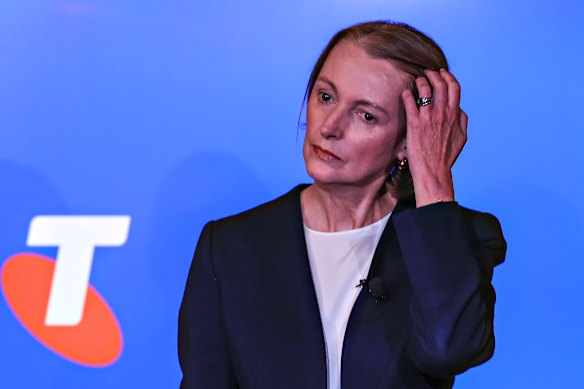
Telstra boss Vicki Brady has admitted that Telstra was responsible for the outage on Wednesday. Businesses and individuals will have to follow a complicated route to apply for compensation. Why? Compensation should be automatically available to customers. Remember, this happened just after Telstra’s increased charges came into effect. At the very least, the new charges should be deferred for six months. Maureen Lysaght, Terrey Hills
The Telstra outage caused genuine concern for Australians unable to contact emergency services. Any failure affecting Triple Zero access deserves urgent investigation and improvement. Beyond those serious cases, however, the public reaction highlighted just how dependent we have become on technologies that barely existed a generation ago, when we arranged meetings in advance, relied on landlines, carried cash and accepted that communication was not always instantaneous. Today’s smartphones have created an expectation of constant connectivity. When that disappears for a few hours, many of us seem ill-equipped to cope. This outage should encourage telcos to build more resilient networks, while reminding us to maintain simple contingencies – have a landline where practical, some cash and a little self-reliance. For the vast majority of Australians, this was ultimately a first-world problem. Joseph Ting, Carina (Qld)
All telephone providers interconnected? What next? All railways using the same gauge? Keith Russell, Mayfield West
Profit for private eyes
Alison Pennington is spot on when she calls out the link between services provided by for-profit providers and inflation (“We’re ignoring the root cause of our inflation scourge. When will we learn?” June 10). The profit motive inevitably leads to reduced quality in the inevitable pursuit of lower costs and higher shareholder returns. An added insult is that many of those shareholders are offshore. The abdication of responsibility for social welfare by governments of all persuasions is now baked into the political landscape. So, without belabouring the obvious need to rethink this politically fraught approach, perhaps we can benefit from the next big thing using a Trump tactic. The Australian government should be given a no-cost percentage equity in shares for AI development and data centre services. The risk is low, and potential benefits are obvious as they accrue directly to the benefit of the tax-paying public. Robert Caraian, Crows Nest
Thank you, Alison Pennington, for saying what so many of us have known for years. The privatisation of key sectors just doesn’t work for the average citizen. It makes chief executives and private entities rich and widens the wealth gap, while at the same time creating havoc with the delivery of key services. Education, health, childcare, aged care, employment and disability services have all suffered under the “privatisation is better” myth. It’s time to change the narrative before it’s too late. Vicki Whyte, Valentine
Alison Pennington’s analysis is depressing. The problem is that in most instances there is no going back. However, one area where government could consider playing a much more central role is in the building of social housing. A well-resourced, government-owned development company focusing on the building of good-quality social housing could be a game changer. Alan Morris, Eastlakes
Balancing act at ABC
Special envoy to combat antisemitism Jillian Segal says that there is “a common perception in the Jewish community” that the ABC reporting of Israel “lacks balance” (“Segal says Gaza ‘over-represented’ in ABC coverage”, July 9). She makes the assumption that there is such a thing as a homogeneous Jewish community in Australia, and that they all share the same views. But perceptions aren’t facts. There are many Jews who are appalled by Israel’s actions over the past three years, and have been brave enough to say so. They recognise the distinction between a nation’s actions and the dominant faith or ethnicity of its citizens. To assert that the independent reporting and analysis of the tragedy in Gaza by the ABC constitutes antisemitism is like saying the broadcaster’s coverage of the manifest idiocies of the Trump administration is anti-Christian. David Salter, Hunters Hill

On Tuesday in Gaza, Palestinians assembled in their hundreds in front of a big screen to watch Argentina play Egypt in the World Cup. Many of them were literally perched on rubble, but that didn’t matter as they shared an opportunity to experience a rare moment of joy and happiness. The event had been made possible by a man named Mohammed Fawaz al-Wahidi, an Egyptian social worker who had sourced the giant television and organised the public broadcast. Al-Wahidi himself missed the occasion because in the hours before kick-off he was killed in an Israeli drone attack while travelling in a taxi. The driver and two children were also killed. The IDF said they were targeting a Hamas militant. While widely reported overseas, it has not been reported by the ABC and other Australian media outlets. This runs contrary to Jillian Segal’s claim that Gaza is over-represented in ABC coverage. Dean Fraser, North Balgowlah
Jillian Segal says the war in Gaza is over-reported and that limited attention is paid to other conflicts. Her point is illustrated well by the visit to Australia of Indian prime minister Narendra Modi (“Thousands cheer Narendra Modi at stadium extravaganza”, June 10). Modi leads a Hindu nationalist government that aids and abets persecution of minorities such as Muslims and Sikhs. Modi was barred from entering the United States for his role in the pogrom against Muslims when he was chief minister of Gujarat. His government has curtailed freedom of the press, yet none of this has been mentioned leading up to or during his visit. It would be a different story if an Israeli politician visited Australia. Steve Castieau, Bexley
Next red card
Waleed Aly exposes the corruption at the heart of the football World Cup after President Donald Trump successfully badgered FIFA to overturn the ban on US striker Folarin Balogun (“Trump’s red card scandal incensed the world. The corruption of Australian sport is even graver”, July 10). This blatant exploitation of what Aly describes as the “emotional monopoly” that sport engenders, whether it be one’s undying loyalty to a club or national team, allows Trump to advance his America-first agenda. But Trump has discovered that such bending of the rules in soccer doesn’t apply to his war in Iran (“Trump trusted Iran’s ‘rational’ new leaders. Now he says he knows better”, July 10). Though he once thought he was dealing with “very rational people” that were “nice to deal with”, he now describes the Iranian leadership as “scum” and “sick people”. For unlike FIFA, Iran does not bend to his will. Nor does a nuclear-armed China, Russia and North Korea allow Trump to rule the whole world simply because he believes America is somehow entitled to do so. Rev Vincent Zankin, Rivett (ACT)

It is becoming more obvious every day that the Iranian leadership have regime change in mind in the USA and are prepared to wait it out, first to see Trump humiliated in the November midterm elections, followed by impeachment, if he is still around (“Trump trusted Iran’s leaders. Now they’re ‘scum’“, July 10). Ian Nicholls, Baulkham Hills
Nuclear test fails
Correspondent Dale Bailey first wants to remove the Howard government’s self-imposed moratorium on nuclear power, then have a national debate concerning the “pros and cons” of nuclear power (Letters, July 10). Australia has had such public debates ever since the British were testing their nuclear bombs on Aboriginal lands. Then, in 1969, the Gorton government proposed a nuclear power station at Jervis Bay. Peter Dutton’s more recent proposal for several nuclear power stations triggered intense debate and ultimately fell over. Arguments all lead to the fact that our continent is dry and suffers from long droughts. Nuclear power stations depend on highly reliable water supplies. The recently experimental so-called dry nuclear power stations are not suited to hot environments like Australia’s. Russia operates one on its Arctic permafrost. Problems abound, not to mention the decades-old, unresolved issue of storing the spent uranium fuel for hundreds of thousands of years. Tony Lewis, Mount Victoria
Dale Bailey is right – many commentators argue that nuclear is too expensive. Even Nationals leader Matt Canavan, in 2024, described the Coalition’s nuclear idea as a “political fix”, conceding that it was not the cheapest form of power. Now that One Nation has joined the Coalition in advocating nuclear, and with both parties rejecting any ambition to reach net zero by 2050, it appears that the political fix is being re-employed as a substitute for genuine, realistic energy policy based on the science. Whether conventional or small modular reactors (SMRs), nuclear would still take too long to build or acquire – about 15 years. We have no regulatory frameworks and no experience. There are still no agreed sites, including for toxic waste. Most nuclear reactors still need water for cooling. It is still the most expensive way to produce electricity. Renewables/storage capacity already provides about 75GW, or about half our needs. One conventional reactor produces 1GW, an SMR about a third of that. It is not “timidity” but exhaustive number-crunching that has made the idea redundant. Fiona Colin, Malvern East (Vic)
Lessons from war
I have spent my career in sustainability. Andrew Forrest has been steadfastly on the right side of this issue for decades, even when it made him unpopular in some circles. His commitment is real. Your article about Forrest is about a rearranging of resources at Minderoo, something which might be expected and is hardly news. Instead, the headline appears to be an attempt to lop off a tall poppy (“Next shiny thing: Inside Twiggy Forrest’s $7b charity”, July 10). I hope Minderoo ignores it. Dr Ann Godfrey, Kensington
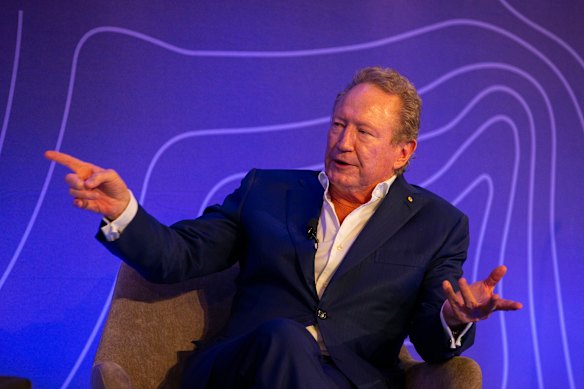
With diesel becoming much more expensive due to the Iran war, the government should wind back the diesel rebate scheme. BHP and Rio Tinto should follow Twiggy Forrest and electrify their fleets and operations. If the war continues until September, there will be a critical shortage of all fuel supplies. The rebate scheme was introduced 44 years ago by the Fraser government, mostly to help farmers. It is now a $4 billion subsidy to the wealthy mining industry. Tony Simons, Balmain
If Andrew Forrest has such lofty philanthropic ambitions for the country and the world, then perhaps he could turn his energies to funding a satellite network dedicated to monitoring this wide brown land for early signs of natural disasters. Such a Twiggynet could use the vast computing resources of, say, Forrest AI Farms to second-guess nature’s penchant for cyclones, floods and bushfires and alert authorities to such imminent dangers. Such energy-hungry data centres could be powered by a national network of Minderoo solar and wind arrays, and in this way Forrest could rest easy in the knowledge that at last he had lighted on a project with wide-reaching and enduring benefits. He then might be able to turn his energies back to addressing some of the misfires of his past. Bradley Wynne, Croydon
Reading: the right act
Like Barbara Chapman, I was brought up in the country and was able to read by the age of five (Letters, July 10). My three daughters grew up on a property near Moree and were all capable readers before they began school (also aged five). They, in turn, always read to their children from the earliest age. The benefit is incalculable. Everywhere I have lived has had full bookcases. Now it’s a minor problem where to keep the ever-increasing supply. If reading is encouraged at home, it not only makes the teacher’s job easier but also leads to enhanced educational outcomes. Jennifer Dewar, Double Bay
I agree totally with your correspondent’s views on reading skills. However, to be two years ahead of one’s peers is not necessarily a good thing. A child might become quickly bored in the classroom or be targeted by other kids. Hopefully, a good teacher will identify the situation and find ways to keep learning challenging. Whatever the situation, if a child is a good reader, the world becomes a more exciting and diverse place, and that child a more compassionate and wiser person. Judy Finch, Taree
Barbara Chapman is right: catching children early with reading is certainly the way to go. The students at several primary schools, including Moree East and Wellington, are benefiting from the “books in homes” program, a not-for-profit foundation that aims to get books into the homes of children in isolated and low socio-economic areas. The children choose their books from a catalogue, and they are delivered to the school. The Rotary Club of Turramurra, supported by North Ryde and Chatswood/Roseville clubs, raises more than $13,000 a year to support Moree East, with 87 per cent of its student population coming from the local Indigenous community. Northbridge Rotary similarly supports Wellington Public School. From little things, big things grow. Bob Selinger, Eastwood
Long live picture palace
As well as serving the best choc tops (Letters, July 10), Roseville Cinemas shows great films that don’t appear at the multiplexes, including many from film festivals and National Theatre Live. This adds enormously to the cultural appeal of the north shore. And it’s also heritage-listed, so shouldn’t it be refurbished as a cultural icon rather than closed down? Hopefully, that’s just a rumour. If not, please could council save it for the good of the community? Christine Stewart, Willoughby
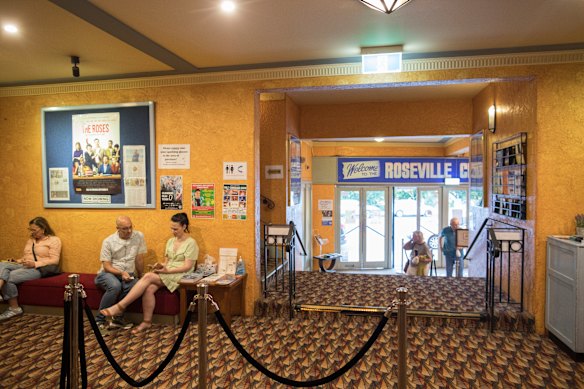
Roseville Cinemas, closing? Please tell me it’s not so. It’s a much-loved heritage cinema in Roseville village and really must be preserved. The government must stop tearing everything down. All the movies I want to see are shown at Roseville. There is a choice of at least four films and 30 sessions a week, plus occasional special sessions for ballet and opera and artists such as Frida Kahlo. There are quite a few restaurants and cafes nearby to cater for all tastes. By all means build multi-storey apartments, but preserve Roseville Cinemas and village so people living in the apartments will have somewhere to go. Judith Rostron, Killarney Heights
Never mind the choc tops, Vicki. My family, friends and I have been going to Roseville Cinemas for more than 50 years to see its great movies, enjoy its friendly service and iconic atmosphere. Whatever happens to the area, we must keep this cinema. Helen Bersten, Lindfield
Lost in France
Nearly 30 years ago, while on holiday in Cambrai, Northern France, I got very lost while out jogging. Of course there were no mobile phones to help navigate, and my French was virtually non-existent. As I wandered the streets, looking for a way back to my apartment, I couldn’t get Bonnie Tyler’s hit Lost in France out of my head. After a couple of hours I was helped by a kind stranger. Vale Bonnie Tyler. Always one of my favourites. Kate Prosser, Armidale

- To submit a letter to the Sydney Morning Herald, email letters@smh.com.au. Click here for tips on how to submit letters.
- The Opinion newsletter is a weekly wrap of views that will challenge, champion and inform. Sign up here.
Disclaimer : This story is auto aggregated by a computer programme and has not been created or edited by DOWNTHENEWS. Publisher: www.smh.com.au


