
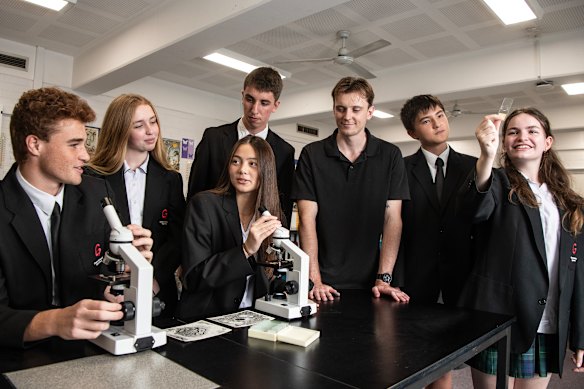
The Department of Education’s announcement last week that it would make challenging HSC subjects available to all public schools via online learning was a welcome boost for talented, aspirational students whose subject choices have been restricted.
The policy means the following 11 subjects will now be available to all public school students: English advanced, English extension 1, English extension 2, mathematics advanced, mathematics extension 1, mathematics extension 2, chemistry, physics, science extension, economics and history extension.
While regional and rural students have had access to courses their schools do not provide for some time, the online option has not been available to metropolitan students. This is despite some schools being unable to offer these harder subjects because there are too few interested students, a lack of qualified teachers, or timetable clashes.
This has been a particular problem for students at schools in disadvantaged areas, despite the well-known and widening gap between advantaged and disadvantaged students that has become an unfortunate hallmark of Australian education.
In the past, students whose preferred subject was not offered by their school may have had the option of travelling to other schools to take the subject, which is onerous and unfair. But many have been left with no other option than to choose less challenging alternatives.
At the same time, enrolments in academically demanding HSC courses have been declining. Last year, many schools – private and public – taught extension 2 mathematics to five or fewer students. Last year just 693 students undertook English extension 2 at public schools at a time when critical thinking in the workplace has never been so valuable.
The policy is also likely to allow students to access instruction from specialist teachers, through online learning school Aurora College, that might not have been available in their home school. As Science Teachers Association of NSW councillor Catriona Chaikin points out: it was “getting harder and harder to get science teachers” and the new policy was a positive step towards encouraging more students into academically rigorous subjects.
The policy follows the rollout of High Performance and Gifted Education (HPGE) classes at state schools that began this year, which is also a welcome step to ensure students at public schools are challenged and extended.
The Herald welcomes the opportunity for all students to have access to subjects of their choosing, which nurtures their talents as well as setting them up for what is often necessary prior learning for tertiary study.
The Higher School Certificate is supposed to be a level playing field; the same subjects, curriculum and final exam, regardless of a student’s school or background or economic advantages. Yet wildly differing resources and opportunities mean the principle of equity often no longer applies in practice. This policy is a small step towards addressing this problem.
And yet, a word of caution. The Herald sincerely hopes this does not tempt public schools to outsource teaching to Aurora and remove in-person offerings for small cohorts.
Jordan Baker sends an exclusive newsletter to subscribers each week. Sign up to receive her Note from the Editor.
 The Herald’s View – Since the Herald was first published in 1831, the editorial team has believed it important to express a considered view on the issues of the day for readers, always putting the public interest first.
From our partners
Disclaimer : This story is auto aggregated by a computer programme and has not been created or edited by DOWNTHENEWS. Publisher: www.smh.com.au


