
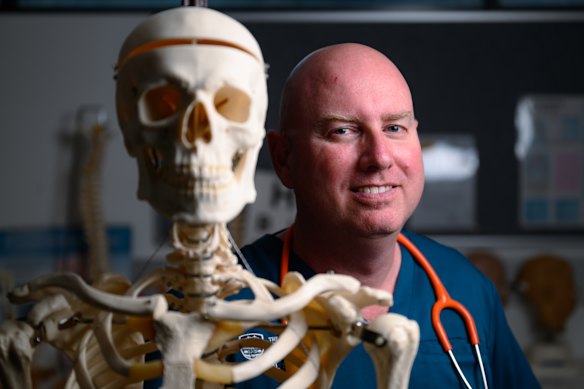

Peter Robertson is studying his second year of medicine for a second time.
The father-of-three had to retake a year of his course after the pressures of balancing family life and paying the bills with a degree likened to “drinking from a fire hose” became too demanding.
A change will provide struggling students with another option. In an Australian first, the University of Sydney will offer its four-year Doctor of Medicine part-time. This flexible option will be available to its third-year students in 2027, with plans to expand the program to other year groups in future.
Rather than a typical uni program of tutorials and lectures, postgraduate medical students spend most of their time doing clinical work, which is why introducing flexibility has proved difficult.
Professor Jane Bleasel, the Sydney Medical School’s Head of School and Dean, said the university worked closely with the Westmead Clinical School and the School of Rural Health in Dubbo to re-structure the third-year program, allowing students to complete it over two years rather than one.
Bleasel, who has five children, was one of the first doctors in Australia to job-share in the early 1990s. She says the medical profession has historically been “quite conservative”, but this change aims to further “inclusion and equity of access”.
Fourth-year student Mahalia King, who transitioned from a career in youth work and public health, was one of the voices who campaigned for the change, advocating for students with a disability and chronic illness.
King lives with a range of chronic autoimmune conditions, including Crohn’s disease, and struggled to attend specialist appointments and procedures without access to the sick leave that traditional full-time work offers, instead “pushing through” at all costs.
“We’ve long had this view of: You’re not working hard if you’re not burning yourself into the ground, and to be exhausted is a badge of honour,” she says. “I don’t think that’s necessarily the way to create sustainable, well-rounded medical professionals. Maybe it’s time to start looking at things a little bit differently.”
Seniru Mudannayake, the president of the Australian Medical Students’ Association (AMSA), said the union welcomed the move, but urged Sydney University and others considering the part-time model “to ensure both placement and teaching remain of a high standard”. He hoped the change would remove a “major barrier to entry” for students, particularly those from rural areas or low socioeconomic backgrounds, who are also more likely to work in these underserved communities.
Robertson, who grew up in Alice Springs, plans to become a rural generalist when he graduates, and agrees that flexible study options will greatly benefit those from the regions, who “tend to reach tertiary education a little later in life, [when] they’ve already got things they just can’t walk away from”, such as financial or caring responsibilities.
He says he would have pursued medicine a decade ago if studying part-time was an option.
“Once you’ve embarked on the journey of parenthood, you don’t get a choice as to when things come up that will demand your time,” he says. “The extra flexibility that part-time brings will open up the degree to some people who will be very, very good doctors that just through circumstance aren’t currently able to make that shift.”
Start the day with a summary of the day’s most important and interesting stories, analysis and insights. Sign up for our Morning Edition newsletter.
From our partners
Disclaimer : This story is auto aggregated by a computer programme and has not been created or edited by DOWNTHENEWS. Publisher: www.smh.com.au


