

What in the World, a free weekly newsletter from our foreign correspondents, is sent every Thursday. Below is an excerpt. Sign up to get the whole newsletter delivered to your inbox.
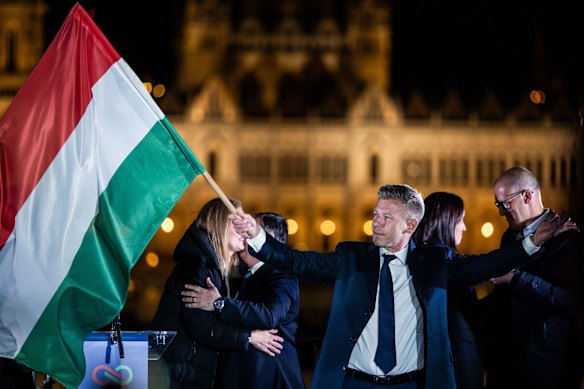
London: I’m sitting at my desk and flicking through images of the euphoric crowd I encountered in Budapest a few nights ago, when thousands of people jammed the streets to celebrate the outcome of Sunday’s election in Hungary. As I look through the video files, I’m grateful to people who had time to share their views about the defeat of prime minister Viktor Orbán. And I’m thankful I had a wireless microphone they could hold while they spoke, because on the night, with all the raucous cheering, I could hardly hear a thing they said.
“We want a whole new government to lead Hungary into a better future,” said one young man holding a placard with the face of Peter Magyar, the new prime minister. Then, as the crowd cheered behind him, he let out a piercing scream. Nearby, a woman with her partner and teenage son was quietly chuffed. “Very basic rules, very basic laws can be changed in a good direction,” she said.
As the results came in, thousands more people caught the metro and packed into Batthyany Square, across the Danube from the historic parliament. They were not just overjoyed at a change of government: they erupted when the results confirmed Magyar could govern with more than two-thirds of the seats, enabling him to overturn laws and appointments with a higher barrier for change. I hadn’t had to weave my way through a crowd this tight since the mosh pit of a David Bowie concert some years back.
A group of young women told me they felt the election made history. “This is the first time I felt proud to vote,” said one. Others described the result as the most important for the country since the fall of communism, given it had swept away a leader who had become so entrenched over 16 years. “It is a truly incredible feeling,” said another young woman.
I’ve been to election night gatherings where supporters have rejoiced in victory. (Kevin Rudd in Brisbane in 2007 comes to mind). I’ve been to nights where the party faithful have wept into their beers (Labor and Bill Shorten in Melbourne in 2019), or greeted a narrow success as if it were a bitter defeat (the Liberals with Malcolm Turnbull in 2016). But I’ve never seen one where so many voters have rushed to the streets in such wild delight.
This was hardly a random sample of the electorate, of course. I chose to join the Magyar crowd without knowing whether they would end the night jubilant or dejected. The Orbán supporters, meanwhile, were across the river, and I could not be in two places at once. When I’d met some of them earlier in the day outside a polling station, one was worried that Magyar would weaken the migration laws. One man simply did not want to risk change. “We need a strong leader, and not someone who needs to learn how to govern a country,” he said.
It is too soon to know if Magyar, 45, will be up to the task ahead.
One placard in Batthyany Square summed up a key feature of the discontent. It showed Orbán’s face on the outside of a matryoshka nesting doll. The man holding the placard flicked his wrist, and the placard revealed who was inside the doll. Surprise! It was Russian President Vladimir Putin. The crowd chanted “Ruszkik haza!” – which means “Russians go home”. Hungarians shouted these same words at Russian troops who took control of the country in 1956. In the crowd, you didn’t just ponder the history, you could feel it.
In the days since the election, I’ve been struck by the lament from conservatives outside Hungary who believe Orbán should have won. Former Australian prime minister Tony Abbott was among them. Many saw Orbán as a global champion of the right, but they overlooked what worried so many Hungarians. The people I spoke to near polling stations talked of the centralisation of power, the state control of the economy and the wealth accumulated by Orbán’s family members, to name a few concerns.
On Wednesday, Magyar appeared on state television for the first time in 18 months. He called the state media a “propaganda machine” and said he would suspend its news services until its public service charter was restored. Long before the election, Reporters Without Borders labelled Orbán a “predator of press freedom” for the many ways he sought to control the media. Outside the country, his fans praised his conservative values. Inside the country, ordinary people saw his autocratic values.
Over a beer in a restaurant near the Opera House, I spoke to an Australian who has lived in Hungary for 35 years. John Verpeleti, a subscriber to The Age, left Melbourne to take up a job in the country of his forebears after the fall of communism. He has seen a lot since then, and he thinks the fall of Orbán was a great day for Hungary and democracy.
“The outgoing administration may have used populism as the cloak, but there were a lot of things underneath that the people noticed and rejected,” he told me. “The abuse of power, state capture and corruption had reached horrendous levels, and a reckoning was overdue. I am glad there was enough of the democratic framework still in place to deliver it.”
One morning after the election, I managed to get a ticket to visit the parliament. (Tip: get there at 8am). The building is so wonderful, with its colossal dome and countless spires, that it seems to feature in every promotion for a cruise on the Danube. It is magnificent in design and decoration, but it is also a monument to history. For more than 1000 years, the Hungarians have survived the rise and fall of empires, invasions and totalitarian rule. No wonder they were so euphoric about democracy in action on Sunday night.
With luck, I’ll get back for another beer. Hopes are high for Magyar and his new government. Let’s see if they can deliver.
Get a note directly from our foreign correspondents on what’s making headlines around the world. Sign up for our weekly What in the World newsletter.
 David Crowe is Europe correspondent for The Sydney Morning Herald and The Age.Connect via X or email.
From our partners
Disclaimer : This story is auto aggregated by a computer programme and has not been created or edited by DOWNTHENEWS. Publisher: www.smh.com.au


