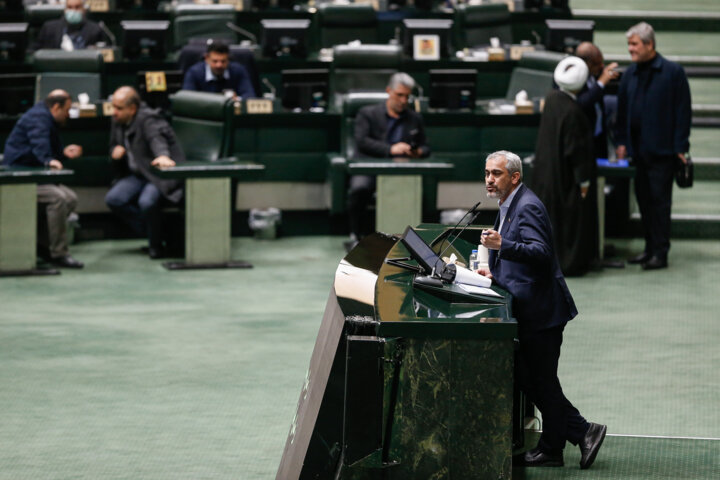
TEHRAN- Iran’s Minister of Economic Affairs and Finance, Seyed Ali Madanizadeh, told parliament on Tuesday that liquidity growth has entered a declining path and that monthly inflation has been falling over the past four months. Answering a question from MP Mostafa Pourdehqan Ardakani and several other lawmakers, he said the government is fully aware of the pressure that inflation and high prices are putting on ordinary households, retirees, workers, and employees, and that economic indicators are being monitored daily.
He described MPs’ concerns as legitimate and said the fact that the government and parliament can debate such problems openly is itself an achievement of the Islamic Republic’s governance system.
He stressed that his explanations were not intended to deny the hardship people face, and that neither he nor the Ministry of Economy is trying to evade responsibility.
Madanizadeh said that when he received a vote of confidence about a year and a half ago, the country was in an economic-war environment in which multiple economic imbalances and structural crises had converged. He said the Ministry of Economy was handed a difficult situation and responded by setting up an “economic war operations room.” One of its first tasks was to monitor and examine insolvent banks. He said the case of Bank Ayandeh was handled successfully, while other insolvent banks and financial institutions are now on the agenda of the Ministry of Economy and the Central Bank and are going through their legal processes.
He also said bank balance sheets have been placed at the center of efforts to control inflation, and that this work has been pursued seriously since the beginning of the year. According to him, liquidity growth has fortunately taken a declining trend, and its inflationary effects should become visible; he added that the downward trend in monthly inflation over the past four months is already completely clear.
The minister also pointed to the capital market as an alternative source of non-inflationary financing. He said the stock market index rose from around 3 million units to more than 8 million units, a significant increase, and that the market has played an important role in financing the economy.
He said the goal is to direct financing of economic enterprises toward the capital market and the debt market rather than making them dependent on the banking network.
He also referred to the reform of the government bond market after eight years, saying that for the first time in eight years rates were made realistic and corruption and rent-seeking in that market were eliminated. This, he argued, helped financing through the capital market and reduced the government’s dependence on the monetary base, which could otherwise increase liquidity and inflation.
Madanizadeh described the financing of the government budget as another major axis of the ministry’s work, aimed at preventing a budget deficit from spilling over into the Central Bank’s monetary base and creating inflation.
Despite all the difficulties imposed by the war, he said, the government tried to close the budget with the minimum possible deficit and to minimize its effects. He acknowledged the difficulties in collecting taxes from people and businesses, but said the government zeroed out the taxes of 10 million businesses and focused instead on large firms that engage in tax evasion.
He also cited the project to make financial statements transparent and electronic, saying it had been stalled for eight years and was finally implemented with the aim of making economic activity transparent and ending the problem of firms keeping dual ledgers. He said the process began several months ago and is intended to create a basis for economic activity grounded in transparent financial statements and verifiable information.
On facilitating production and reducing cost pressures on firms, he said automatic issuance of permits is among the measures being pursued; only in the past week, about 12,000 permits were issued through the Ministry of Economy’s permit system.
He also mentioned the comprehensive collateral system, designed to make it easier for people and firms to access financing through non-inflationary channels at a time when inflation-control policies impose limits on financial resources.
The minister emphasized the need to increase the share of tax revenues in financing the public budget. He said about 50 percent of public budget resources are now supplied through taxes, and that systematizing tax processes is meant to raise this share. Tax revenues grew by 39 percent last year, and a 70 percent growth is projected for this year.
He expressed hope that with continued progress and a more efficient tax system, a significant part of the country’s budget resources will be supplied through taxes from next year, reducing budget dependence on other sources.
He also said full reports on the causes of imposed inflation have been presented to MPs in private sessions, and that many events cannot be discussed on official platforms. He asked MPs not to use the phrase “the government made the currency expensive,” arguing that the situation was imposed on the country and that access to foreign currency and dollar resources was blocked.
Madanizadeh said the rise in prices had two main causes: the economic-war conditions and imposed pressures on the country. He said 230 million cubic meters of Iran’s export gas and gas allocated to industries were damaged, and that petrochemical and steel facilities were hit. When the sources of foreign-currency supply are damaged, he argued, the government does not have access to foreign currency, and price increases are natural.
He added that when transport costs rise tenfold because of an economic blockade, and when import and export prices rise by 100 percent, all of these affect the exchange rate. He also rejected the idea that the government removed preferential currency, saying preferential currency was not removed but simply ran out.
He said this reality should not be conveyed to the people as a government choice; rather, he said, the US Treasury Secretary framed it as a crime against the Iranian people, and the enemy killed children in the military arena and in the economic arena prevented medicine from reaching people, including through air and sea blockades.
Despite these pressures, he said, monthly inflation has fallen below 4 percent. He described the effort as trying to bring inflation from above 90 percent down to 40 percent, and hopefully to 20 percent next year. He insisted that Iran’s economy has not collapsed and will not collapse. He said the “criminals and killers” who imposed the war first tried to disrupt the economic decision-making system, but the Ministry of Economy responded by launching the economic war room and passing resolutions in the government and the Supreme National Security Council to compensate for the imposed budget deficit.
He referred to a seven-axis plan covering inflation control, trade facilitation, investment facilitation, production facilitation, energy management, and livelihood reconstruction.
He said the ministry has moved toward replacing oil revenues with new sources, managed the treasury’s cash flow, is launching oil certificates, and doubled the stock market index.
He also said a new investment campaign would be launched, and that diplomacy with neighboring countries has been activated. He told the people that the “soldiers” in the Ministry of Economy and Finance have not and will not shrink under pressure and will stand for the elevation of the country until their last breath.
Addressing the enemy, he said: “You have not yet understood the Iranian nation, and you imagine that by closing trade routes and pressuring people’s tables you can break the will of a nation, but that is a vain fantasy. Iran is the land of a people who have stood firm in the hardest storms of history, and the government and parliament, as servants of the people, will defeat the enemy. Iran is a civilization, and a civilization will never be defeated.”
MA
Disclaimer : This story is auto aggregated by a computer programme and has not been created or edited by DOWNTHENEWS. Publisher: tehrantimes.com