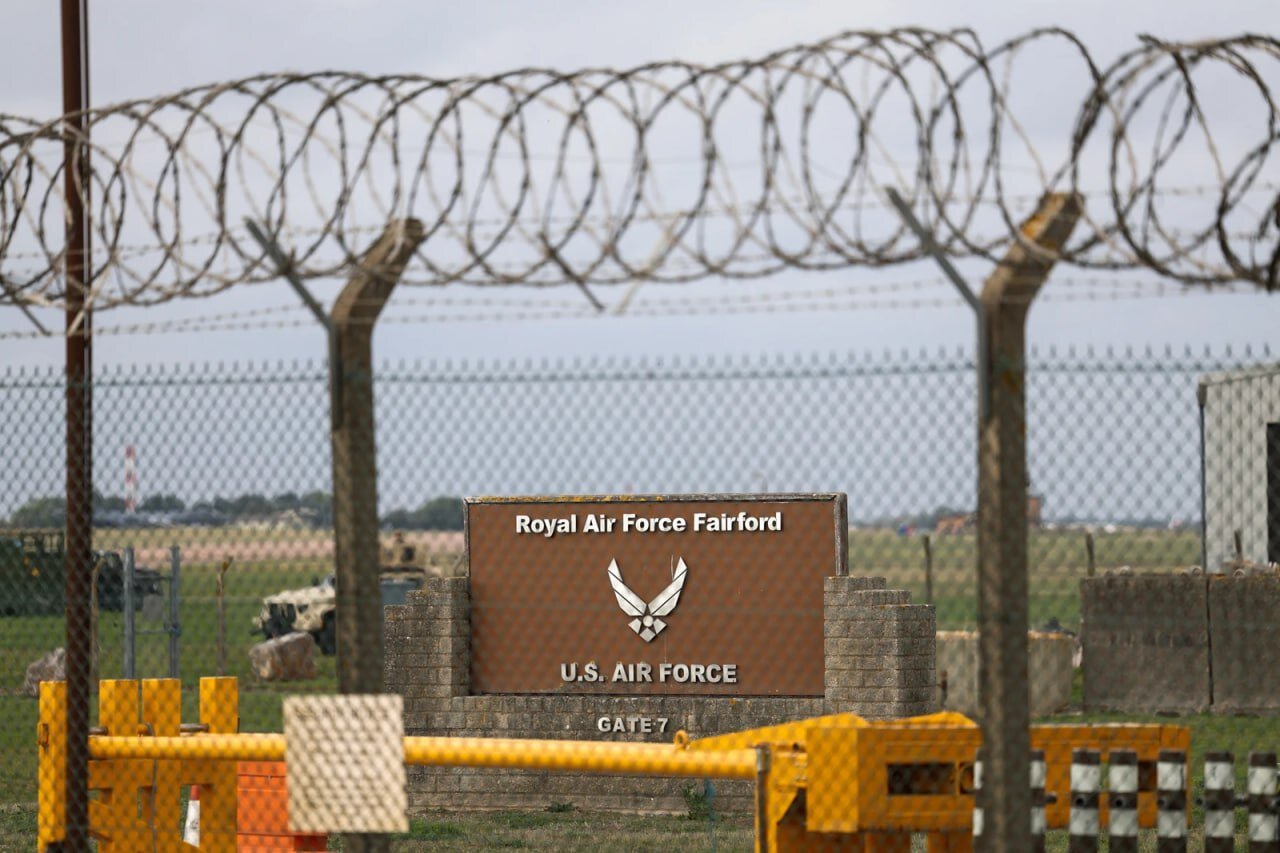
TEHRAN – Iran’s Foreign Ministry has strongly condemned Britain’s accusation linking Tehran to an alleged security incident at RAF Fairford air base, dismissing it as an ugly plot designed to fuel Iranophobia and evade accountability for London’s direct participation in the ongoing American-Zionist military aggression against the Iranian nation.
In a formal statement issued late Monday, the Ministry said the British government’s claim attributing the alleged incident to Iran is categorically rejected, holding London and the designers and perpetrators of what it called a clumsy false-flag operation responsible for all consequences arising from the fabrication.
“The government of Britain cannot, without presenting solid evidence and reasons, shirk its political and legal responsibility for its claims and their possible consequences by hiding behind ambiguous phrases,” the statement said. ” Resort to terms such as ‘highly likely’ and ‘almost certainly’ to insinuate the credibility of attributing the alleged incident to Iran is a blatant attempt to evade responsibility for baseless accusations.”
The Ministry further recalled Britain’s track record of fabricating security claims against other countries – which in some cases have led to devastating tensions and conflicts in West Asia – stressing that London must be held accountable for insisting on an approach that undermines international peace and security.
The strongly-worded rebuke came hours after British Prime Minister Andy Burnham told Parliament on Monday that a suspected plot last month against RAF Fairford, a U.S.-operated bomber base in southern England, was “highly likely to have been coordinated in Iran” and “almost certainly directed by Iran’s Islamic Revolutionary Guard Corps.”
“We will not tolerate these threats on our soil,” Burnham claimed, pledging to “crack down on Iran’s use of criminal networks, using our full range of powers to target them and their funding streams” and to bring further sanctions to restrict the capacity of Iran and the IRGC.
Foreign Secretary Ed Miliband announced that London had summoned the Iranian ambassador and imposed sanctions on two Iranian nationals – Ruhollah Bazghandi, described as head of IRGC counterespionage operations, and Shahram Ali Reza Tamarzadeh Jakki, described as a facilitator for the Zindashti criminal network – including asset freezes, travel bans and director disqualification, for their alleged role in facilitating hostile activity.
Iran’s Ambassador to London, Seyed Ali Mousavi, who was summoned by UK Minister for the Middle East Stephen Doughty, categorically rejected any Iranian role and urged the British side to present evidence supporting its allegations if it possesses any, according to IRNA. He also expressed Tehran’s readiness to cooperate with the investigation to clarify the facts.
The Iranian Embassy in London had already on September 28 “categorically” rejected “unfounded and malicious speculations” linking Tehran to the arrests near Fairford, warning they would only fuel Iranophobia propaganda in Britain.
The diplomatic escalation was accompanied by a joint political statement issued Monday by the foreign ministers of 29 countries – including the UK, the United States, most European states, Canada, Australia and New Zealand – condemning “in the strongest terms Iran’s use of violent attacks, including acts of lethal plotting, arson, sabotage, cyber-attacks, and other hybrid activities against us and our partners.”
The statement explicitly endorsed London’s attribution, saying: “We recognise the United Kingdom’s attribution of Iran’s involvement in the incident at RAF Fairford on 27 September. The UK has also concluded this event demonstrates the IRGC’s continued willingness to project hostile activity beyond its borders through covert networks and proxy actors.”
Tehran says that cascade – from an unexplained local arrest to prime-ministerial attribution to instant multilateral endorsement and fresh sanctions, all without a single document made public – is precisely the hallmark of a coordinated smear campaign.
What actually happened at Fairford?
According to British police and media reports, in the early hours of September 27, five British men in their 20s were arrested in the vicinity of RAF Fairford on suspicion of terrorism and explosives offences. Two more arrests followed in subsequent days, bringing the total to seven. Counter Terrorism Policing launched an investigation into a suspected foreign state link.
Yet more than two weeks later, the source and nature of the threat remain shrouded in mystery. No one has been charged. All suspects have been released on bail under strict conditions.
Police later acknowledged they had found only a quantity of accelerant – gasoline – in three vans linked to the initial suspects, but no explosives, no detonators, no drones, no weapons-grade material. Home Secretary Shabana Mahmood told Parliament the coordinator was assessed to be “a known individual based in Iran,” but she did not name that person nor disclose any supporting communications, financial records, travel data, or other intelligence.
U.S. officials, speaking anonymously to Reuters, spoke of a suspected Iranian plot to carry out a “complex drone attack” on the facility. Last week, U.S. President Donald Trump claimed an Iran-linked threat intended “to kill as many American troops and destroy as many U.S. planes as possible” had prompted a decision to withdraw American bombers. The Pentagon confirmed the B-1 and B-52 bombers stationed at Fairford have now been redeployed to their home bases.
London then upgraded its language in stages: first “strong indications,” then on Monday “highly likely coordinated in Iran, almost certainly directed by the IRGC.” The two Iranians sanctioned on Monday were not explicitly identified as the organizers of Fairford.
For Tehran and for independent legal observers, that timeline raises far more questions than it answers.
A terrorism plot without terrorists?
The first and most serious ambiguity, Iranian officials stress, is elementary criminal procedure: if this was a genuine terrorist operation against a strategic NATO air base, why are all alleged perpetrators free on bail?
Under British counter-terrorism law, police can detain suspects for extended periods with judicial approval when the threat is deemed grave and evidence is substantive. The unconditional release – without charge, without presentation to a court of any explosive device, without even an official charge sheet linking the men to any foreign handler – is difficult to reconcile with claims of an IRGC-directed mass-casualty plot.
Second: how can a government accuse a sovereign state of directing an attack while admitting it has no evidence to show? Burnham offered no photographs, no intercepted communications, no money trail, no travel records, not even a surname of the alleged coordinator in Iran. Miliband’s sanctions designation speaks of “facilitating hostile activity” in general terms for Europe and the U.S., not of commanding the Fairford vans.
Iran’s Foreign Ministry put it bluntly: London cannot hide behind “highly likely” and “almost certainly.” Those phrases, Tehran notes, have a notorious pedigree in British politics – from the Iraq WMD dossier to the Skripal affair – where probabilistic language was later used to justify concrete sanctions, expulsions and even war, without ever meeting the standard of proof.
Third: what was actually found? Gasoline in vans is not a military capability. It is legally purchasable at any petrol station, and British police themselves confirmed no explosives were present. To extrapolate from jerry cans to an IRGC external operation to kill Americans en masse is, in Tehran’s view, a leap that no court would accept, but one that fits a propaganda need.
Fourth: who are the suspects? All are British nationals in their 20s, with no announced Iranian nationality, no announced travel to Iran, no announced IRGC affiliation. If Tehran had recruited and directed them, London has shown no recruitment chain. The claim of direction by the IRGC’s counterespionage chief, Bazghandi, was asserted without any published link to Fairford at all.
“How do they accuse Iran while they do not even have a small clue to present?” an Iranian diplomat asked. “If they have documents, present them. If they are willing to cooperate, as Ambassador Mousavi has offered, accept cooperation. Trial by press release is not investigation.”
Tehran sees in this pattern what IRNA on Monday called “a coordinated wave to smear Iran” – a series of suspicious incidents recently attributed to Tehran by the U.S. president and senior Western officials without offering any evidence.
The bombers that fled: why Fairford matters
The irony, Iranian analysts note, is that while London portrays itself as a victim of extraterritorial threats, Fairford itself has been an active platform for extraterritorial aggression against Iran.
RAF Fairford, about 160 kilometers (100 miles) west of London in Gloucestershire, is not an ordinary Royal Air Force station. It is the U.S. Air Force’s preferred forward operating location in Europe for heavy bombers. Its 3,000-meter runway, vast munitions areas and specialized maintenance facilities allow it to host B-52 Stratofortress and B-1 Lancer bombers that cannot be permanently based in crowded continental bases.
Since the U.S.-Israeli war on Iran began on February 28 – with surprise strikes that martyred several Iranian leaders and officials, including the Leader of the Islamic Revolution Ayatollah Seyed Ali Khamenei, according to regional reports – Fairford has served as a critical staging point for American air operations against Iran.
In other words, U.S. bombers took off from British soil, refueled by NATO tankers, guided by NATO intelligence, to bomb Iranian territory. Their sudden withdrawal last week under the pretext of an Iranian threat only confirms, in Tehran’s assessment, the base’s combat role: you do not evacuate strategic bombers from a base that has nothing to do with the war.
Iran has repeatedly and openly stated a clear legal doctrine: any base used to attack its territory is a legitimate military target under the right of self-defense enshrined in Article 51 of the UN Charter. That is a public, state-level deterrent posture – the opposite of covertly hiring young Britons with gasoline cans. Conflating the two, Tehran argues, is deliberate.
Britain’s hidden hand in the war on Iran
Far more significant than one night in Gloucestershire, Tehran says, is Britain’s sustained, if less visible, participation in the war that began in February.
London has provided three layers of support to the American-Israeli aggression, Iranian officials and Western reporting indicate:
First, basing and logistics. Beyond Fairford, Britain has opened its airspace, its Cyprus bases at Akrotiri and Dhekelia, its intelligence facilities and its naval logistics to the U.S. war effort. RAF tankers have supported air bridges toward West Asia. British officials have not denied that U.S. aircraft engaged in operations against Iran have transited UK-controlled infrastructure.
Second, political and intelligence cover. London, alongside Paris and Berlin, has consistently endorsed Washington’s narrative of Iranian escalation while remaining silent on the initial U.S.-Israeli strikes and on repeated Israeli attacks on Iranian nuclear, military and civilian infrastructure – including the strike on a girls’ school in Minab that martyred schoolchildren. British intelligence-sharing within the Five Eyes and NATO frameworks has fed directly into targeting and missile-defense operations in defense of Israel and Gulf-based U.S. assets.
Third, direct military engagement. The British government admitted its forces participated in what it termed defensive actions against Iranian missiles and drones aimed at Israel and at allied interests in the Gulf, positioning Royal Navy destroyers and RAF fighters as a shield for the aggressor while claiming non-belligerency.
It is this complicity, Tehran argues, that London now seeks to obscure by casting itself as the victim of Iranian terrorism. Accusing the IRGC of plotting on English soil shifts attention from English runways being used to bomb Iranian cities.
“The ugly plot to advance the Iranophobia campaign and escape accountability for participation in the American-Zionist military aggression against the Iranian nation,” as the Foreign Ministry phrased it, is therefore not rhetorical excess but a legal argument: a co-belligerent cannot claim the immunity of a neutral and then criminalize the self-defense discourse of the state it helped attack.
International law scholars sympathetic to neither side have similarly warned that the 29-country statement – which speaks of Iranian “lethal plotting, arson, sabotage, cyber-attacks” without referencing the ongoing bombing of Iran, the U.S. withdrawal of bombers from a combat base, or Britain’s own admitted hosting of strike aircraft – presents a one-sided picture that undermines its credibility.
Tehran’s position is unequivocal: it had no involvement in Fairford, it is ready to assist a genuine technical investigation, and it demands evidence. Until London produces verifiable proof – names, transfers, communications subject to judicial scrutiny – the case will be remembered, in Iran’s words, alongside previous fabricated security dossiers that paved the way for aggression in West Asia, not as counter-terrorism but as information warfare to sustain an unlawful war.
Disclaimer : This story is auto aggregated by a computer programme and has not been created or edited by DOWNTHENEWS. Publisher: tehrantimes.com